


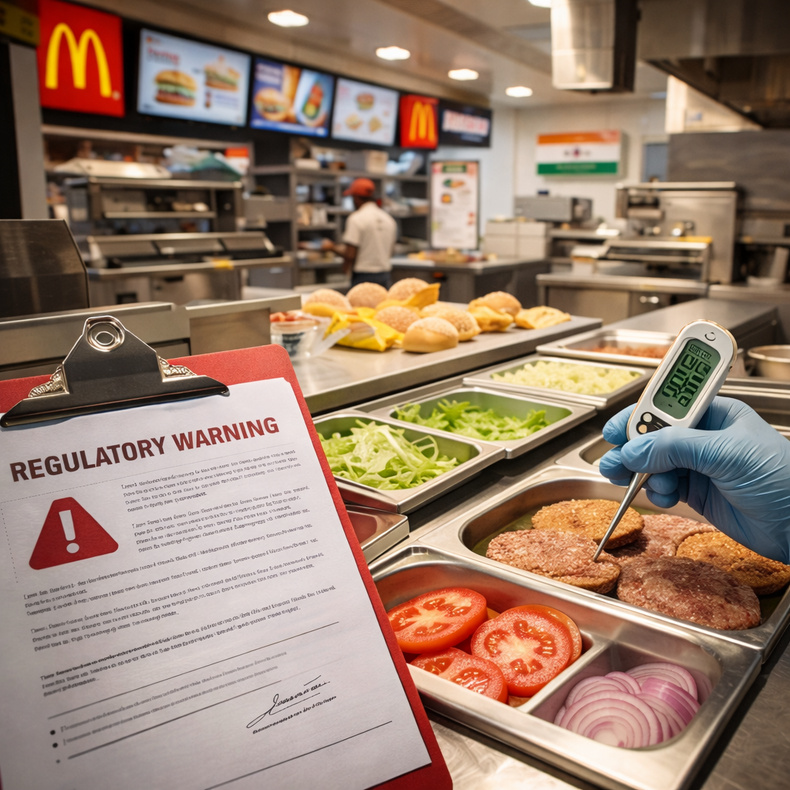
Food safety enforcement in India has once again drawn national attention after a McDonald’s outlet in Jaipur received a regulatory warning over the use of deteriorated ingredients and repeatedly heated cooking oil. While isolated inspections are routine in the country’s vast and diverse food services market, the case underscores how even globally recognized brands are subject to local compliance standards and operational accountability.
Authorities acted after an inspection identified lapses in kitchen management practices at the outlet, including the storage of tomatoes deemed unfit for consumption and the reuse of cooking oil beyond permissible safety thresholds. Samples were seized for laboratory testing, and the operator was granted a fixed period to rectify deficiencies or face stricter action.
The development illustrates not only the mechanics of regulatory enforcement, but also the broader framework governing food safety compliance in India, where multinational chains must align global protocols with domestic statutory requirements.
Inspection Protocols and Regulatory Triggers
In India, food safety inspections are conducted under the authority of the Food Safety and Standards Act, overseen by state-level officers empowered to conduct surprise checks, seize samples, and issue compliance notices. These inspections often focus on storage conditions, hygiene standards, temperature controls, labeling practices, and the quality of raw materials.
In the Jaipur case, officials reportedly identified two key issues: the presence of rotten tomatoes in storage and approximately 40 litres of cooking oil that had been repeatedly used. Both findings point to violations of established food safety norms.
Cooking oil degradation is a well-documented food safety concern. When oil is heated repeatedly at high temperatures, it undergoes chemical changes that increase the formation of harmful compounds, including trans fats and polar compounds. Excessive reuse can compromise both food quality and consumer health. Indian regulations set specific limits on total polar compounds in used oil, requiring establishments to discard oil once it crosses defined thresholds.
Similarly, the storage of perishable vegetables such as tomatoes demands strict quality control. Fresh produce can deteriorate quickly in warm climates if not properly stored. The presence of visibly spoiled ingredients signals potential lapses in inventory rotation, inspection routines, or supply chain oversight.
Regulators typically follow a graduated enforcement model. A warning accompanied by a rectification window allows businesses to correct deficiencies before penalties escalate. In this instance, the outlet was reportedly given two weeks to address shortcomings.
How Operational Gaps Occur in Large Chains
For multinational restaurant chains like McDonald’s, operational complexity increases with scale. In India, outlets are operated through franchise models, with regional franchisees responsible for day-to-day management while adhering to brand-wide standards. The Jaipur outlet falls under a franchise entity managing North and East India operations.
Global fast-food brands rely on standardized processes to ensure consistency across markets. These include strict supplier audits, hazard analysis and critical control point (HACCP) protocols, oil filtration schedules, and inventory management systems designed to prevent spoilage.
However, local execution remains crucial. Even with global frameworks in place, lapses can occur due to staffing turnover, inadequate training, cost pressures, or breakdowns in supervisory checks. In high-volume kitchens, maintaining quality under peak demand requires disciplined adherence to operational checklists.
Repeated oil usage may result from attempts to optimize costs or manage inventory, especially in outlets experiencing fluctuating demand. Similarly, improper stock rotation—such as failing to follow first-in-first-out inventory principles—can lead to spoiled produce remaining in storage.
The regulatory warning highlights that compliance depends not only on corporate guidelines but also on frontline implementation.
Why Enforcement Matters for Brand Equity
Food safety violations at high-profile chains attract disproportionate public scrutiny. Unlike smaller eateries, multinational brands operate under reputational expectations shaped by global marketing campaigns centered on hygiene, quality assurance, and consistency.
India represents one of McDonald’s fastest-growing markets, with hundreds of outlets across metropolitan and tier-two cities. The brand’s appeal lies in standardized menus adapted to local tastes, robust supply chains, and an image of reliability. Regulatory action, even at a single outlet, can challenge that perception.
Consumer trust in quick-service restaurants hinges on the assumption that industrial-scale systems reduce the likelihood of contamination or spoilage. When regulators intervene, it serves as a reminder that no brand is immune from operational risk.
At the same time, regulatory oversight reinforces market discipline. Routine inspections signal to both consumers and businesses that compliance standards apply uniformly, regardless of corporate stature.
The Broader Context of Food Safety in India
India’s food ecosystem spans street vendors, small family-run establishments, and global chains. Instances of adulteration and hygiene lapses are frequently reported in informal segments of the market. By contrast, large branded chains have generally been perceived as safer alternatives due to structured quality controls.
Regulators, however, have intensified monitoring across all segments in recent years. Rapid urbanization, growing middle-class consumption, and heightened consumer awareness have increased demand for transparent food safety enforcement.
Authorities often conduct targeted drives in tourist cities, where food establishments experience heavy footfall. Jaipur, known for its cultural heritage and visitor traffic, represents a location where enforcement visibility carries broader public health implications.
The warning issued in this case aligns with a pattern of proactive inspections rather than reactive responses to reported illnesses. By intervening before confirmed health incidents, regulators aim to prevent potential risks.
Corporate Response and Compliance Pathways
Franchise operators typically respond to such notices by reviewing internal audits, retraining staff, and enhancing monitoring mechanisms. This can include stricter oil testing protocols, improved stock management systems, and reinforcement of sanitation guidelines.
Oil quality management, in particular, has become a focus area in India’s quick-service sector. Many chains deploy digital oil testing devices that measure polar compound levels in real time, ensuring timely disposal. Enhanced documentation and traceability are also standard corrective measures.
The rectification window granted by authorities provides an opportunity for the outlet to demonstrate compliance improvements. Follow-up inspections determine whether corrective actions meet regulatory expectations.
For multinational brands, swift cooperation with authorities and transparent remediation steps are critical in containing reputational impact. Public statements emphasizing adherence to both local regulations and global standards often accompany such corrective measures.
Implications for the Quick-Service Industry
The episode serves as a case study in operational vigilance. As India’s quick-service restaurant market expands, driven by urban consumption patterns and digital food delivery platforms, regulatory scrutiny is likely to intensify.
Higher consumer awareness means that isolated compliance failures can gain rapid visibility. Social media amplification further raises stakes for brand operators. Consequently, chains are investing more heavily in food safety technologies, centralized quality control systems, and supplier audits.
The Jaipur inspection underscores a broader principle: food safety governance in India is evolving toward stricter enforcement, even for established global brands. Operational discipline at the outlet level remains the decisive factor in ensuring compliance.
By issuing a warning rather than imposing immediate penalties, regulators have reaffirmed a structured enforcement approach that balances accountability with corrective opportunity. For McDonald’s and the wider quick-service industry, the incident reinforces the imperative of constant vigilance in ingredient handling, oil management, and storage practices—areas where minor lapses can quickly escalate into regulatory and reputational challenges.
(Source:www.reuters.com)
Authorities acted after an inspection identified lapses in kitchen management practices at the outlet, including the storage of tomatoes deemed unfit for consumption and the reuse of cooking oil beyond permissible safety thresholds. Samples were seized for laboratory testing, and the operator was granted a fixed period to rectify deficiencies or face stricter action.
The development illustrates not only the mechanics of regulatory enforcement, but also the broader framework governing food safety compliance in India, where multinational chains must align global protocols with domestic statutory requirements.
Inspection Protocols and Regulatory Triggers
In India, food safety inspections are conducted under the authority of the Food Safety and Standards Act, overseen by state-level officers empowered to conduct surprise checks, seize samples, and issue compliance notices. These inspections often focus on storage conditions, hygiene standards, temperature controls, labeling practices, and the quality of raw materials.
In the Jaipur case, officials reportedly identified two key issues: the presence of rotten tomatoes in storage and approximately 40 litres of cooking oil that had been repeatedly used. Both findings point to violations of established food safety norms.
Cooking oil degradation is a well-documented food safety concern. When oil is heated repeatedly at high temperatures, it undergoes chemical changes that increase the formation of harmful compounds, including trans fats and polar compounds. Excessive reuse can compromise both food quality and consumer health. Indian regulations set specific limits on total polar compounds in used oil, requiring establishments to discard oil once it crosses defined thresholds.
Similarly, the storage of perishable vegetables such as tomatoes demands strict quality control. Fresh produce can deteriorate quickly in warm climates if not properly stored. The presence of visibly spoiled ingredients signals potential lapses in inventory rotation, inspection routines, or supply chain oversight.
Regulators typically follow a graduated enforcement model. A warning accompanied by a rectification window allows businesses to correct deficiencies before penalties escalate. In this instance, the outlet was reportedly given two weeks to address shortcomings.
How Operational Gaps Occur in Large Chains
For multinational restaurant chains like McDonald’s, operational complexity increases with scale. In India, outlets are operated through franchise models, with regional franchisees responsible for day-to-day management while adhering to brand-wide standards. The Jaipur outlet falls under a franchise entity managing North and East India operations.
Global fast-food brands rely on standardized processes to ensure consistency across markets. These include strict supplier audits, hazard analysis and critical control point (HACCP) protocols, oil filtration schedules, and inventory management systems designed to prevent spoilage.
However, local execution remains crucial. Even with global frameworks in place, lapses can occur due to staffing turnover, inadequate training, cost pressures, or breakdowns in supervisory checks. In high-volume kitchens, maintaining quality under peak demand requires disciplined adherence to operational checklists.
Repeated oil usage may result from attempts to optimize costs or manage inventory, especially in outlets experiencing fluctuating demand. Similarly, improper stock rotation—such as failing to follow first-in-first-out inventory principles—can lead to spoiled produce remaining in storage.
The regulatory warning highlights that compliance depends not only on corporate guidelines but also on frontline implementation.
Why Enforcement Matters for Brand Equity
Food safety violations at high-profile chains attract disproportionate public scrutiny. Unlike smaller eateries, multinational brands operate under reputational expectations shaped by global marketing campaigns centered on hygiene, quality assurance, and consistency.
India represents one of McDonald’s fastest-growing markets, with hundreds of outlets across metropolitan and tier-two cities. The brand’s appeal lies in standardized menus adapted to local tastes, robust supply chains, and an image of reliability. Regulatory action, even at a single outlet, can challenge that perception.
Consumer trust in quick-service restaurants hinges on the assumption that industrial-scale systems reduce the likelihood of contamination or spoilage. When regulators intervene, it serves as a reminder that no brand is immune from operational risk.
At the same time, regulatory oversight reinforces market discipline. Routine inspections signal to both consumers and businesses that compliance standards apply uniformly, regardless of corporate stature.
The Broader Context of Food Safety in India
India’s food ecosystem spans street vendors, small family-run establishments, and global chains. Instances of adulteration and hygiene lapses are frequently reported in informal segments of the market. By contrast, large branded chains have generally been perceived as safer alternatives due to structured quality controls.
Regulators, however, have intensified monitoring across all segments in recent years. Rapid urbanization, growing middle-class consumption, and heightened consumer awareness have increased demand for transparent food safety enforcement.
Authorities often conduct targeted drives in tourist cities, where food establishments experience heavy footfall. Jaipur, known for its cultural heritage and visitor traffic, represents a location where enforcement visibility carries broader public health implications.
The warning issued in this case aligns with a pattern of proactive inspections rather than reactive responses to reported illnesses. By intervening before confirmed health incidents, regulators aim to prevent potential risks.
Corporate Response and Compliance Pathways
Franchise operators typically respond to such notices by reviewing internal audits, retraining staff, and enhancing monitoring mechanisms. This can include stricter oil testing protocols, improved stock management systems, and reinforcement of sanitation guidelines.
Oil quality management, in particular, has become a focus area in India’s quick-service sector. Many chains deploy digital oil testing devices that measure polar compound levels in real time, ensuring timely disposal. Enhanced documentation and traceability are also standard corrective measures.
The rectification window granted by authorities provides an opportunity for the outlet to demonstrate compliance improvements. Follow-up inspections determine whether corrective actions meet regulatory expectations.
For multinational brands, swift cooperation with authorities and transparent remediation steps are critical in containing reputational impact. Public statements emphasizing adherence to both local regulations and global standards often accompany such corrective measures.
Implications for the Quick-Service Industry
The episode serves as a case study in operational vigilance. As India’s quick-service restaurant market expands, driven by urban consumption patterns and digital food delivery platforms, regulatory scrutiny is likely to intensify.
Higher consumer awareness means that isolated compliance failures can gain rapid visibility. Social media amplification further raises stakes for brand operators. Consequently, chains are investing more heavily in food safety technologies, centralized quality control systems, and supplier audits.
The Jaipur inspection underscores a broader principle: food safety governance in India is evolving toward stricter enforcement, even for established global brands. Operational discipline at the outlet level remains the decisive factor in ensuring compliance.
By issuing a warning rather than imposing immediate penalties, regulators have reaffirmed a structured enforcement approach that balances accountability with corrective opportunity. For McDonald’s and the wider quick-service industry, the incident reinforces the imperative of constant vigilance in ingredient handling, oil management, and storage practices—areas where minor lapses can quickly escalate into regulatory and reputational challenges.
(Source:www.reuters.com)
 Homepage
 Send to a friend
 Printable version
 Share
Share


