


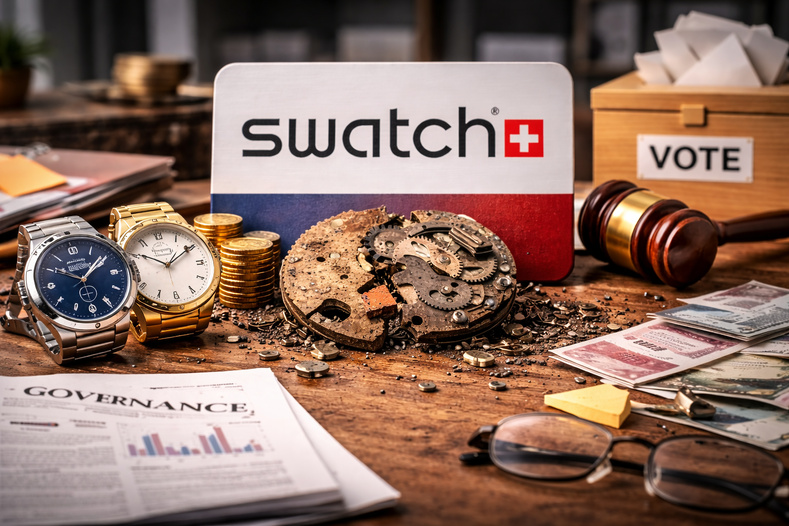
Swatch Group, once the architect of Switzerland’s modern watch revival, now finds itself under mounting pressure to redefine its strategy. Years of uneven performance, slipping margins and lagging shareholder returns have raised a central question inside the luxury timepiece industry: can the company reinvent itself without dismantling the structure that once made it formidable?
The urgency stems not from a single weak quarter, but from a longer arc of relative decline. While rivals have refined their brand portfolios, tightened governance structures and leaned into global luxury demand, Swatch has struggled to articulate a convincing next chapter. Investors and analysts increasingly argue that incremental adjustments will not suffice. A broader strategic overhaul—touching innovation, portfolio focus and corporate governance—appears essential.
From Industry Disruptor to Strategic Drift
Swatch’s origins are rooted in disruption. In the 1980s, the company revitalized Swiss watchmaking with affordable, design-forward quartz watches that countered the rise of Japanese competitors. Over subsequent decades, it expanded into high-end mechanical craftsmanship through acquisitions such as Blancpain and Breguet, blending mass-market appeal with luxury prestige.
That model once provided balance: entry-level brands drove volume, while luxury marques delivered margin. However, the global watch market has evolved. Demand has polarized, with high-end timepieces outperforming mid-market offerings. Affluent buyers remain resilient during economic downturns, while aspirational consumers become more cautious.
Swatch’s portfolio—spanning 16 brands across price tiers—now appears weighted toward segments facing structural headwinds. Brands such as Longines and Tissot occupy competitive mid-range categories where growth is slower and pricing power weaker. Meanwhile, ultra-luxury brands hold untapped potential but represent a smaller share of overall earnings.
Critics argue that Swatch has not recalibrated its brand architecture to reflect this shift. Without a sharper emphasis on high-margin luxury, the group risks being anchored by slower-moving divisions.
Innovation and Brand Relevance in a Changing Market
Beyond portfolio balance lies the question of innovation. The global luxury industry has increasingly intertwined heritage craftsmanship with digital storytelling, experiential marketing and limited-edition product cycles. Brands that successfully blend tradition with contemporary relevance have captured new generations of buyers.
Swatch’s creative DNA once defined this space. Yet in recent years, observers contend that product launches have lacked the disruptive spark that characterized earlier decades. While research and development remain active within the group, visible breakthroughs have been sporadic.
The rise of smartwatches and connected devices added complexity. Although mechanical watches maintain symbolic appeal and status value, technology-driven alternatives have altered consumer expectations around functionality. Swatch’s response to this trend has been measured rather than transformative.
Reinvigorating innovation requires not only product design but also brand narrative. Younger consumers increasingly seek authenticity, sustainability and experiential engagement. The company’s ability to refresh its image while preserving heritage may determine whether it regains cultural relevance.
Governance Under the Microscope
Corporate governance has emerged as another focal point. The Hayek family maintains significant control through a dual-class share structure that grants disproportionate voting power relative to economic ownership. Supporters argue that this stability allows for long-term strategic thinking insulated from short-term market pressures.
Critics counter that entrenched control can dampen accountability and slow reform. Over the past decade, board renewal has been limited, with few new independent directors added. Governance experts have suggested that a more diverse and internationally experienced board could strengthen oversight and strategic agility.
The proposal to appoint a new board member signals incremental movement. Yet many investors view it as only a first step. Calls for broader board renewal, enhanced shareholder representation and clearer succession planning have grown louder.
The governance debate intersects directly with strategic transformation. Implementing portfolio rationalization or divestitures often requires decisive leadership and transparent communication. Without perceived governance modernization, investor skepticism may persist regardless of operational improvements.
Operational Efficiency and Production Discipline
Operational management has also come under scrutiny. Analysts point to rising inventories and sustained production levels despite softer demand as evidence of misalignment. Maintaining high output may preserve manufacturing capacity and employment, but it compresses margins when sales slow.
Inventory growth over several years has coincided with declining core earnings, raising questions about capital allocation discipline. Luxury competitors have demonstrated greater flexibility in adjusting production to match demand, protecting brand exclusivity and profitability.
Swatch’s vertically integrated structure—owning significant components of its supply chain—provides control and craftsmanship continuity. However, it also requires careful calibration to avoid overcapacity. Achieving balance between preserving artisanal expertise and ensuring financial efficiency is central to any turnaround strategy.
Valuation and the Long-Term Bet
Despite underperformance, some investors argue that Swatch’s underlying assets retain significant value. The group controls prestigious brands with deep heritage, global distribution networks and technical know-how that would be costly to replicate. From this perspective, the market may undervalue the company relative to its intrinsic worth.
However, asset value alone does not guarantee investor confidence. Markets reward growth visibility and credible execution plans. Rivals such as Richemont have demonstrated that disciplined portfolio focus and brand elevation can translate into sustained shareholder returns.
For Swatch, the clock is not merely ticking on quarterly earnings but on strategic clarity. Rebuilding momentum likely requires a combination of targeted divestitures, renewed luxury emphasis, governance modernization and operational tightening. Incremental adjustments may stabilize performance, but transformative change demands coordinated action across multiple fronts.
The watch industry thrives on heritage, precision and long-term craftsmanship. Yet even in an industry defined by tradition, adaptability determines survival. Swatch’s challenge is to reconcile its storied past with a future shaped by shifting consumer preferences and heightened investor scrutiny. Whether it can recalibrate in time will define the next chapter of Swiss watchmaking’s most iconic revival story.
(Source:www.investing.com)
The urgency stems not from a single weak quarter, but from a longer arc of relative decline. While rivals have refined their brand portfolios, tightened governance structures and leaned into global luxury demand, Swatch has struggled to articulate a convincing next chapter. Investors and analysts increasingly argue that incremental adjustments will not suffice. A broader strategic overhaul—touching innovation, portfolio focus and corporate governance—appears essential.
From Industry Disruptor to Strategic Drift
Swatch’s origins are rooted in disruption. In the 1980s, the company revitalized Swiss watchmaking with affordable, design-forward quartz watches that countered the rise of Japanese competitors. Over subsequent decades, it expanded into high-end mechanical craftsmanship through acquisitions such as Blancpain and Breguet, blending mass-market appeal with luxury prestige.
That model once provided balance: entry-level brands drove volume, while luxury marques delivered margin. However, the global watch market has evolved. Demand has polarized, with high-end timepieces outperforming mid-market offerings. Affluent buyers remain resilient during economic downturns, while aspirational consumers become more cautious.
Swatch’s portfolio—spanning 16 brands across price tiers—now appears weighted toward segments facing structural headwinds. Brands such as Longines and Tissot occupy competitive mid-range categories where growth is slower and pricing power weaker. Meanwhile, ultra-luxury brands hold untapped potential but represent a smaller share of overall earnings.
Critics argue that Swatch has not recalibrated its brand architecture to reflect this shift. Without a sharper emphasis on high-margin luxury, the group risks being anchored by slower-moving divisions.
Innovation and Brand Relevance in a Changing Market
Beyond portfolio balance lies the question of innovation. The global luxury industry has increasingly intertwined heritage craftsmanship with digital storytelling, experiential marketing and limited-edition product cycles. Brands that successfully blend tradition with contemporary relevance have captured new generations of buyers.
Swatch’s creative DNA once defined this space. Yet in recent years, observers contend that product launches have lacked the disruptive spark that characterized earlier decades. While research and development remain active within the group, visible breakthroughs have been sporadic.
The rise of smartwatches and connected devices added complexity. Although mechanical watches maintain symbolic appeal and status value, technology-driven alternatives have altered consumer expectations around functionality. Swatch’s response to this trend has been measured rather than transformative.
Reinvigorating innovation requires not only product design but also brand narrative. Younger consumers increasingly seek authenticity, sustainability and experiential engagement. The company’s ability to refresh its image while preserving heritage may determine whether it regains cultural relevance.
Governance Under the Microscope
Corporate governance has emerged as another focal point. The Hayek family maintains significant control through a dual-class share structure that grants disproportionate voting power relative to economic ownership. Supporters argue that this stability allows for long-term strategic thinking insulated from short-term market pressures.
Critics counter that entrenched control can dampen accountability and slow reform. Over the past decade, board renewal has been limited, with few new independent directors added. Governance experts have suggested that a more diverse and internationally experienced board could strengthen oversight and strategic agility.
The proposal to appoint a new board member signals incremental movement. Yet many investors view it as only a first step. Calls for broader board renewal, enhanced shareholder representation and clearer succession planning have grown louder.
The governance debate intersects directly with strategic transformation. Implementing portfolio rationalization or divestitures often requires decisive leadership and transparent communication. Without perceived governance modernization, investor skepticism may persist regardless of operational improvements.
Operational Efficiency and Production Discipline
Operational management has also come under scrutiny. Analysts point to rising inventories and sustained production levels despite softer demand as evidence of misalignment. Maintaining high output may preserve manufacturing capacity and employment, but it compresses margins when sales slow.
Inventory growth over several years has coincided with declining core earnings, raising questions about capital allocation discipline. Luxury competitors have demonstrated greater flexibility in adjusting production to match demand, protecting brand exclusivity and profitability.
Swatch’s vertically integrated structure—owning significant components of its supply chain—provides control and craftsmanship continuity. However, it also requires careful calibration to avoid overcapacity. Achieving balance between preserving artisanal expertise and ensuring financial efficiency is central to any turnaround strategy.
Valuation and the Long-Term Bet
Despite underperformance, some investors argue that Swatch’s underlying assets retain significant value. The group controls prestigious brands with deep heritage, global distribution networks and technical know-how that would be costly to replicate. From this perspective, the market may undervalue the company relative to its intrinsic worth.
However, asset value alone does not guarantee investor confidence. Markets reward growth visibility and credible execution plans. Rivals such as Richemont have demonstrated that disciplined portfolio focus and brand elevation can translate into sustained shareholder returns.
For Swatch, the clock is not merely ticking on quarterly earnings but on strategic clarity. Rebuilding momentum likely requires a combination of targeted divestitures, renewed luxury emphasis, governance modernization and operational tightening. Incremental adjustments may stabilize performance, but transformative change demands coordinated action across multiple fronts.
The watch industry thrives on heritage, precision and long-term craftsmanship. Yet even in an industry defined by tradition, adaptability determines survival. Swatch’s challenge is to reconcile its storied past with a future shaped by shifting consumer preferences and heightened investor scrutiny. Whether it can recalibrate in time will define the next chapter of Swiss watchmaking’s most iconic revival story.
(Source:www.investing.com)
 Homepage
 Send to a friend
 Printable version
 Share
Share


