


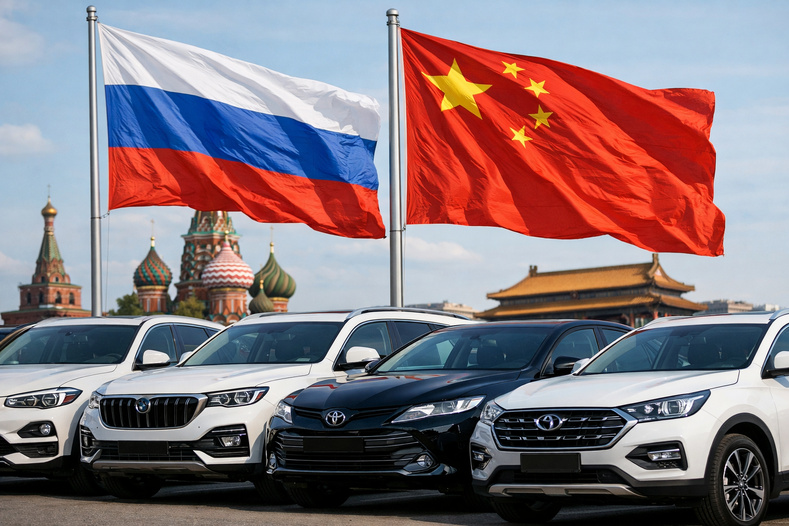
When Western and Asian governments imposed sweeping automotive sanctions on Russia after the 2022 invasion of Ukraine, the expectation was clear: the supply of foreign vehicles would sharply contract, particularly higher-priced models, hybrids and electric cars. Officially, that contraction occurred. Major automakers halted exports, suspended local operations and pledged to sever direct ties with the Russian market.
Yet on the streets of Moscow, Vladivostok and other major cities, new German SUVs, Japanese hybrids and Korean crossovers continue to appear. The flow has not stopped; it has been rerouted. At the center of this parallel supply chain stands China, whose vast manufacturing ecosystem and export infrastructure have become the principal conduit for foreign-brand vehicles reaching Russia despite sanctions.
The mechanics of this trade reveal not only the limits of sanctions enforcement but also the structural features of the global auto industry that make circumvention possible.
China’s Automotive Ecosystem as a Strategic Transit Hub
China occupies a unique position in the global car market. It is the world’s largest auto producer and consumer, hosting joint ventures between domestic firms and international brands from Europe, Japan and South Korea. Many foreign automakers manufacture vehicles inside China through local partnerships, while others export finished units into the country for sale.
This dense production and distribution network creates opportunities for re-export. Vehicles assembled in Chinese factories under joint ventures—bearing badges from global brands—are legally produced within China’s borders. Once registered domestically, they can be reclassified and shipped abroad through trading companies, often without direct involvement from the original brand owner.
For Russian dealers seeking Western or Japanese cars, Chinese intermediaries have become indispensable. Informal networks of traders, logistics firms and brokers connect Russian buyers to Chinese wholesalers. A dealer in Vladivostok or Moscow may not maintain inventory of sanctioned brands, but can source vehicles on demand through a web of middlemen operating across provincial Chinese markets.
The result is a gray-market pipeline that is difficult to track comprehensively. While automakers may prohibit exports to Russia contractually, enforcement becomes complicated once vehicles change hands multiple times inside China’s vast domestic market.
The “Zero-Mileage Used” Loophole
One of the most consequential mechanisms enabling this trade is the classification of new vehicles as “zero-mileage used” cars. In China’s intensely competitive auto market, dealers sometimes register unsold new cars as sold to meet sales targets, secure government subsidies or clear inventory. These vehicles, though technically registered, have never been driven.
Once classified as used, they can be exported more easily because they no longer fall under the same distribution controls applied to new-car exports. Traders can ship them abroad without seeking approval from the automaker’s headquarters, sidestepping restrictions designed to prevent sales into sanctioned markets.
In Russia, these vehicles are treated as new upon registration, provided they have no prior mileage. Consumers pay prices comparable to brand-new imports, particularly for high-demand models from German and Japanese brands. The margin between discounted acquisition prices in China and final sale prices in Russia creates powerful financial incentives for intermediaries.
This practice is not limited to a single brand or country of origin. Vehicles from global manufacturers—including Toyota, Mazda, Mercedes-Benz and BMW—have appeared in Russian registration data through these channels. Many are assembled in China; others are produced in Europe or Japan and routed through Chinese trading hubs before reaching Russian buyers.
Sanctions Architecture and Its Gaps
The European Union, the United States, Japan and South Korea imposed restrictions that generally prohibit the sale of vehicles above certain price thresholds, along with bans on electric vehicles, hybrids and models with larger engines. Automakers from these jurisdictions pledged to suspend or curtail operations in Russia, and official exports declined sharply after 2022.
However, sanctions typically regulate direct sales and corporate activity, not every possible secondary transaction across global markets. Once a vehicle enters China’s domestic system—especially if produced locally under a joint venture—it can circulate beyond the original distribution chain.
Enforcement becomes further complicated by the fragmentation of trade documentation. A car manufactured in Austria, shipped to China, registered by a Chinese dealer and then exported to a third party may traverse multiple legal regimes. Each step, taken individually, may not violate domestic laws in the countries involved, even if the final destination undermines the intent of sanctions.
Legal experts often note that preventing every instance of circumvention is extraordinarily difficult. Monitoring thousands of dealers and traders across jurisdictions requires cross-border cooperation, extensive documentation review and sustained political will. Even then, gray-market flows may persist through smaller intermediaries that operate outside major corporate oversight.
Russia’s Demand for Western Brands
On the Russian side, demand has proven resilient, particularly among affluent consumers and business elites who value Western and Japanese marques. German luxury SUVs, Japanese hybrids and premium sedans carry symbolic and practical appeal. They are associated with reliability, status and engineering quality, attributes that domestic alternatives or newer Chinese brands may not fully replicate in the eyes of some buyers.
Registration data in recent years show that a substantial share of foreign-brand vehicles entering Russia are manufactured in China. In some categories, nearly half of newly registered vehicles from sanctioned-brand countries originate from Chinese production facilities. Hybrids from Japanese manufacturers remain especially popular, reflecting consumer preferences for fuel efficiency and technology.
Luxury models command particular attention. Vehicles such as the Mercedes G-class, produced exclusively in Austria, have surfaced in Russian markets despite official export prohibitions. Shipping records and industry analyses suggest that even European-built cars can transit through China, where traders consolidate shipments and handle onward export logistics.
This sustained demand ensures that gray-market channels remain profitable. Russian dealers frequently operate on a bespoke basis, sourcing vehicles individually rather than maintaining large inventories. The flexibility of this approach reduces exposure while allowing them to meet specific customer requests.
China’s Geopolitical and Economic Calculus
China has publicly opposed unilateral sanctions and maintains robust trade ties with Russia. Bilateral trade between the two countries has expanded significantly since 2022, encompassing energy, commodities and manufactured goods. In the automotive sector, Chinese domestic brands have also gained substantial market share inside Russia, filling gaps left by departing Western companies.
At the same time, China’s internal auto market is characterized by overcapacity, intense price competition and generous local subsidies. Exporting surplus vehicles—whether under domestic brands or foreign badges produced in joint ventures—helps relieve pressure on domestic inventories. The gray-market export of zero-mileage used cars aligns with these commercial incentives.
For Chinese traders and logistics firms, Russia represents a sizable nearby market with strong demand and fewer political barriers than Western destinations. Overland rail routes and maritime links facilitate transport, while established trade corridors reduce transaction friction.
The Persistence of Parallel Trade
The flow of foreign cars to Russia through China underscores a broader reality about global commerce: supply chains are adaptable. Sanctions can disrupt official channels, but alternative pathways often emerge when economic incentives remain strong. In the automotive industry—where production spans continents and vehicles pass through multiple intermediaries—control is diffuse.
Automakers may continue to prohibit direct exports and strengthen compliance mechanisms. Governments may tighten enforcement and coordinate investigations. Yet as long as vehicles can be manufactured, registered, reclassified and resold across jurisdictions, the gray-market ecosystem retains room to operate.
What has emerged is not a collapse of foreign car availability in Russia, but a transformation of the route by which those cars arrive. China’s manufacturing scale, regulatory flexibility and trade connectivity have positioned it as the pivotal bridge in this parallel supply chain, illustrating how globalized production can blunt the force of geopolitical barriers.
(Source:www.reuters.com)
Yet on the streets of Moscow, Vladivostok and other major cities, new German SUVs, Japanese hybrids and Korean crossovers continue to appear. The flow has not stopped; it has been rerouted. At the center of this parallel supply chain stands China, whose vast manufacturing ecosystem and export infrastructure have become the principal conduit for foreign-brand vehicles reaching Russia despite sanctions.
The mechanics of this trade reveal not only the limits of sanctions enforcement but also the structural features of the global auto industry that make circumvention possible.
China’s Automotive Ecosystem as a Strategic Transit Hub
China occupies a unique position in the global car market. It is the world’s largest auto producer and consumer, hosting joint ventures between domestic firms and international brands from Europe, Japan and South Korea. Many foreign automakers manufacture vehicles inside China through local partnerships, while others export finished units into the country for sale.
This dense production and distribution network creates opportunities for re-export. Vehicles assembled in Chinese factories under joint ventures—bearing badges from global brands—are legally produced within China’s borders. Once registered domestically, they can be reclassified and shipped abroad through trading companies, often without direct involvement from the original brand owner.
For Russian dealers seeking Western or Japanese cars, Chinese intermediaries have become indispensable. Informal networks of traders, logistics firms and brokers connect Russian buyers to Chinese wholesalers. A dealer in Vladivostok or Moscow may not maintain inventory of sanctioned brands, but can source vehicles on demand through a web of middlemen operating across provincial Chinese markets.
The result is a gray-market pipeline that is difficult to track comprehensively. While automakers may prohibit exports to Russia contractually, enforcement becomes complicated once vehicles change hands multiple times inside China’s vast domestic market.
The “Zero-Mileage Used” Loophole
One of the most consequential mechanisms enabling this trade is the classification of new vehicles as “zero-mileage used” cars. In China’s intensely competitive auto market, dealers sometimes register unsold new cars as sold to meet sales targets, secure government subsidies or clear inventory. These vehicles, though technically registered, have never been driven.
Once classified as used, they can be exported more easily because they no longer fall under the same distribution controls applied to new-car exports. Traders can ship them abroad without seeking approval from the automaker’s headquarters, sidestepping restrictions designed to prevent sales into sanctioned markets.
In Russia, these vehicles are treated as new upon registration, provided they have no prior mileage. Consumers pay prices comparable to brand-new imports, particularly for high-demand models from German and Japanese brands. The margin between discounted acquisition prices in China and final sale prices in Russia creates powerful financial incentives for intermediaries.
This practice is not limited to a single brand or country of origin. Vehicles from global manufacturers—including Toyota, Mazda, Mercedes-Benz and BMW—have appeared in Russian registration data through these channels. Many are assembled in China; others are produced in Europe or Japan and routed through Chinese trading hubs before reaching Russian buyers.
Sanctions Architecture and Its Gaps
The European Union, the United States, Japan and South Korea imposed restrictions that generally prohibit the sale of vehicles above certain price thresholds, along with bans on electric vehicles, hybrids and models with larger engines. Automakers from these jurisdictions pledged to suspend or curtail operations in Russia, and official exports declined sharply after 2022.
However, sanctions typically regulate direct sales and corporate activity, not every possible secondary transaction across global markets. Once a vehicle enters China’s domestic system—especially if produced locally under a joint venture—it can circulate beyond the original distribution chain.
Enforcement becomes further complicated by the fragmentation of trade documentation. A car manufactured in Austria, shipped to China, registered by a Chinese dealer and then exported to a third party may traverse multiple legal regimes. Each step, taken individually, may not violate domestic laws in the countries involved, even if the final destination undermines the intent of sanctions.
Legal experts often note that preventing every instance of circumvention is extraordinarily difficult. Monitoring thousands of dealers and traders across jurisdictions requires cross-border cooperation, extensive documentation review and sustained political will. Even then, gray-market flows may persist through smaller intermediaries that operate outside major corporate oversight.
Russia’s Demand for Western Brands
On the Russian side, demand has proven resilient, particularly among affluent consumers and business elites who value Western and Japanese marques. German luxury SUVs, Japanese hybrids and premium sedans carry symbolic and practical appeal. They are associated with reliability, status and engineering quality, attributes that domestic alternatives or newer Chinese brands may not fully replicate in the eyes of some buyers.
Registration data in recent years show that a substantial share of foreign-brand vehicles entering Russia are manufactured in China. In some categories, nearly half of newly registered vehicles from sanctioned-brand countries originate from Chinese production facilities. Hybrids from Japanese manufacturers remain especially popular, reflecting consumer preferences for fuel efficiency and technology.
Luxury models command particular attention. Vehicles such as the Mercedes G-class, produced exclusively in Austria, have surfaced in Russian markets despite official export prohibitions. Shipping records and industry analyses suggest that even European-built cars can transit through China, where traders consolidate shipments and handle onward export logistics.
This sustained demand ensures that gray-market channels remain profitable. Russian dealers frequently operate on a bespoke basis, sourcing vehicles individually rather than maintaining large inventories. The flexibility of this approach reduces exposure while allowing them to meet specific customer requests.
China’s Geopolitical and Economic Calculus
China has publicly opposed unilateral sanctions and maintains robust trade ties with Russia. Bilateral trade between the two countries has expanded significantly since 2022, encompassing energy, commodities and manufactured goods. In the automotive sector, Chinese domestic brands have also gained substantial market share inside Russia, filling gaps left by departing Western companies.
At the same time, China’s internal auto market is characterized by overcapacity, intense price competition and generous local subsidies. Exporting surplus vehicles—whether under domestic brands or foreign badges produced in joint ventures—helps relieve pressure on domestic inventories. The gray-market export of zero-mileage used cars aligns with these commercial incentives.
For Chinese traders and logistics firms, Russia represents a sizable nearby market with strong demand and fewer political barriers than Western destinations. Overland rail routes and maritime links facilitate transport, while established trade corridors reduce transaction friction.
The Persistence of Parallel Trade
The flow of foreign cars to Russia through China underscores a broader reality about global commerce: supply chains are adaptable. Sanctions can disrupt official channels, but alternative pathways often emerge when economic incentives remain strong. In the automotive industry—where production spans continents and vehicles pass through multiple intermediaries—control is diffuse.
Automakers may continue to prohibit direct exports and strengthen compliance mechanisms. Governments may tighten enforcement and coordinate investigations. Yet as long as vehicles can be manufactured, registered, reclassified and resold across jurisdictions, the gray-market ecosystem retains room to operate.
What has emerged is not a collapse of foreign car availability in Russia, but a transformation of the route by which those cars arrive. China’s manufacturing scale, regulatory flexibility and trade connectivity have positioned it as the pivotal bridge in this parallel supply chain, illustrating how globalized production can blunt the force of geopolitical barriers.
(Source:www.reuters.com)
 Homepage
 Send to a friend
 Printable version
 Share
Share


