


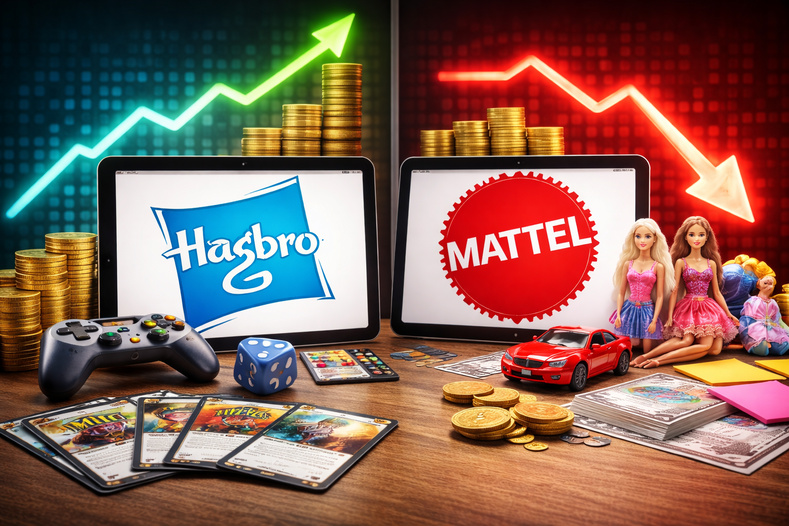
Two of the world’s largest toymakers have delivered similarly cautious outlooks, yet investor reactions have split sharply. The divergence reflects more than quarterly numbers. It reveals how business model evolution—particularly the embrace of digital gaming—has reshaped risk perception in the children’s entertainment sector.
While both companies face softer demand for traditional toys amid tighter consumer budgets and retailer caution, one has repositioned itself as a hybrid digital entertainment platform. The other remains in the midst of transition, still anchored in physical product cycles and exposed to inventory volatility. The contrast underscores how and why strategic timing, execution and capital allocation can redefine market confidence.
The Structural Shift from Plastic to Pixels
The global toy industry has undergone a profound transformation over the past decade. Children increasingly divide their leisure time between physical play and digital interaction, while older demographics spend more on immersive games, collectible card ecosystems and online communities. The rise of live-service gaming, downloadable content and mobile platforms has expanded revenue streams beyond one-time product sales.
Hasbro moved early to capitalize on this evolution. Through its Wizards of the Coast division, anchored by the long-running “Magic: The Gathering” franchise and later strengthened by digital adaptations, the company built a scalable ecosystem combining physical cards, online gameplay and competitive events. Digital gaming revenues surged, and operating margins in that segment expanded sharply as software economics replaced manufacturing costs.
By contrast, Mattel’s portfolio remains predominantly physical. Barbie, Hot Wheels and Fisher-Price continue to command brand recognition, but their growth depends on retail shelf space, production logistics and seasonal cycles. Even with successful media tie-ins and brand extensions, the revenue profile remains tied to consumer discretionary spending patterns and retailer inventory strategies.
As digital entertainment commands higher margins and recurring revenue potential, investors increasingly reward companies with exposure to scalable software-like models. This structural re-rating helps explain why two cautious forecasts produced opposite stock reactions.
Inventory Exposure and Retailer Power
Physical toy manufacturing is inherently vulnerable to supply chain shifts. Production often occurs months before peak demand seasons, requiring careful forecasting and coordination with retailers. When consumer demand softens or retailer purchasing patterns change, manufacturers bear the brunt of excess inventory.
Mattel has faced precisely this challenge. Shifts in shipping patterns, adjustments in retailer order timing and tariff-related uncertainty have disrupted traditional forecasting models. Large retailers, seeking flexibility, have shortened order windows and demanded faster fulfillment cycles. This places inventory risk increasingly on manufacturers rather than distributors.
Discounting to clear unsold stock compresses margins and erodes pricing power. For a company already navigating soft consumer demand, the need to manage inventory overhang compounds earnings pressure. Analysts have noted that inventory normalization may extend into subsequent quarters, prolonging volatility.
Hasbro, though not immune to physical toy pressures, has mitigated these risks through its digital segment. Digital games require minimal inventory holding costs and generate incremental revenue without comparable logistical burdens. As a result, fluctuations in physical toy demand exert less influence on overall profitability.
Capital Allocation and the Timing of Transformation
Strategic pivots rarely produce immediate results. Hasbro’s investment in gaming and digital capabilities began years before recent margin expansion. Acquisitions, licensing agreements and technology development required upfront spending before revenue acceleration materialized. The payoff now reinforces the perception of foresight.
Mattel is embarking on a similar digital journey, including acquiring greater control over joint ventures and committing substantial investment toward gaming development. The ambition is clear: extend iconic intellectual property into digital platforms and capture higher-margin growth.
Yet markets tend to penalize transition periods. Investment outlays depress near-term earnings, while revenue contributions remain uncertain. Until digital initiatives scale meaningfully, investors may view such spending as risk rather than opportunity.
This temporal gap between investment and return is central to the current divergence. Hasbro’s digital strategy has reached maturity, delivering visible operating leverage. Mattel’s digital expansion remains nascent, creating an earnings drag before potential upside emerges.
Intellectual Property and Monetization Models
Both companies possess powerful brands with cross-media appeal. Film adaptations, streaming partnerships and merchandising agreements extend intellectual property beyond toy aisles. The difference lies in monetization pathways.
Hasbro has increasingly positioned its intellectual property within gaming ecosystems. “Magic: The Gathering” operates as a continuous content engine, releasing expansions that drive recurring purchases. Digital platforms enable microtransactions, subscriptions and global player engagement without physical constraints.
Mattel’s brands, while culturally influential, have traditionally translated into product sales rather than recurring digital experiences. The success of brand-driven films demonstrates storytelling strength, yet translating that engagement into sustained digital revenue remains a work in progress.
The distinction matters because investors prize predictable, recurring cash flows. Software-based gaming models offer that predictability. Physical toys, influenced by fashion cycles and seasonal demand, generate lumpier revenue patterns.
Valuation and Risk Perception
Equity markets often function as forward-looking assessments of risk and growth durability. Companies perceived to have diversified revenue streams and higher-margin digital exposure typically command richer valuation multiples.
Hasbro’s digital pivot has altered its risk profile. Even when issuing cautious forecasts, the company benefits from confidence in its gaming engine. Investors interpret short-term softness as manageable within a broader, structurally improved model.
Mattel’s valuation reflects skepticism about growth visibility. The market reaction to its outlook underscores concern over execution risk, margin compression and the timeline for digital returns. A sharp share price decline signals not just disappointment with guidance but doubt about the pace of transformation.
Broader Industry Implications
The contrast between these two toymakers mirrors a wider industry reckoning. Traditional consumer goods companies face intensifying competition from digital-native entertainment platforms. Success increasingly depends on blending physical products with immersive digital ecosystems.
Companies that adapt early capture margin expansion and investor confidence. Those transitioning later must endure periods of compressed profitability while building capabilities.
Retailer dynamics further amplify this shift. As e-commerce platforms and direct-to-consumer channels expand, digital engagement becomes integral to brand loyalty. Interactive gaming communities often serve as marketing engines in their own right, reducing reliance on costly traditional advertising.
In this evolving landscape, the divergence between two longstanding rivals illustrates how strategic emphasis reshapes outcomes. One company’s early embrace of digital gaming has transformed it into a hybrid entertainment entity with enhanced resilience. The other, still rooted in its physical heritage, is navigating the complex path toward reinvention.
(Source:www.tradingview.com)
While both companies face softer demand for traditional toys amid tighter consumer budgets and retailer caution, one has repositioned itself as a hybrid digital entertainment platform. The other remains in the midst of transition, still anchored in physical product cycles and exposed to inventory volatility. The contrast underscores how and why strategic timing, execution and capital allocation can redefine market confidence.
The Structural Shift from Plastic to Pixels
The global toy industry has undergone a profound transformation over the past decade. Children increasingly divide their leisure time between physical play and digital interaction, while older demographics spend more on immersive games, collectible card ecosystems and online communities. The rise of live-service gaming, downloadable content and mobile platforms has expanded revenue streams beyond one-time product sales.
Hasbro moved early to capitalize on this evolution. Through its Wizards of the Coast division, anchored by the long-running “Magic: The Gathering” franchise and later strengthened by digital adaptations, the company built a scalable ecosystem combining physical cards, online gameplay and competitive events. Digital gaming revenues surged, and operating margins in that segment expanded sharply as software economics replaced manufacturing costs.
By contrast, Mattel’s portfolio remains predominantly physical. Barbie, Hot Wheels and Fisher-Price continue to command brand recognition, but their growth depends on retail shelf space, production logistics and seasonal cycles. Even with successful media tie-ins and brand extensions, the revenue profile remains tied to consumer discretionary spending patterns and retailer inventory strategies.
As digital entertainment commands higher margins and recurring revenue potential, investors increasingly reward companies with exposure to scalable software-like models. This structural re-rating helps explain why two cautious forecasts produced opposite stock reactions.
Inventory Exposure and Retailer Power
Physical toy manufacturing is inherently vulnerable to supply chain shifts. Production often occurs months before peak demand seasons, requiring careful forecasting and coordination with retailers. When consumer demand softens or retailer purchasing patterns change, manufacturers bear the brunt of excess inventory.
Mattel has faced precisely this challenge. Shifts in shipping patterns, adjustments in retailer order timing and tariff-related uncertainty have disrupted traditional forecasting models. Large retailers, seeking flexibility, have shortened order windows and demanded faster fulfillment cycles. This places inventory risk increasingly on manufacturers rather than distributors.
Discounting to clear unsold stock compresses margins and erodes pricing power. For a company already navigating soft consumer demand, the need to manage inventory overhang compounds earnings pressure. Analysts have noted that inventory normalization may extend into subsequent quarters, prolonging volatility.
Hasbro, though not immune to physical toy pressures, has mitigated these risks through its digital segment. Digital games require minimal inventory holding costs and generate incremental revenue without comparable logistical burdens. As a result, fluctuations in physical toy demand exert less influence on overall profitability.
Capital Allocation and the Timing of Transformation
Strategic pivots rarely produce immediate results. Hasbro’s investment in gaming and digital capabilities began years before recent margin expansion. Acquisitions, licensing agreements and technology development required upfront spending before revenue acceleration materialized. The payoff now reinforces the perception of foresight.
Mattel is embarking on a similar digital journey, including acquiring greater control over joint ventures and committing substantial investment toward gaming development. The ambition is clear: extend iconic intellectual property into digital platforms and capture higher-margin growth.
Yet markets tend to penalize transition periods. Investment outlays depress near-term earnings, while revenue contributions remain uncertain. Until digital initiatives scale meaningfully, investors may view such spending as risk rather than opportunity.
This temporal gap between investment and return is central to the current divergence. Hasbro’s digital strategy has reached maturity, delivering visible operating leverage. Mattel’s digital expansion remains nascent, creating an earnings drag before potential upside emerges.
Intellectual Property and Monetization Models
Both companies possess powerful brands with cross-media appeal. Film adaptations, streaming partnerships and merchandising agreements extend intellectual property beyond toy aisles. The difference lies in monetization pathways.
Hasbro has increasingly positioned its intellectual property within gaming ecosystems. “Magic: The Gathering” operates as a continuous content engine, releasing expansions that drive recurring purchases. Digital platforms enable microtransactions, subscriptions and global player engagement without physical constraints.
Mattel’s brands, while culturally influential, have traditionally translated into product sales rather than recurring digital experiences. The success of brand-driven films demonstrates storytelling strength, yet translating that engagement into sustained digital revenue remains a work in progress.
The distinction matters because investors prize predictable, recurring cash flows. Software-based gaming models offer that predictability. Physical toys, influenced by fashion cycles and seasonal demand, generate lumpier revenue patterns.
Valuation and Risk Perception
Equity markets often function as forward-looking assessments of risk and growth durability. Companies perceived to have diversified revenue streams and higher-margin digital exposure typically command richer valuation multiples.
Hasbro’s digital pivot has altered its risk profile. Even when issuing cautious forecasts, the company benefits from confidence in its gaming engine. Investors interpret short-term softness as manageable within a broader, structurally improved model.
Mattel’s valuation reflects skepticism about growth visibility. The market reaction to its outlook underscores concern over execution risk, margin compression and the timeline for digital returns. A sharp share price decline signals not just disappointment with guidance but doubt about the pace of transformation.
Broader Industry Implications
The contrast between these two toymakers mirrors a wider industry reckoning. Traditional consumer goods companies face intensifying competition from digital-native entertainment platforms. Success increasingly depends on blending physical products with immersive digital ecosystems.
Companies that adapt early capture margin expansion and investor confidence. Those transitioning later must endure periods of compressed profitability while building capabilities.
Retailer dynamics further amplify this shift. As e-commerce platforms and direct-to-consumer channels expand, digital engagement becomes integral to brand loyalty. Interactive gaming communities often serve as marketing engines in their own right, reducing reliance on costly traditional advertising.
In this evolving landscape, the divergence between two longstanding rivals illustrates how strategic emphasis reshapes outcomes. One company’s early embrace of digital gaming has transformed it into a hybrid entertainment entity with enhanced resilience. The other, still rooted in its physical heritage, is navigating the complex path toward reinvention.
(Source:www.tradingview.com)
 Homepage
 Send to a friend
 Printable version
 Share
Share


