


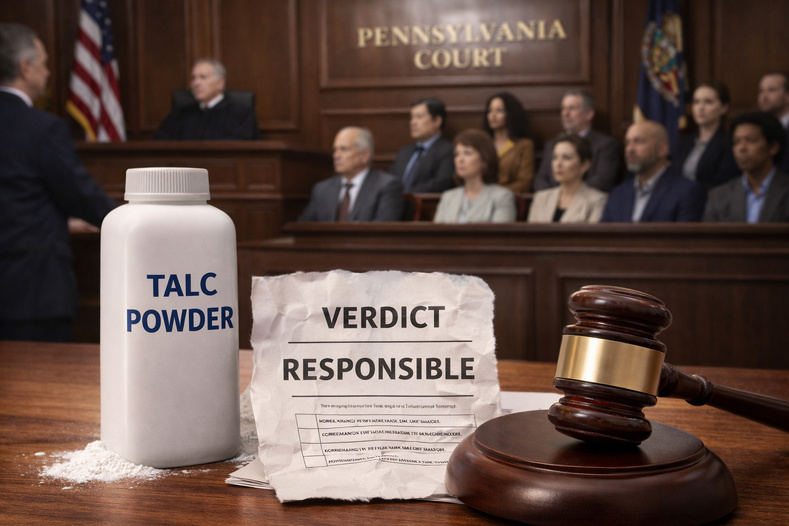
A Pennsylvania jury’s decision to hold Johnson & Johnson liable in the latest talc-related ovarian cancer trial reflects more than a single-family’s legal victory. It signals the continuing force of product-liability principles in mass tort litigation and underscores how juries are evaluating corporate knowledge, consumer expectations, and scientific uncertainty in one of the most closely watched pharmaceutical disputes in the United States.
In the Philadelphia Court of Common Pleas, jurors awarded $250,000 to the family of Gayle Emerson, concluding that the company’s talc-based baby powder contributed to her ovarian cancer and that its corporate conduct warranted punitive damages. While the financial award was modest compared with earlier multibillion-dollar verdicts in similar litigation, the ruling illustrates how plaintiffs are persuading juries not merely on emotional grounds, but through structured arguments about internal corporate awareness, evolving scientific literature, and the duty to warn.
The verdict comes as Johnson & Johnson faces tens of thousands of lawsuits alleging that long-term use of its talc products led to ovarian cancer or mesothelioma. Although the company has consistently maintained that its products are safe and asbestos-free, juries in various jurisdictions have delivered a mix of outcomes, shaping a litigation landscape defined by both scientific debate and legal strategy.
Corporate Knowledge and the Duty to Warn
At the center of the Pennsylvania case was the argument that Johnson & Johnson knew, or should have known, about potential contamination risks and epidemiological signals linking perineal talc use to ovarian cancer. Plaintiffs’ attorneys have for years pointed to internal documents disclosed in earlier trials suggesting that company officials discussed asbestos testing methods, regulatory scrutiny, and public relations responses to health concerns dating back decades.
Under product liability law, particularly in failure-to-warn claims, the pivotal question is not solely whether a product causes harm in every instance, but whether the manufacturer adequately informed consumers of known or reasonably knowable risks. In the Emerson case, jurors appear to have concluded that the company’s warnings were insufficient given the scientific information available over time.
This legal theory rests on the principle that manufacturers occupy a superior position in assessing product safety. They control testing protocols, regulatory submissions, and labeling decisions. When juries are presented with evidence suggesting gaps in disclosure or internal acknowledgment of risk debates, even if those debates remain scientifically contested, it can tilt the balance toward liability.
The Pennsylvania verdict demonstrates how plaintiffs have refined their strategy. Rather than focusing exclusively on proving definitive causation, they frame the issue around transparency and corporate conduct. Punitive damages—$200,000 of the award—reflect the jury’s assessment not only of injury but of behavior considered sufficiently troubling to warrant deterrence.
Scientific Controversy and Legal Standards of Proof
The talc litigation occupies a complicated space between epidemiology and courtroom standards. Some epidemiological studies have suggested a modest association between long-term genital talc use and ovarian cancer, while others have found no statistically significant link. Regulatory agencies have not uniformly classified cosmetic talc as a carcinogen, and Johnson & Johnson has repeatedly cited decades of product testing to assert that its powders are safe.
Yet civil litigation does not require the same threshold of certainty as scientific consensus. Plaintiffs must demonstrate, by a preponderance of evidence, that it is more likely than not that the product contributed to the harm. Expert testimony plays a decisive role, translating population-level data into individualized causation arguments.
In recent federal proceedings, judges have allowed plaintiffs’ experts to present testimony linking talc use to ovarian cancer, despite challenges from the company. That development is significant. Once expert opinions clear admissibility standards, juries are permitted to weigh competing scientific narratives. The Pennsylvania outcome suggests that at least in some courtrooms, jurors find plaintiffs’ experts persuasive enough to attribute responsibility.
This dynamic illustrates a broader reality of mass tort litigation: courtroom determinations of causation can evolve independently of regulatory determinations. Even in the absence of an outright governmental ban on talc, juries may conclude that long-term exposure combined with corporate knowledge creates legal liability.
Bankruptcy Strategy and Litigation Momentum
Johnson & Johnson’s attempt to channel talc claims through a subsidiary bankruptcy process has also shaped the trajectory of these trials. The company created a subsidiary entity to assume talc-related liabilities and sought to resolve claims through a global settlement within bankruptcy court. Federal courts rejected those efforts multiple times, ruling that the maneuver did not meet the requirements for Chapter 11 protection.
The collapse of that strategy effectively reopened the door for state-court trials to proceed. The Pennsylvania case is part of that renewed momentum. As bankruptcy-related pauses lift, plaintiffs once again have the opportunity to present individual stories before juries.
For defendants in mass torts, bankruptcy can provide predictability and cap exposure. Without it, companies face the variability of jury trials across jurisdictions. Some juries have delivered massive awards later reduced on appeal; others have sided with Johnson & Johnson outright. The Pennsylvania verdict, though comparatively modest, contributes to a pattern in which litigation pressure continues rather than dissipates.
The persistence of trials also affects settlement dynamics. Each plaintiff victory, regardless of size, adds incremental leverage. Conversely, defense wins can temper expectations. In this environment, every verdict becomes a data point in a broader negotiation landscape.
Consumer Trust, Brand Legacy, and Corporate Risk
Johnson & Johnson’s baby powder once symbolized safety and gentleness, a product marketed for infants and families for generations. The talc controversy has therefore carried reputational implications extending beyond legal liability. In 2020, the company discontinued sales of talc-based baby powder in the United States, later transitioning globally to a cornstarch-based formula.
That shift, while described as a commercial decision tied to declining demand and litigation costs, inevitably intersects with jurors’ perceptions. When a company withdraws a longstanding product amid safety allegations, even without admitting fault, it can influence how past conduct is interpreted.
In the Pennsylvania trial, jurors were tasked with evaluating decades of product use by a consumer who reportedly relied on the powder from the late 1960s through 2017. The longevity of that use underscores the core issue in many talc cases: cumulative exposure over time. Plaintiffs argue that even small, repeated applications may allow talc particles to migrate internally, potentially triggering inflammation linked to cancer development.
Whether that mechanism is conclusively proven remains debated in scientific circles. But in the courtroom, jurors assess not only mechanistic plausibility but also corporate responsibility. The Emerson verdict indicates that, in this instance, the narrative of prolonged consumer reliance combined with alleged internal awareness resonated.
As additional trials move forward in state courts and potentially in consolidated federal proceedings, the legal and financial exposure for Johnson & Johnson remains fluid. Each jury’s decision contributes to a complex mosaic that blends evolving science, corporate governance, and public health considerations.
The Pennsylvania ruling stands as a reminder that in product liability litigation, accountability is shaped as much by perceptions of corporate conduct as by scientific argument. In that interplay between evidence and ethics, juries continue to define the contours of responsibility in one of the most consequential consumer health disputes of the past decade.
(Source:www.investing.com)
In the Philadelphia Court of Common Pleas, jurors awarded $250,000 to the family of Gayle Emerson, concluding that the company’s talc-based baby powder contributed to her ovarian cancer and that its corporate conduct warranted punitive damages. While the financial award was modest compared with earlier multibillion-dollar verdicts in similar litigation, the ruling illustrates how plaintiffs are persuading juries not merely on emotional grounds, but through structured arguments about internal corporate awareness, evolving scientific literature, and the duty to warn.
The verdict comes as Johnson & Johnson faces tens of thousands of lawsuits alleging that long-term use of its talc products led to ovarian cancer or mesothelioma. Although the company has consistently maintained that its products are safe and asbestos-free, juries in various jurisdictions have delivered a mix of outcomes, shaping a litigation landscape defined by both scientific debate and legal strategy.
Corporate Knowledge and the Duty to Warn
At the center of the Pennsylvania case was the argument that Johnson & Johnson knew, or should have known, about potential contamination risks and epidemiological signals linking perineal talc use to ovarian cancer. Plaintiffs’ attorneys have for years pointed to internal documents disclosed in earlier trials suggesting that company officials discussed asbestos testing methods, regulatory scrutiny, and public relations responses to health concerns dating back decades.
Under product liability law, particularly in failure-to-warn claims, the pivotal question is not solely whether a product causes harm in every instance, but whether the manufacturer adequately informed consumers of known or reasonably knowable risks. In the Emerson case, jurors appear to have concluded that the company’s warnings were insufficient given the scientific information available over time.
This legal theory rests on the principle that manufacturers occupy a superior position in assessing product safety. They control testing protocols, regulatory submissions, and labeling decisions. When juries are presented with evidence suggesting gaps in disclosure or internal acknowledgment of risk debates, even if those debates remain scientifically contested, it can tilt the balance toward liability.
The Pennsylvania verdict demonstrates how plaintiffs have refined their strategy. Rather than focusing exclusively on proving definitive causation, they frame the issue around transparency and corporate conduct. Punitive damages—$200,000 of the award—reflect the jury’s assessment not only of injury but of behavior considered sufficiently troubling to warrant deterrence.
Scientific Controversy and Legal Standards of Proof
The talc litigation occupies a complicated space between epidemiology and courtroom standards. Some epidemiological studies have suggested a modest association between long-term genital talc use and ovarian cancer, while others have found no statistically significant link. Regulatory agencies have not uniformly classified cosmetic talc as a carcinogen, and Johnson & Johnson has repeatedly cited decades of product testing to assert that its powders are safe.
Yet civil litigation does not require the same threshold of certainty as scientific consensus. Plaintiffs must demonstrate, by a preponderance of evidence, that it is more likely than not that the product contributed to the harm. Expert testimony plays a decisive role, translating population-level data into individualized causation arguments.
In recent federal proceedings, judges have allowed plaintiffs’ experts to present testimony linking talc use to ovarian cancer, despite challenges from the company. That development is significant. Once expert opinions clear admissibility standards, juries are permitted to weigh competing scientific narratives. The Pennsylvania outcome suggests that at least in some courtrooms, jurors find plaintiffs’ experts persuasive enough to attribute responsibility.
This dynamic illustrates a broader reality of mass tort litigation: courtroom determinations of causation can evolve independently of regulatory determinations. Even in the absence of an outright governmental ban on talc, juries may conclude that long-term exposure combined with corporate knowledge creates legal liability.
Bankruptcy Strategy and Litigation Momentum
Johnson & Johnson’s attempt to channel talc claims through a subsidiary bankruptcy process has also shaped the trajectory of these trials. The company created a subsidiary entity to assume talc-related liabilities and sought to resolve claims through a global settlement within bankruptcy court. Federal courts rejected those efforts multiple times, ruling that the maneuver did not meet the requirements for Chapter 11 protection.
The collapse of that strategy effectively reopened the door for state-court trials to proceed. The Pennsylvania case is part of that renewed momentum. As bankruptcy-related pauses lift, plaintiffs once again have the opportunity to present individual stories before juries.
For defendants in mass torts, bankruptcy can provide predictability and cap exposure. Without it, companies face the variability of jury trials across jurisdictions. Some juries have delivered massive awards later reduced on appeal; others have sided with Johnson & Johnson outright. The Pennsylvania verdict, though comparatively modest, contributes to a pattern in which litigation pressure continues rather than dissipates.
The persistence of trials also affects settlement dynamics. Each plaintiff victory, regardless of size, adds incremental leverage. Conversely, defense wins can temper expectations. In this environment, every verdict becomes a data point in a broader negotiation landscape.
Consumer Trust, Brand Legacy, and Corporate Risk
Johnson & Johnson’s baby powder once symbolized safety and gentleness, a product marketed for infants and families for generations. The talc controversy has therefore carried reputational implications extending beyond legal liability. In 2020, the company discontinued sales of talc-based baby powder in the United States, later transitioning globally to a cornstarch-based formula.
That shift, while described as a commercial decision tied to declining demand and litigation costs, inevitably intersects with jurors’ perceptions. When a company withdraws a longstanding product amid safety allegations, even without admitting fault, it can influence how past conduct is interpreted.
In the Pennsylvania trial, jurors were tasked with evaluating decades of product use by a consumer who reportedly relied on the powder from the late 1960s through 2017. The longevity of that use underscores the core issue in many talc cases: cumulative exposure over time. Plaintiffs argue that even small, repeated applications may allow talc particles to migrate internally, potentially triggering inflammation linked to cancer development.
Whether that mechanism is conclusively proven remains debated in scientific circles. But in the courtroom, jurors assess not only mechanistic plausibility but also corporate responsibility. The Emerson verdict indicates that, in this instance, the narrative of prolonged consumer reliance combined with alleged internal awareness resonated.
As additional trials move forward in state courts and potentially in consolidated federal proceedings, the legal and financial exposure for Johnson & Johnson remains fluid. Each jury’s decision contributes to a complex mosaic that blends evolving science, corporate governance, and public health considerations.
The Pennsylvania ruling stands as a reminder that in product liability litigation, accountability is shaped as much by perceptions of corporate conduct as by scientific argument. In that interplay between evidence and ethics, juries continue to define the contours of responsibility in one of the most consequential consumer health disputes of the past decade.
(Source:www.investing.com)
 Homepage
 Send to a friend
 Printable version
 Share
Share


