


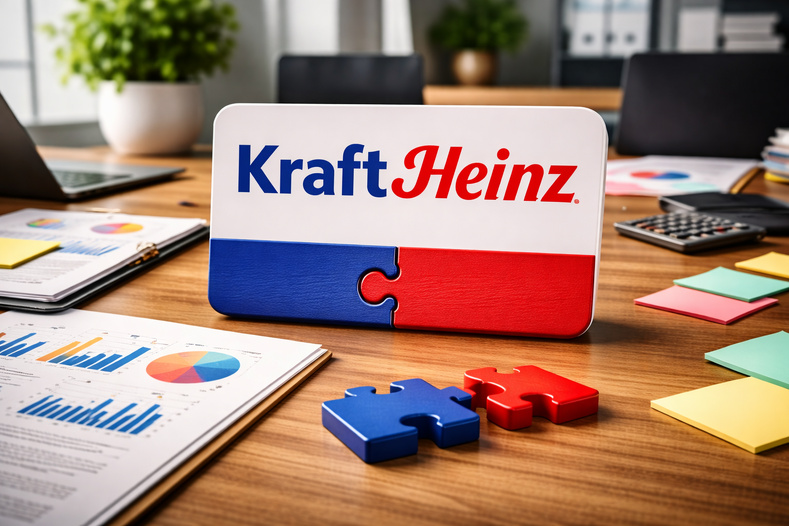
Kraft Heinz has reversed course on a planned corporate split, signaling a decisive shift in strategy under its new chief executive. The move, which pauses preparations to separate the company into two distinct businesses, reflects a growing belief inside the food giant that its challenges are operational rather than structural. Instead of dividing grocery staples from sauces and spreads, management is now prioritizing execution, brand investment and profitability restoration.
The decision marks a rare reversal in an era when corporate breakups are often seen as a remedy for sluggish growth. Yet for Kraft Heinz, the calculus appears to have changed. The leadership transition has reframed the debate from structural simplification to disciplined reinvention within a unified organization.
From Structural Reset to Operational Repair
When Kraft Foods and Heinz merged in 2015, the deal was heralded as a transformative consolidation in the packaged food industry. Backed by aggressive cost-cutting and efficiency drives, the combined company sought to extract synergies and expand margins. Over time, however, the relentless focus on expenses came at a cost. Marketing budgets tightened, innovation slowed and brand equity eroded in certain segments.
By 2023, growth had stalled relative to competitors that invested more heavily in product development and consumer engagement. The proposed split—dividing the business into separate grocery and condiments-focused entities—was framed as a way to unlock value and sharpen strategic focus. Management argued that complexity hindered capital allocation and slowed decision-making.
Under new CEO Steve Cahillane, that thesis has been reassessed. Rather than viewing organizational scale as the core impediment, the leadership now emphasizes that many of the company’s obstacles lie within management’s control. Execution gaps, underinvestment in marketing and limited responsiveness to shifting consumer tastes have emerged as focal points.
Halting the split avoids hundreds of millions of dollars in separation-related dis-synergies and one-time costs. It also preserves operational continuity at a moment when industry conditions remain volatile.
Consumer Pressure and Shifting Demand Patterns
Kraft Heinz operates in a segment facing structural change. After years of price increases driven by inflation in commodities and supply chains, consumers have grown more price-sensitive. Private-label brands have gained traction, particularly in categories such as condiments, cheese, and pantry staples where differentiation can blur.
Higher interest rates and tighter household budgets have reinforced value-seeking behavior. For a company heavily reliant on established brands like ketchup, macaroni and cheese, and packaged meats, sustaining volume growth has become more challenging.
The company’s recent financial performance reflects these pressures. Sales growth has moderated, and earnings forecasts have come under scrutiny. Organic revenue is expected to decline modestly in the near term, underscoring the urgency of strategic recalibration.
By pausing the split, leadership aims to concentrate resources on reinvigorating demand. A substantial marketing and research investment is intended to modernize brand positioning, accelerate product innovation and align offerings with evolving consumer preferences. In categories increasingly shaped by health-conscious choices and convenience-driven formats, agility is essential.
The Case Against Fragmentation
Corporate separations often promise clarity and investor appeal, but they also carry risk. Spinoffs can disrupt supply chains, fragment shared services and weaken bargaining power with retailers. For a company with extensive manufacturing and distribution networks, splitting operations could introduce inefficiencies precisely when cost discipline remains vital.
The rarity of canceled spinoffs underscores how unusual Kraft Heinz’s reversal is. Yet the decision suggests confidence that integration still holds strategic advantages. A unified entity can allocate capital flexibly across brands, leverage scale in procurement and coordinate marketing campaigns more effectively.
Moreover, the industry landscape has shifted since the breakup plan was announced. Economic uncertainty and uneven consumer demand may favor stability over structural experimentation. Investors, while initially unsettled by the reversal, may ultimately judge the strategy by its operational outcomes rather than its organizational form.
Cahillane brings experience from prior leadership roles in the packaged food sector, including overseeing a major corporate split at another multinational food company. His willingness to pause a similar plan at Kraft Heinz signals a pragmatic approach: strategy should adapt to conditions rather than adhere rigidly to precedent.
Investment, Innovation and Cultural Reset
Central to the new direction is a renewed emphasis on growth drivers long overshadowed by cost management. The planned $600 million investment in marketing and research represents an attempt to rebalance priorities. Advertising campaigns, digital engagement and product reformulation are expected to receive greater attention.
In recent years, consumer trends have tilted toward natural ingredients, plant-based alternatives and functional foods. Kraft Heinz must compete not only with legacy rivals but also with nimble startups that quickly capture niche demand. Accelerating innovation cycles and modernizing brand narratives are essential components of regaining market momentum.
Operationally, the company is also focusing on supply chain optimization. Pandemic-era disruptions exposed vulnerabilities in logistics and procurement. Streamlining distribution and enhancing forecasting capabilities could improve service levels while containing costs.
Leadership messaging has stressed that the company’s portfolio remains fundamentally strong. Iconic brands retain significant household recognition, and international markets offer avenues for expansion. The challenge lies in translating brand equity into consistent volume growth in a competitive retail environment.
Halting the split aligns with a broader corporate philosophy that transformation does not always require division. In some cases, sustained investment, disciplined execution and cultural renewal can achieve what structural reorganization cannot. Kraft Heinz’s pivot suggests that management believes its difficulties stem less from organizational design and more from underleveraged potential.
As the company embarks on this renewed strategy, the test will be whether operational improvements can restore profitable growth in a market defined by cautious consumers and intensifying competition. The decision to remain intact places accountability squarely on execution—an acknowledgment that the company’s future depends not on separation, but on revitalization from within.
(Source:www.bloomberg.com)
The decision marks a rare reversal in an era when corporate breakups are often seen as a remedy for sluggish growth. Yet for Kraft Heinz, the calculus appears to have changed. The leadership transition has reframed the debate from structural simplification to disciplined reinvention within a unified organization.
From Structural Reset to Operational Repair
When Kraft Foods and Heinz merged in 2015, the deal was heralded as a transformative consolidation in the packaged food industry. Backed by aggressive cost-cutting and efficiency drives, the combined company sought to extract synergies and expand margins. Over time, however, the relentless focus on expenses came at a cost. Marketing budgets tightened, innovation slowed and brand equity eroded in certain segments.
By 2023, growth had stalled relative to competitors that invested more heavily in product development and consumer engagement. The proposed split—dividing the business into separate grocery and condiments-focused entities—was framed as a way to unlock value and sharpen strategic focus. Management argued that complexity hindered capital allocation and slowed decision-making.
Under new CEO Steve Cahillane, that thesis has been reassessed. Rather than viewing organizational scale as the core impediment, the leadership now emphasizes that many of the company’s obstacles lie within management’s control. Execution gaps, underinvestment in marketing and limited responsiveness to shifting consumer tastes have emerged as focal points.
Halting the split avoids hundreds of millions of dollars in separation-related dis-synergies and one-time costs. It also preserves operational continuity at a moment when industry conditions remain volatile.
Consumer Pressure and Shifting Demand Patterns
Kraft Heinz operates in a segment facing structural change. After years of price increases driven by inflation in commodities and supply chains, consumers have grown more price-sensitive. Private-label brands have gained traction, particularly in categories such as condiments, cheese, and pantry staples where differentiation can blur.
Higher interest rates and tighter household budgets have reinforced value-seeking behavior. For a company heavily reliant on established brands like ketchup, macaroni and cheese, and packaged meats, sustaining volume growth has become more challenging.
The company’s recent financial performance reflects these pressures. Sales growth has moderated, and earnings forecasts have come under scrutiny. Organic revenue is expected to decline modestly in the near term, underscoring the urgency of strategic recalibration.
By pausing the split, leadership aims to concentrate resources on reinvigorating demand. A substantial marketing and research investment is intended to modernize brand positioning, accelerate product innovation and align offerings with evolving consumer preferences. In categories increasingly shaped by health-conscious choices and convenience-driven formats, agility is essential.
The Case Against Fragmentation
Corporate separations often promise clarity and investor appeal, but they also carry risk. Spinoffs can disrupt supply chains, fragment shared services and weaken bargaining power with retailers. For a company with extensive manufacturing and distribution networks, splitting operations could introduce inefficiencies precisely when cost discipline remains vital.
The rarity of canceled spinoffs underscores how unusual Kraft Heinz’s reversal is. Yet the decision suggests confidence that integration still holds strategic advantages. A unified entity can allocate capital flexibly across brands, leverage scale in procurement and coordinate marketing campaigns more effectively.
Moreover, the industry landscape has shifted since the breakup plan was announced. Economic uncertainty and uneven consumer demand may favor stability over structural experimentation. Investors, while initially unsettled by the reversal, may ultimately judge the strategy by its operational outcomes rather than its organizational form.
Cahillane brings experience from prior leadership roles in the packaged food sector, including overseeing a major corporate split at another multinational food company. His willingness to pause a similar plan at Kraft Heinz signals a pragmatic approach: strategy should adapt to conditions rather than adhere rigidly to precedent.
Investment, Innovation and Cultural Reset
Central to the new direction is a renewed emphasis on growth drivers long overshadowed by cost management. The planned $600 million investment in marketing and research represents an attempt to rebalance priorities. Advertising campaigns, digital engagement and product reformulation are expected to receive greater attention.
In recent years, consumer trends have tilted toward natural ingredients, plant-based alternatives and functional foods. Kraft Heinz must compete not only with legacy rivals but also with nimble startups that quickly capture niche demand. Accelerating innovation cycles and modernizing brand narratives are essential components of regaining market momentum.
Operationally, the company is also focusing on supply chain optimization. Pandemic-era disruptions exposed vulnerabilities in logistics and procurement. Streamlining distribution and enhancing forecasting capabilities could improve service levels while containing costs.
Leadership messaging has stressed that the company’s portfolio remains fundamentally strong. Iconic brands retain significant household recognition, and international markets offer avenues for expansion. The challenge lies in translating brand equity into consistent volume growth in a competitive retail environment.
Halting the split aligns with a broader corporate philosophy that transformation does not always require division. In some cases, sustained investment, disciplined execution and cultural renewal can achieve what structural reorganization cannot. Kraft Heinz’s pivot suggests that management believes its difficulties stem less from organizational design and more from underleveraged potential.
As the company embarks on this renewed strategy, the test will be whether operational improvements can restore profitable growth in a market defined by cautious consumers and intensifying competition. The decision to remain intact places accountability squarely on execution—an acknowledgment that the company’s future depends not on separation, but on revitalization from within.
(Source:www.bloomberg.com)
 Homepage
 Send to a friend
 Printable version
 Share
Share


