


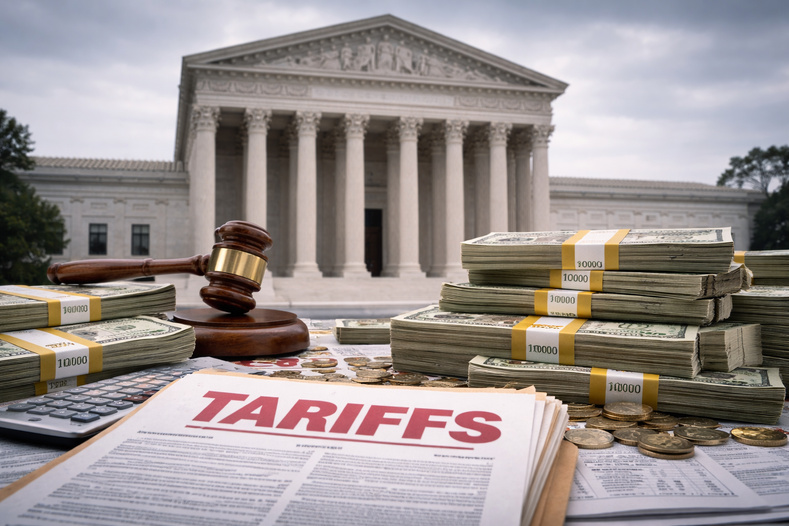
More than $175 billion in U.S. tariff revenue could be thrown into uncertainty as the Supreme Court weighs the legality of sweeping emergency duties imposed under presidential authority. Fiscal analysts estimate that if the Court rules against the tariffs, the federal government may be required to refund a sum that rivals the annual budgets of major cabinet departments — a development that would reverberate across trade policy, budget planning and executive power.
The potential exposure stems from tariffs imposed under the International Emergency Economic Powers Act (IEEPA), a statute that grants the president broad authority to regulate commerce during declared national emergencies. Over recent years, that authority has been used to levy wide-ranging duties on imports from multiple countries and across thousands of product categories. The revenue generated has been significant, but its legal foundation now faces judicial review.
How the $175 Billion Figure Was Calculated
Economic modeling suggests that daily tariff collections under IEEPA authorities have averaged roughly half a billion dollars at peak implementation periods. By aggregating product-level import data across approximately 11,000 tariff classifications and 233 trading partners, researchers have estimated cumulative collections approaching $175–$180 billion since the duties were imposed.
The methodology relies on granular import data, applying specific tariff rates by product and country of origin, then projecting revenue flows forward while adjusting for shifts in trade volumes. Because tariffs often alter sourcing decisions and supply chains, models incorporate elasticity assumptions to account for reduced imports or substitution effects.
Separate extrapolations using Treasury and Customs assessment data have produced similar totals. While gross tariff assessments can differ slightly from net receipts due to corrections and administrative adjustments, the range consistently exceeds $175 billion. If deemed unlawful, importers who paid duties over the covered period would likely seek refunds through U.S. Customs and Border Protection, creating a substantial fiscal obligation.
Why the Legal Challenge Matters
The Supreme Court’s review centers on whether IEEPA permits the imposition of broad-based tariffs unrelated to traditional sanctions or asset freezes. Historically, the statute has been used to restrict financial transactions and block property during emergencies, not as a general trade policy instrument.
Challengers argue that the tariffs stretch the statute beyond its intended scope, effectively bypassing Congress’s constitutional authority over taxation and trade. Supporters counter that the language of IEEPA grants the executive wide discretion in responding to perceived economic threats.
If the Court narrows or invalidates this interpretation, it could curtail executive flexibility in trade disputes. More immediately, it would raise the question of retroactive liability: whether tariffs collected under the contested authority must be returned.
Budgetary Implications for the Federal Government
Tariff revenue has become a notable component of federal receipts. In recent fiscal periods, customs collections surged by roughly $20 billion per month compared with pre-tariff baselines, with monthly totals exceeding $27 billion at certain points. Over a decade, official projections have suggested tariffs could contribute hundreds of billions in revenue.
A refund obligation exceeding $175 billion would represent one of the largest single fiscal reversals in modern U.S. history. To put the magnitude in context, the amount surpasses annual spending for several major departments combined. Such a payout would affect Treasury cash balances, debt issuance schedules, and deficit projections.
The Treasury maintains substantial liquidity buffers, often holding cash balances in the high hundreds of billions of dollars to manage payment flows. Officials have indicated that refund capacity exists if required. Nevertheless, absorbing a liability of this scale would complicate fiscal management and potentially alter borrowing patterns in the short term.
Beyond budget arithmetic, the ruling could reshape trade strategy. Tariffs imposed under emergency powers have been defended as tools to address trade imbalances, protect domestic industries, and exert leverage in negotiations. If the Court restricts that authority, policymakers may need to rely more heavily on alternative statutes such as Section 232 of the Trade Expansion Act or Section 301 of the Trade Act of 1974.
Those mechanisms involve distinct investigative processes and procedural requirements, potentially slowing the imposition of new duties. The shift could reduce the executive branch’s ability to act swiftly in response to perceived economic threats.
For importers and multinational firms, a ruling against the tariffs would open the door to refund claims and recalibration of supply chains. Companies that absorbed tariff costs or passed them on to consumers might reassess sourcing strategies. Financial markets would also monitor the decision for its implications on inflation, given that tariffs can raise import prices and influence consumer costs.
Administrative Complexity of Refunds
If refunds are mandated, the process would not be instantaneous. Importers would need to file formal claims documenting duties paid, supported by customs entries and transaction records. Customs authorities would review submissions, verify eligibility, and process repayments.
Given the sheer volume of affected transactions — spanning thousands of tariff codes and multiple years — administrative systems would face heavy strain. Disputes over eligibility, interest payments, and calculation methods could extend the timeline.
In addition, net duty collections differ from gross assessments due to adjustments, exemptions, and post-entry corrections. Determining precise refund totals would require reconciliation across databases and financial systems.
Executive Power and Congressional Authority
At its core, the case touches on the constitutional balance between executive action and legislative oversight. Congress holds the power to levy taxes and regulate commerce. Over decades, it has delegated certain trade authorities to the president, often with conditions and reporting requirements.
IEEPA’s use as a tariff instrument tests the outer boundaries of that delegation. A Supreme Court decision narrowing the statute could reaffirm congressional primacy in trade taxation, while an affirmation of executive authority would cement a broad interpretation of emergency powers.
The ruling may also influence future administrations’ willingness to invoke national emergencies for economic policy objectives. Markets and policymakers alike are closely watching the precedent that will emerge.
Economic Modeling and Policy Forecasts
Forecasting the fiscal impact of tariff reversals involves assumptions about trade flows and legal outcomes. If tariffs are invalidated prospectively but not retroactively, refund liabilities could be limited. Conversely, a ruling requiring full restitution would amplify budgetary strain.
Economists note that tariff revenue is inherently volatile, influenced by global demand, exchange rates, and geopolitical developments. Abrupt changes in duty rates — whether increases tied to trade disputes or reductions following agreements — can rapidly alter revenue trajectories.
The broader economic context matters as well. In periods of elevated deficits and rising debt service costs, unexpected liabilities heighten fiscal sensitivity. A $175 billion refund would not only erase past revenue gains but also remove anticipated future receipts if alternative authorities prove less expansive.
As the Supreme Court deliberates, the stakes extend beyond a single policy instrument. The decision could redefine the interplay between trade policy, executive authority, and federal finances — with more than $175 billion in collected tariffs hanging in the balance.
(Source:www.TradingView.com)
The potential exposure stems from tariffs imposed under the International Emergency Economic Powers Act (IEEPA), a statute that grants the president broad authority to regulate commerce during declared national emergencies. Over recent years, that authority has been used to levy wide-ranging duties on imports from multiple countries and across thousands of product categories. The revenue generated has been significant, but its legal foundation now faces judicial review.
How the $175 Billion Figure Was Calculated
Economic modeling suggests that daily tariff collections under IEEPA authorities have averaged roughly half a billion dollars at peak implementation periods. By aggregating product-level import data across approximately 11,000 tariff classifications and 233 trading partners, researchers have estimated cumulative collections approaching $175–$180 billion since the duties were imposed.
The methodology relies on granular import data, applying specific tariff rates by product and country of origin, then projecting revenue flows forward while adjusting for shifts in trade volumes. Because tariffs often alter sourcing decisions and supply chains, models incorporate elasticity assumptions to account for reduced imports or substitution effects.
Separate extrapolations using Treasury and Customs assessment data have produced similar totals. While gross tariff assessments can differ slightly from net receipts due to corrections and administrative adjustments, the range consistently exceeds $175 billion. If deemed unlawful, importers who paid duties over the covered period would likely seek refunds through U.S. Customs and Border Protection, creating a substantial fiscal obligation.
Why the Legal Challenge Matters
The Supreme Court’s review centers on whether IEEPA permits the imposition of broad-based tariffs unrelated to traditional sanctions or asset freezes. Historically, the statute has been used to restrict financial transactions and block property during emergencies, not as a general trade policy instrument.
Challengers argue that the tariffs stretch the statute beyond its intended scope, effectively bypassing Congress’s constitutional authority over taxation and trade. Supporters counter that the language of IEEPA grants the executive wide discretion in responding to perceived economic threats.
If the Court narrows or invalidates this interpretation, it could curtail executive flexibility in trade disputes. More immediately, it would raise the question of retroactive liability: whether tariffs collected under the contested authority must be returned.
Budgetary Implications for the Federal Government
Tariff revenue has become a notable component of federal receipts. In recent fiscal periods, customs collections surged by roughly $20 billion per month compared with pre-tariff baselines, with monthly totals exceeding $27 billion at certain points. Over a decade, official projections have suggested tariffs could contribute hundreds of billions in revenue.
A refund obligation exceeding $175 billion would represent one of the largest single fiscal reversals in modern U.S. history. To put the magnitude in context, the amount surpasses annual spending for several major departments combined. Such a payout would affect Treasury cash balances, debt issuance schedules, and deficit projections.
The Treasury maintains substantial liquidity buffers, often holding cash balances in the high hundreds of billions of dollars to manage payment flows. Officials have indicated that refund capacity exists if required. Nevertheless, absorbing a liability of this scale would complicate fiscal management and potentially alter borrowing patterns in the short term.
Beyond budget arithmetic, the ruling could reshape trade strategy. Tariffs imposed under emergency powers have been defended as tools to address trade imbalances, protect domestic industries, and exert leverage in negotiations. If the Court restricts that authority, policymakers may need to rely more heavily on alternative statutes such as Section 232 of the Trade Expansion Act or Section 301 of the Trade Act of 1974.
Those mechanisms involve distinct investigative processes and procedural requirements, potentially slowing the imposition of new duties. The shift could reduce the executive branch’s ability to act swiftly in response to perceived economic threats.
For importers and multinational firms, a ruling against the tariffs would open the door to refund claims and recalibration of supply chains. Companies that absorbed tariff costs or passed them on to consumers might reassess sourcing strategies. Financial markets would also monitor the decision for its implications on inflation, given that tariffs can raise import prices and influence consumer costs.
Administrative Complexity of Refunds
If refunds are mandated, the process would not be instantaneous. Importers would need to file formal claims documenting duties paid, supported by customs entries and transaction records. Customs authorities would review submissions, verify eligibility, and process repayments.
Given the sheer volume of affected transactions — spanning thousands of tariff codes and multiple years — administrative systems would face heavy strain. Disputes over eligibility, interest payments, and calculation methods could extend the timeline.
In addition, net duty collections differ from gross assessments due to adjustments, exemptions, and post-entry corrections. Determining precise refund totals would require reconciliation across databases and financial systems.
Executive Power and Congressional Authority
At its core, the case touches on the constitutional balance between executive action and legislative oversight. Congress holds the power to levy taxes and regulate commerce. Over decades, it has delegated certain trade authorities to the president, often with conditions and reporting requirements.
IEEPA’s use as a tariff instrument tests the outer boundaries of that delegation. A Supreme Court decision narrowing the statute could reaffirm congressional primacy in trade taxation, while an affirmation of executive authority would cement a broad interpretation of emergency powers.
The ruling may also influence future administrations’ willingness to invoke national emergencies for economic policy objectives. Markets and policymakers alike are closely watching the precedent that will emerge.
Economic Modeling and Policy Forecasts
Forecasting the fiscal impact of tariff reversals involves assumptions about trade flows and legal outcomes. If tariffs are invalidated prospectively but not retroactively, refund liabilities could be limited. Conversely, a ruling requiring full restitution would amplify budgetary strain.
Economists note that tariff revenue is inherently volatile, influenced by global demand, exchange rates, and geopolitical developments. Abrupt changes in duty rates — whether increases tied to trade disputes or reductions following agreements — can rapidly alter revenue trajectories.
The broader economic context matters as well. In periods of elevated deficits and rising debt service costs, unexpected liabilities heighten fiscal sensitivity. A $175 billion refund would not only erase past revenue gains but also remove anticipated future receipts if alternative authorities prove less expansive.
As the Supreme Court deliberates, the stakes extend beyond a single policy instrument. The decision could redefine the interplay between trade policy, executive authority, and federal finances — with more than $175 billion in collected tariffs hanging in the balance.
(Source:www.TradingView.com)
 Homepage
 Send to a friend
 Printable version
 Share
Share


