


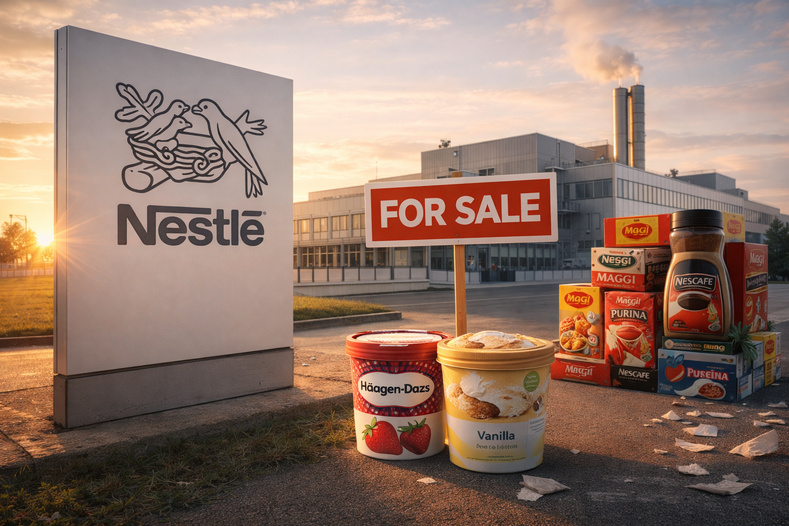
Nestlé delivered stronger-than-expected fourth-quarter sales growth while simultaneously unveiling a sharper strategic blueprint centered on divestments, operational streamlining and renewed focus on its most resilient global franchises. The performance, which exceeded market expectations, offers early validation of Chief Executive Philipp Navratil’s effort to recalibrate the world’s largest food and beverage company around fewer, higher-margin categories. Central to that recalibration is a plan to exit the remaining ice cream business and narrow corporate attention to coffee, petcare, nutrition, and core food and snack brands.
The dual announcement—solid top-line momentum and structural portfolio pruning—signals a deliberate pivot rather than incremental adjustment. In a consumer landscape defined by inflationary strain, private-label encroachment and shifting health preferences, Nestlé’s leadership appears intent on concentrating capital and management bandwidth where it sees sustainable pricing power and long-term growth visibility.
Organic sales growth of 4% in the final quarter surpassed expectations, suggesting that price discipline and brand strength offset pressure on volumes. Yet beneath the headline performance lies a more consequential transformation: a multinational conglomerate reducing complexity to accelerate execution and protect profitability in an era of cost volatility and geopolitical friction.
Portfolio Simplification as a Growth Lever
Nestlé’s decision to focus on four principal businesses—Coffee, Petcare, Nutrition, and Food & Snacks—reflects a broader industry trend toward specialization. Conglomerates that once thrived on diversification are increasingly judged on their ability to deliver category leadership and margin clarity. For Nestlé, whose portfolio spans everything from bottled water to frozen desserts, simplification is less about contraction and more about strategic coherence.
Coffee remains one of Nestlé’s most formidable franchises. Through brands such as Nescafé and Nespresso, the company commands global reach across premium and mass-market segments. Coffee’s resilience stems from habitual consumption and pricing elasticity; even during economic downturns, consumers tend to maintain daily rituals. Moreover, innovation in single-serve formats and sustainable sourcing has reinforced customer loyalty while supporting premium pricing.
Petcare, anchored by brands like Purina, has become one of Nestlé’s fastest-growing and highest-margin divisions. Rising pet ownership and the humanization of pets have driven demand for premium nutrition and specialized products. Unlike discretionary indulgences, pet food expenditures are relatively non-cyclical, providing earnings stability amid macroeconomic swings.
Nutrition—including infant formula and medical nutrition—remains strategically significant despite reputational setbacks tied to product recalls. The recent infant formula recall, one of the largest in the company’s history, temporarily disrupted volumes and strained brand perception. Yet demographic trends and increasing health awareness sustain long-term demand in the category. Nestlé’s commitment to restoring supply reliability and quality assurance underscores its intention to rebuild trust while preserving category leadership.
The Food & Snacks segment, encompassing iconic products such as Maggi and KitKat, offers global scale and adaptability. Reformulation efforts aimed at reducing sugar, salt and artificial additives align with regulatory pressure and evolving consumer expectations. By concentrating on these pillars, Nestlé aims to create a portfolio characterized by brand equity, defensible margins and scalable innovation.
Ice Cream Exit and Capital Reallocation
The proposed sale of Nestlé’s remaining ice cream business marks a decisive step in its portfolio overhaul. Ice cream, though historically profitable and globally recognized, presents structural challenges. Seasonality, cold-chain logistics and intense private-label competition compress margins relative to other categories. Furthermore, capital intensity in production and distribution can dilute returns compared with asset-light businesses such as coffee capsules or petcare formulations.
Negotiations to transfer the business to Froneri—an established joint venture player in the frozen dessert sector—signal a pragmatic assessment of competitive advantage. Froneri’s operational specialization in ice cream manufacturing and distribution allows Nestlé to monetize its stake while maintaining exposure through partnership structures, if desired.
Divesting ice cream aligns with Navratil’s emphasis on agility. Large conglomerates often struggle with slow decision-making across diverse divisions. By shedding lower-priority assets, management can redeploy capital toward innovation in core segments and digital transformation initiatives.
This divestment follows a broader review of vitamin, supplement and water businesses. Nestlé’s exploration of options for mainstream supplement brands and its plan to deconsolidate the waters division suggest a disciplined approach to portfolio management. Rather than retaining businesses for legacy reasons, the company appears prepared to reshape its footprint to meet future growth dynamics.
Margin Discipline in a Volatile Cost Environment
While revenue growth exceeded expectations, Nestlé continues to operate in a cost environment marked by commodity price fluctuations, currency volatility and trade policy uncertainty. Input costs for agricultural commodities, packaging materials and transportation remain elevated compared to pre-pandemic norms.
Navratil’s strategy includes workforce reductions—approximately 16,000 positions—to streamline operations and contain fixed expenses. Such restructuring initiatives aim to enhance efficiency without undermining innovation capacity. In global consumer goods companies, margin resilience often hinges on balancing scale economies with localized responsiveness.
Nestlé has projected an improvement in its underlying trading operating profit margin following a period of pressure. Achieving this will depend not only on pricing but also on productivity gains. Investments in digital supply chain management and predictive analytics are intended to reduce waste and optimize inventory turnover.
The company also faces the impact of U.S. import tariffs and foreign exchange swings. A multinational footprint exposes Nestlé to currency translation effects that can obscure underlying performance. By emphasizing organic sales—excluding currency and acquisition impacts—the company underscores the operational health of its core businesses.
Consumer Behavior and Brand Resilience
Consumer purchasing power remains under strain in many markets due to lingering inflation and uneven wage growth. In such conditions, branded food manufacturers must justify price increases through perceived quality and trust. Nestlé’s stronger-than-expected quarterly growth indicates that its brands retain pricing power, particularly in premium segments.
The company has adopted a calibrated pricing strategy, avoiding excessive hikes that risk volume erosion while leveraging innovation to sustain value perception. Limited-edition flavors, health-focused reformulations and sustainability commitments enhance brand differentiation.
Emerging markets remain critical growth engines. Rising urbanization and middle-class expansion in Asia, Africa and Latin America create opportunities for packaged foods and petcare expansion. Nestlé’s localized manufacturing footprint enables responsiveness to regional taste preferences while benefiting from global procurement scale.
At the same time, e-commerce and direct-to-consumer channels are reshaping distribution. Coffee capsules and specialized nutrition products lend themselves to subscription models, fostering recurring revenue streams. By focusing on categories suited to digital engagement, Nestlé enhances customer lifetime value.
Leadership Vision and Execution Imperatives
Navratil’s tenure began amid operational challenges and reputational headwinds. The infant formula recall tested supply chain resilience and public trust. Yet the current quarter’s performance suggests early traction in restoring operational discipline.
Sharpening focus is not merely a financial maneuver but a cultural signal. Large organizations often accumulate layers of complexity that impede speed. By narrowing strategic priorities, leadership aims to foster accountability and accelerate decision cycles.
Investors increasingly evaluate consumer goods companies on capital allocation rigor. Divestments, margin expansion targets and transparent guidance reinforce credibility. Nestlé’s forecast of 3–4% organic sales growth for the coming year reflects cautious optimism rather than exuberance, acknowledging macroeconomic uncertainty while signaling confidence in core demand drivers.
The combination of portfolio refinement and operational streamlining positions Nestlé to navigate structural shifts in food consumption. Health consciousness, sustainability concerns and premiumization trends are reshaping grocery aisles globally. Companies able to concentrate on high-growth niches while exiting commoditized segments may achieve more consistent returns.
Nestlé’s fourth-quarter outperformance thus represents more than a cyclical rebound. It marks an inflection in corporate direction—one defined by sharper category focus, capital redeployment and renewed emphasis on brand-led growth. By divesting ice cream and reassessing ancillary businesses, the company signals that scale alone is no longer sufficient. Strategic clarity and disciplined execution are becoming the defining metrics of competitiveness in the global packaged food industry.
(Source:www.usnews.com)
The dual announcement—solid top-line momentum and structural portfolio pruning—signals a deliberate pivot rather than incremental adjustment. In a consumer landscape defined by inflationary strain, private-label encroachment and shifting health preferences, Nestlé’s leadership appears intent on concentrating capital and management bandwidth where it sees sustainable pricing power and long-term growth visibility.
Organic sales growth of 4% in the final quarter surpassed expectations, suggesting that price discipline and brand strength offset pressure on volumes. Yet beneath the headline performance lies a more consequential transformation: a multinational conglomerate reducing complexity to accelerate execution and protect profitability in an era of cost volatility and geopolitical friction.
Portfolio Simplification as a Growth Lever
Nestlé’s decision to focus on four principal businesses—Coffee, Petcare, Nutrition, and Food & Snacks—reflects a broader industry trend toward specialization. Conglomerates that once thrived on diversification are increasingly judged on their ability to deliver category leadership and margin clarity. For Nestlé, whose portfolio spans everything from bottled water to frozen desserts, simplification is less about contraction and more about strategic coherence.
Coffee remains one of Nestlé’s most formidable franchises. Through brands such as Nescafé and Nespresso, the company commands global reach across premium and mass-market segments. Coffee’s resilience stems from habitual consumption and pricing elasticity; even during economic downturns, consumers tend to maintain daily rituals. Moreover, innovation in single-serve formats and sustainable sourcing has reinforced customer loyalty while supporting premium pricing.
Petcare, anchored by brands like Purina, has become one of Nestlé’s fastest-growing and highest-margin divisions. Rising pet ownership and the humanization of pets have driven demand for premium nutrition and specialized products. Unlike discretionary indulgences, pet food expenditures are relatively non-cyclical, providing earnings stability amid macroeconomic swings.
Nutrition—including infant formula and medical nutrition—remains strategically significant despite reputational setbacks tied to product recalls. The recent infant formula recall, one of the largest in the company’s history, temporarily disrupted volumes and strained brand perception. Yet demographic trends and increasing health awareness sustain long-term demand in the category. Nestlé’s commitment to restoring supply reliability and quality assurance underscores its intention to rebuild trust while preserving category leadership.
The Food & Snacks segment, encompassing iconic products such as Maggi and KitKat, offers global scale and adaptability. Reformulation efforts aimed at reducing sugar, salt and artificial additives align with regulatory pressure and evolving consumer expectations. By concentrating on these pillars, Nestlé aims to create a portfolio characterized by brand equity, defensible margins and scalable innovation.
Ice Cream Exit and Capital Reallocation
The proposed sale of Nestlé’s remaining ice cream business marks a decisive step in its portfolio overhaul. Ice cream, though historically profitable and globally recognized, presents structural challenges. Seasonality, cold-chain logistics and intense private-label competition compress margins relative to other categories. Furthermore, capital intensity in production and distribution can dilute returns compared with asset-light businesses such as coffee capsules or petcare formulations.
Negotiations to transfer the business to Froneri—an established joint venture player in the frozen dessert sector—signal a pragmatic assessment of competitive advantage. Froneri’s operational specialization in ice cream manufacturing and distribution allows Nestlé to monetize its stake while maintaining exposure through partnership structures, if desired.
Divesting ice cream aligns with Navratil’s emphasis on agility. Large conglomerates often struggle with slow decision-making across diverse divisions. By shedding lower-priority assets, management can redeploy capital toward innovation in core segments and digital transformation initiatives.
This divestment follows a broader review of vitamin, supplement and water businesses. Nestlé’s exploration of options for mainstream supplement brands and its plan to deconsolidate the waters division suggest a disciplined approach to portfolio management. Rather than retaining businesses for legacy reasons, the company appears prepared to reshape its footprint to meet future growth dynamics.
Margin Discipline in a Volatile Cost Environment
While revenue growth exceeded expectations, Nestlé continues to operate in a cost environment marked by commodity price fluctuations, currency volatility and trade policy uncertainty. Input costs for agricultural commodities, packaging materials and transportation remain elevated compared to pre-pandemic norms.
Navratil’s strategy includes workforce reductions—approximately 16,000 positions—to streamline operations and contain fixed expenses. Such restructuring initiatives aim to enhance efficiency without undermining innovation capacity. In global consumer goods companies, margin resilience often hinges on balancing scale economies with localized responsiveness.
Nestlé has projected an improvement in its underlying trading operating profit margin following a period of pressure. Achieving this will depend not only on pricing but also on productivity gains. Investments in digital supply chain management and predictive analytics are intended to reduce waste and optimize inventory turnover.
The company also faces the impact of U.S. import tariffs and foreign exchange swings. A multinational footprint exposes Nestlé to currency translation effects that can obscure underlying performance. By emphasizing organic sales—excluding currency and acquisition impacts—the company underscores the operational health of its core businesses.
Consumer Behavior and Brand Resilience
Consumer purchasing power remains under strain in many markets due to lingering inflation and uneven wage growth. In such conditions, branded food manufacturers must justify price increases through perceived quality and trust. Nestlé’s stronger-than-expected quarterly growth indicates that its brands retain pricing power, particularly in premium segments.
The company has adopted a calibrated pricing strategy, avoiding excessive hikes that risk volume erosion while leveraging innovation to sustain value perception. Limited-edition flavors, health-focused reformulations and sustainability commitments enhance brand differentiation.
Emerging markets remain critical growth engines. Rising urbanization and middle-class expansion in Asia, Africa and Latin America create opportunities for packaged foods and petcare expansion. Nestlé’s localized manufacturing footprint enables responsiveness to regional taste preferences while benefiting from global procurement scale.
At the same time, e-commerce and direct-to-consumer channels are reshaping distribution. Coffee capsules and specialized nutrition products lend themselves to subscription models, fostering recurring revenue streams. By focusing on categories suited to digital engagement, Nestlé enhances customer lifetime value.
Leadership Vision and Execution Imperatives
Navratil’s tenure began amid operational challenges and reputational headwinds. The infant formula recall tested supply chain resilience and public trust. Yet the current quarter’s performance suggests early traction in restoring operational discipline.
Sharpening focus is not merely a financial maneuver but a cultural signal. Large organizations often accumulate layers of complexity that impede speed. By narrowing strategic priorities, leadership aims to foster accountability and accelerate decision cycles.
Investors increasingly evaluate consumer goods companies on capital allocation rigor. Divestments, margin expansion targets and transparent guidance reinforce credibility. Nestlé’s forecast of 3–4% organic sales growth for the coming year reflects cautious optimism rather than exuberance, acknowledging macroeconomic uncertainty while signaling confidence in core demand drivers.
The combination of portfolio refinement and operational streamlining positions Nestlé to navigate structural shifts in food consumption. Health consciousness, sustainability concerns and premiumization trends are reshaping grocery aisles globally. Companies able to concentrate on high-growth niches while exiting commoditized segments may achieve more consistent returns.
Nestlé’s fourth-quarter outperformance thus represents more than a cyclical rebound. It marks an inflection in corporate direction—one defined by sharper category focus, capital redeployment and renewed emphasis on brand-led growth. By divesting ice cream and reassessing ancillary businesses, the company signals that scale alone is no longer sufficient. Strategic clarity and disciplined execution are becoming the defining metrics of competitiveness in the global packaged food industry.
(Source:www.usnews.com)
 Homepage
 Send to a friend
 Printable version
 Share
Share


