


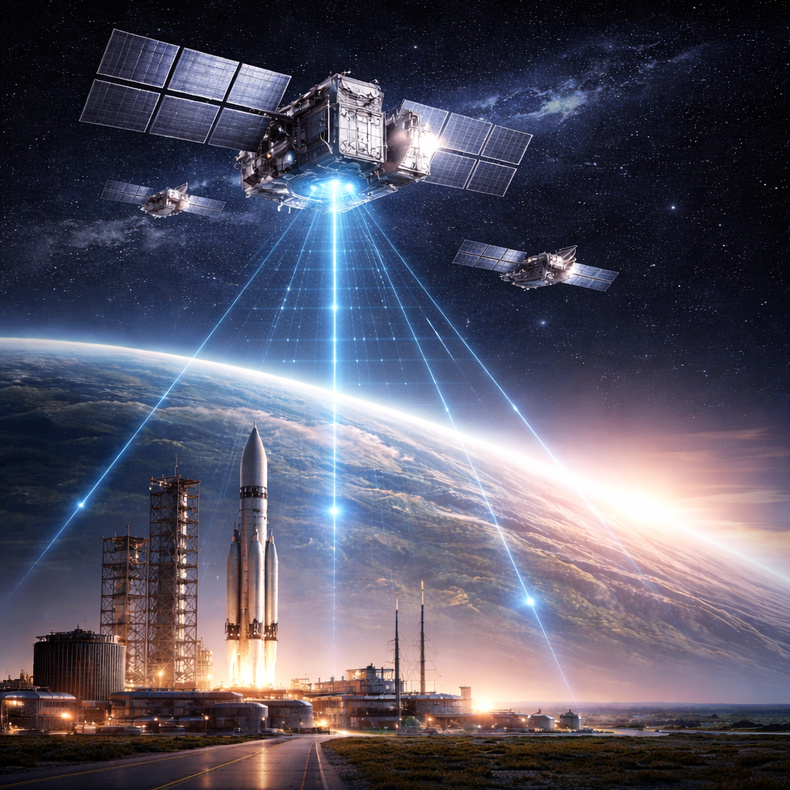
The merger of SpaceX and xAI marks more than a corporate restructuring. It signals an attempt to redraw the physical boundaries of digital infrastructure itself. By binding a rocket company to an artificial intelligence venture, Elon Musk is advancing a thesis that once belonged to science fiction: that the future scale of computing cannot be sustained on Earth alone, and that space will eventually become the natural home for the most energy-intensive forms of intelligence.
At its core, the deal reframes data centers not as static, terrestrial assets constrained by land, power grids, and climate, but as orbital systems designed to tap near-limitless solar energy and operate beyond the bottlenecks of Earth. The ambition is vast, speculative, and laden with risk. Yet it is precisely this willingness to absorb long-dated uncertainty that defines the strategic logic behind the merger.
Why AI Infrastructure Is Colliding With Physical Limits on Earth
The modern AI boom has transformed data centers from background utilities into central economic infrastructure. Training and running large AI models requires enormous amounts of electricity, cooling, land, and capital. As demand accelerates, the constraints are becoming more visible: strained power grids, water scarcity for cooling, regulatory resistance, and rising costs tied to geography.
These pressures have led technologists to confront a fundamental question. If computing demand continues to grow exponentially, where does the energy come from, and how is heat managed at scale? Incremental efficiency gains help, but they do not eliminate the structural mismatch between AI’s energy appetite and Earth’s finite infrastructure.
Musk’s answer pushes the problem outward rather than inward. Space offers continuous solar exposure, vast physical volume, and freedom from terrestrial land use conflicts. In this framework, Earth becomes the interface and demand center, while space becomes the engine room.
The Strategic Logic Behind Merging SpaceX and xAI
Individually, SpaceX and xAI serve different purposes. Together, they form a vertically integrated system that collapses what would otherwise be insurmountable coordination costs. SpaceX provides launch capacity, orbital manufacturing experience, satellite networking, and cost control. xAI supplies the demand driver: increasingly power-hungry artificial intelligence workloads.
The merger allows Musk to internalize the entire value chain. Rockets move hardware. Satellites host compute. Optical links transmit data. AI models consume it. This integration is essential because space-based data centers cannot be modular add-ons to existing systems. They require tight coupling between hardware design, launch cadence, power generation, thermal management, and software architecture.
By unifying these layers under one corporate structure, Musk is betting that the speed of iteration will outweigh the inefficiencies and risks of scale. It is a familiar playbook, seen previously in electric vehicles, reusable rockets, and satellite broadband.
Why Space Changes the Economics of Energy and Heat
The economic appeal of space-based data centers rests on two physics realities. First, solar energy in orbit is constant and intense. Unlike Earth, there is no night cycle, no weather, and no seasonal variation. Second, while space is a vacuum, it allows heat to be radiated directly without competing with atmospheric constraints or water availability.
On Earth, cooling is a major cost driver for AI infrastructure. In orbit, heat must still be managed, but the solution shifts from active cooling to radiative dissipation. Large radiator surfaces can shed thermal energy as infrared radiation, theoretically allowing continuous operation without water or refrigeration plants.
This does not make space cheap. Launch costs, materials, redundancy, and maintenance remain formidable. But Musk’s calculation hinges on trajectory rather than current prices. As launch frequency increases and hardware becomes more standardized, the cost curve may flatten in ways terrestrial infrastructure cannot replicate.
Why This Is Not Simply Science Fiction Anymore
Space-based computing has been discussed for decades, often dismissed as impractical. What has changed is not the underlying physics, but the economics of access to orbit. Reusable rockets, mass-produced satellites, and private capital have altered the feasibility frontier.
SpaceX’s experience deploying thousands of satellites has demonstrated that orbital infrastructure can be scaled industrially rather than artisanally. That capability underpins the credibility of far larger constellations designed not for communication, but for computation.
The merger also reflects a shift in how ambition is financed. Unlike government-led space programs constrained by political cycles, Musk’s ecosystem is funded by private capital willing to tolerate long payback periods. That financial patience is essential for projects whose returns may be measured in decades rather than quarters.
The Technical Barriers That Still Define the Timeline
Despite the vision, the obstacles remain severe. Radiation poses a constant threat to high-performance chips. While radiation-hardened components exist, they traditionally lag behind commercial chips in performance. Running cutting-edge AI workloads in orbit requires either new chip designs or sophisticated error correction that adds cost and complexity.
Cooling, while conceptually simpler in space, demands large radiators that increase mass and surface area. Every kilogram launched multiplies cost. Debris avoidance, orbital decay, and collision risk add operational uncertainty. Latency, while manageable for certain workloads, limits real-time applications.
These challenges explain why even optimistic projections place meaningful space-based data centers years away. The merger does not eliminate these constraints; it attempts to concentrate the resources needed to solve them incrementally.
Why Musk Is Willing to Bet on Time as the Missing Ingredient
What differentiates Musk’s approach is his willingness to treat time as a strategic asset. He has repeatedly pursued projects that appeared economically irrational at the outset but became viable through persistence, scale, and learning effects. Reusable rockets were once dismissed as impractical. Satellite broadband was seen as niche. Electric vehicles were viewed as marginal.
Space-based AI fits this pattern. The initial use cases may be narrow—training non-latency-sensitive models, experimental workloads, or overflow compute during peak demand. Over time, as reliability improves and costs fall, the scope expands.
The merger allows Musk to align incentives across that timeline. Losses in one area can be subsidized by gains in another, buying time for the ecosystem to mature.
If successful, space-based computing would alter the geography of digital power. Data centers would no longer cluster around cheap land and electricity, but around orbital logistics and transmission pathways. Energy constraints would shift from local grids to launch capacity. The bottleneck would move from real estate to orbital slots.
This reframing has implications beyond Musk’s companies. It challenges governments, utilities, and cloud providers to rethink long-term infrastructure planning. Even if space-based data centers remain niche, their existence could reshape expectations about scale and resilience.
A Bet on Systems, Not Single Technologies
Ultimately, the merger is less about a single breakthrough than about systems thinking. Musk is not claiming that one invention will unlock space-based AI. He is assembling a platform in which multiple incremental advances compound over time.
That makes the bet difficult to model and easy to dismiss. The financial returns are uncertain, the technical risks high, and the timeline long. Yet the logic is internally consistent: if intelligence continues to demand more energy than Earth can comfortably supply, expansion into space becomes not an indulgence, but a necessity.
By merging SpaceX and xAI, Musk is positioning himself not just as a builder of companies, but as an architect of where intelligence itself might live.
(Source:www.aljazeera.com)
At its core, the deal reframes data centers not as static, terrestrial assets constrained by land, power grids, and climate, but as orbital systems designed to tap near-limitless solar energy and operate beyond the bottlenecks of Earth. The ambition is vast, speculative, and laden with risk. Yet it is precisely this willingness to absorb long-dated uncertainty that defines the strategic logic behind the merger.
Why AI Infrastructure Is Colliding With Physical Limits on Earth
The modern AI boom has transformed data centers from background utilities into central economic infrastructure. Training and running large AI models requires enormous amounts of electricity, cooling, land, and capital. As demand accelerates, the constraints are becoming more visible: strained power grids, water scarcity for cooling, regulatory resistance, and rising costs tied to geography.
These pressures have led technologists to confront a fundamental question. If computing demand continues to grow exponentially, where does the energy come from, and how is heat managed at scale? Incremental efficiency gains help, but they do not eliminate the structural mismatch between AI’s energy appetite and Earth’s finite infrastructure.
Musk’s answer pushes the problem outward rather than inward. Space offers continuous solar exposure, vast physical volume, and freedom from terrestrial land use conflicts. In this framework, Earth becomes the interface and demand center, while space becomes the engine room.
The Strategic Logic Behind Merging SpaceX and xAI
Individually, SpaceX and xAI serve different purposes. Together, they form a vertically integrated system that collapses what would otherwise be insurmountable coordination costs. SpaceX provides launch capacity, orbital manufacturing experience, satellite networking, and cost control. xAI supplies the demand driver: increasingly power-hungry artificial intelligence workloads.
The merger allows Musk to internalize the entire value chain. Rockets move hardware. Satellites host compute. Optical links transmit data. AI models consume it. This integration is essential because space-based data centers cannot be modular add-ons to existing systems. They require tight coupling between hardware design, launch cadence, power generation, thermal management, and software architecture.
By unifying these layers under one corporate structure, Musk is betting that the speed of iteration will outweigh the inefficiencies and risks of scale. It is a familiar playbook, seen previously in electric vehicles, reusable rockets, and satellite broadband.
Why Space Changes the Economics of Energy and Heat
The economic appeal of space-based data centers rests on two physics realities. First, solar energy in orbit is constant and intense. Unlike Earth, there is no night cycle, no weather, and no seasonal variation. Second, while space is a vacuum, it allows heat to be radiated directly without competing with atmospheric constraints or water availability.
On Earth, cooling is a major cost driver for AI infrastructure. In orbit, heat must still be managed, but the solution shifts from active cooling to radiative dissipation. Large radiator surfaces can shed thermal energy as infrared radiation, theoretically allowing continuous operation without water or refrigeration plants.
This does not make space cheap. Launch costs, materials, redundancy, and maintenance remain formidable. But Musk’s calculation hinges on trajectory rather than current prices. As launch frequency increases and hardware becomes more standardized, the cost curve may flatten in ways terrestrial infrastructure cannot replicate.
Why This Is Not Simply Science Fiction Anymore
Space-based computing has been discussed for decades, often dismissed as impractical. What has changed is not the underlying physics, but the economics of access to orbit. Reusable rockets, mass-produced satellites, and private capital have altered the feasibility frontier.
SpaceX’s experience deploying thousands of satellites has demonstrated that orbital infrastructure can be scaled industrially rather than artisanally. That capability underpins the credibility of far larger constellations designed not for communication, but for computation.
The merger also reflects a shift in how ambition is financed. Unlike government-led space programs constrained by political cycles, Musk’s ecosystem is funded by private capital willing to tolerate long payback periods. That financial patience is essential for projects whose returns may be measured in decades rather than quarters.
The Technical Barriers That Still Define the Timeline
Despite the vision, the obstacles remain severe. Radiation poses a constant threat to high-performance chips. While radiation-hardened components exist, they traditionally lag behind commercial chips in performance. Running cutting-edge AI workloads in orbit requires either new chip designs or sophisticated error correction that adds cost and complexity.
Cooling, while conceptually simpler in space, demands large radiators that increase mass and surface area. Every kilogram launched multiplies cost. Debris avoidance, orbital decay, and collision risk add operational uncertainty. Latency, while manageable for certain workloads, limits real-time applications.
These challenges explain why even optimistic projections place meaningful space-based data centers years away. The merger does not eliminate these constraints; it attempts to concentrate the resources needed to solve them incrementally.
Why Musk Is Willing to Bet on Time as the Missing Ingredient
What differentiates Musk’s approach is his willingness to treat time as a strategic asset. He has repeatedly pursued projects that appeared economically irrational at the outset but became viable through persistence, scale, and learning effects. Reusable rockets were once dismissed as impractical. Satellite broadband was seen as niche. Electric vehicles were viewed as marginal.
Space-based AI fits this pattern. The initial use cases may be narrow—training non-latency-sensitive models, experimental workloads, or overflow compute during peak demand. Over time, as reliability improves and costs fall, the scope expands.
The merger allows Musk to align incentives across that timeline. Losses in one area can be subsidized by gains in another, buying time for the ecosystem to mature.
If successful, space-based computing would alter the geography of digital power. Data centers would no longer cluster around cheap land and electricity, but around orbital logistics and transmission pathways. Energy constraints would shift from local grids to launch capacity. The bottleneck would move from real estate to orbital slots.
This reframing has implications beyond Musk’s companies. It challenges governments, utilities, and cloud providers to rethink long-term infrastructure planning. Even if space-based data centers remain niche, their existence could reshape expectations about scale and resilience.
A Bet on Systems, Not Single Technologies
Ultimately, the merger is less about a single breakthrough than about systems thinking. Musk is not claiming that one invention will unlock space-based AI. He is assembling a platform in which multiple incremental advances compound over time.
That makes the bet difficult to model and easy to dismiss. The financial returns are uncertain, the technical risks high, and the timeline long. Yet the logic is internally consistent: if intelligence continues to demand more energy than Earth can comfortably supply, expansion into space becomes not an indulgence, but a necessity.
By merging SpaceX and xAI, Musk is positioning himself not just as a builder of companies, but as an architect of where intelligence itself might live.
(Source:www.aljazeera.com)
 Homepage
 Send to a friend
 Printable version
 Share
Share


