


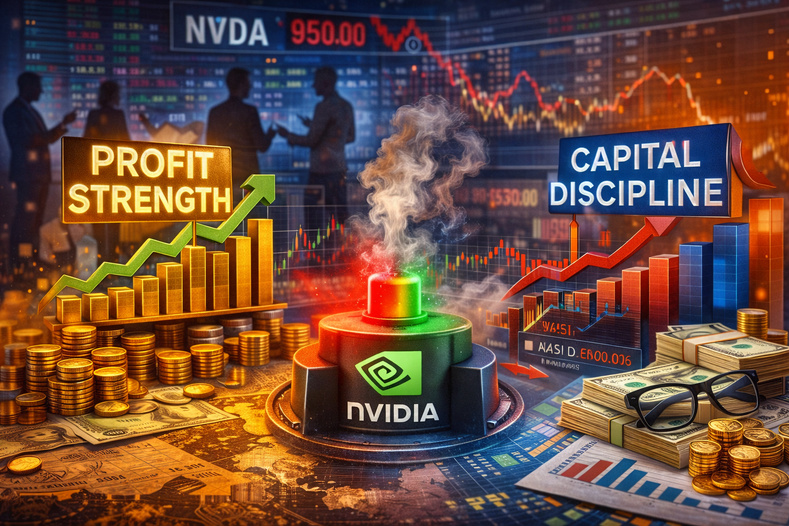
Nvidia once again delivered financial results that surpassed Wall Street expectations, extending a streak of quarterly outperformance that has come to define the artificial intelligence era. Revenue surged, guidance exceeded consensus forecasts and demand for its data-center processors remained robust. Yet the market reaction was muted. For a company that has become synonymous with AI’s explosive growth, strong numbers alone are no longer sufficient. Investors are increasingly focused on how Nvidia deploys the immense cash it generates—and whether shareholders will see more direct returns.
The earnings report highlighted a central tension: Nvidia is producing extraordinary cash flows from the AI buildout, but management remains committed to reinvesting aggressively rather than expanding capital return programs. That strategic choice has prompted fresh debate over whether the company should pivot from pure growth mode toward a more balanced capital allocation framework.
The quarter reinforced Nvidia’s dominance in AI infrastructure. It also underscored the evolving expectations of a market that now demands not only growth but also disciplined financial stewardship.
AI Demand Remains Relentless
Nvidia’s revenue growth was propelled primarily by its data-center segment, which has become the company’s financial engine. The proliferation of generative AI models, large language models and machine-learning workloads has fueled unprecedented demand for high-performance graphics processing units and AI accelerators.
Cloud hyperscalers—including major technology platforms—continue to expand capital expenditure budgets to build AI-ready data centers. These facilities rely heavily on Nvidia’s advanced processors, networking components and software ecosystem. The company’s January-quarter revenue growth, nearing a near-doubling year over year, reflected sustained investment from these customers.
Importantly, Nvidia projected current-quarter revenue above market estimates, signaling that order backlogs and customer commitments remain intact. Fears of an AI spending slowdown have not materialized in the numbers. Instead, enterprise adoption and hyperscale infrastructure expansion appear to be broadening.
However, as Nvidia’s growth base expands, incremental beats must clear an ever-higher bar to excite investors. Markets accustomed to dramatic outperformance now view strong quarters as baseline expectations rather than catalysts.
Cash Generation and Shareholder Expectations
A focal point of post-earnings discussion was Nvidia’s growing cash balance and projected free cash flow. With billions flowing in each quarter, analysts questioned whether the company should increase share repurchases or dividends.
Management emphasized continued reinvestment in the AI ecosystem—expanding capacity, advancing chip architectures and strengthening software platforms. Chief executives have framed AI as a foundational shift in computing that demands sustained infrastructure buildout. From this perspective, capital allocated to research, manufacturing commitments and ecosystem development promises higher long-term returns than immediate shareholder distributions.
Yet Wall Street’s calculus is evolving. Nvidia’s stock has experienced periods of consolidation despite record earnings growth. Investors weighing valuation multiples may prefer a clearer pathway to returning capital, particularly as the company’s market capitalization has swelled.
Share buybacks can signal confidence and support earnings per share growth, while dividends attract income-focused investors. For a company transitioning from hypergrowth to scaled profitability, capital return policy becomes a strategic lever in shaping shareholder perception.
The debate reflects a broader lifecycle dynamic in technology firms. High-growth phases prioritize reinvestment; mature phases introduce balanced capital allocation. Nvidia’s leadership appears intent on prolonging the former.
Supply Chain Stability and Competitive Landscape
Beyond capital returns, Nvidia addressed concerns over supply constraints. As a fabless semiconductor company, it relies on manufacturing partners for chip production. Assurances that capacity is secured for upcoming quarters aimed to dispel worries that bottlenecks could curb revenue momentum.
The company acknowledged that certain segments, such as gaming, may face supply-related pressures. However, data-center output—the primary revenue driver—remains prioritized.
Competition is intensifying. Rival chipmakers are introducing advanced AI processors targeting Nvidia’s customer base. Simultaneously, large cloud providers are investing in in-house chip development to reduce dependency on third-party suppliers. Custom accelerators designed internally by major technology firms represent a strategic hedge against supplier concentration.
Despite these dynamics, Nvidia’s software ecosystem, including its CUDA platform and integrated development tools, continues to serve as a competitive moat. Customers benefit from mature libraries and optimized frameworks that streamline AI deployment.
Nevertheless, revenue concentration among a small group of hyperscalers introduces risk. A significant portion of sales is tied to a limited number of customers. Any moderation in their capital expenditure plans could materially affect growth trajectories.
Geopolitical and Regulatory Dimensions
Another element influencing Nvidia’s outlook is export regulation. Restrictions on advanced chip shipments to certain markets have reshaped global sales patterns. While limited licenses may permit selective exports, geopolitical constraints remain a variable in forecasting revenue.
The company’s current guidance excludes certain international sales categories, reflecting compliance with regulatory frameworks. As global semiconductor policy evolves, Nvidia’s ability to navigate export rules while sustaining growth will remain critical.
At the same time, AI has become a strategic priority for governments worldwide. Public and private investment into data infrastructure suggests sustained demand for high-performance computing. Nvidia’s role as a central supplier places it at the intersection of technological ambition and geopolitical policy.
Stock-Based Compensation and Talent Investment
Nvidia also signaled a willingness to incorporate stock-based compensation expenses into certain non-GAAP measures. The competition for AI engineers and researchers has intensified dramatically, and equity-based compensation remains a cornerstone of recruitment and retention strategies.
From a financial perspective, expanding compensation disclosures enhances transparency but may influence earnings comparisons. From a strategic standpoint, talent investment reinforces management’s argument that reinvestment is essential to maintaining leadership.
In a sector defined by rapid innovation cycles, human capital often proves as decisive as hardware capability. Nvidia’s prioritization of ecosystem expansion, research and workforce investment underscores its view that AI infrastructure buildout is still in early innings.
The company’s latest earnings demonstrate continued operational strength and sustained demand for its products. Yet the market’s tempered reaction illustrates a shift in investor priorities. Exceptional growth is now assumed; capital allocation discipline is the emerging differentiator. Whether Nvidia chooses to amplify shareholder returns or double down on infrastructure expansion will shape not only its stock trajectory but its long-term identity within the technology landscape.
(Source:www.nasdaq.com)
The earnings report highlighted a central tension: Nvidia is producing extraordinary cash flows from the AI buildout, but management remains committed to reinvesting aggressively rather than expanding capital return programs. That strategic choice has prompted fresh debate over whether the company should pivot from pure growth mode toward a more balanced capital allocation framework.
The quarter reinforced Nvidia’s dominance in AI infrastructure. It also underscored the evolving expectations of a market that now demands not only growth but also disciplined financial stewardship.
AI Demand Remains Relentless
Nvidia’s revenue growth was propelled primarily by its data-center segment, which has become the company’s financial engine. The proliferation of generative AI models, large language models and machine-learning workloads has fueled unprecedented demand for high-performance graphics processing units and AI accelerators.
Cloud hyperscalers—including major technology platforms—continue to expand capital expenditure budgets to build AI-ready data centers. These facilities rely heavily on Nvidia’s advanced processors, networking components and software ecosystem. The company’s January-quarter revenue growth, nearing a near-doubling year over year, reflected sustained investment from these customers.
Importantly, Nvidia projected current-quarter revenue above market estimates, signaling that order backlogs and customer commitments remain intact. Fears of an AI spending slowdown have not materialized in the numbers. Instead, enterprise adoption and hyperscale infrastructure expansion appear to be broadening.
However, as Nvidia’s growth base expands, incremental beats must clear an ever-higher bar to excite investors. Markets accustomed to dramatic outperformance now view strong quarters as baseline expectations rather than catalysts.
Cash Generation and Shareholder Expectations
A focal point of post-earnings discussion was Nvidia’s growing cash balance and projected free cash flow. With billions flowing in each quarter, analysts questioned whether the company should increase share repurchases or dividends.
Management emphasized continued reinvestment in the AI ecosystem—expanding capacity, advancing chip architectures and strengthening software platforms. Chief executives have framed AI as a foundational shift in computing that demands sustained infrastructure buildout. From this perspective, capital allocated to research, manufacturing commitments and ecosystem development promises higher long-term returns than immediate shareholder distributions.
Yet Wall Street’s calculus is evolving. Nvidia’s stock has experienced periods of consolidation despite record earnings growth. Investors weighing valuation multiples may prefer a clearer pathway to returning capital, particularly as the company’s market capitalization has swelled.
Share buybacks can signal confidence and support earnings per share growth, while dividends attract income-focused investors. For a company transitioning from hypergrowth to scaled profitability, capital return policy becomes a strategic lever in shaping shareholder perception.
The debate reflects a broader lifecycle dynamic in technology firms. High-growth phases prioritize reinvestment; mature phases introduce balanced capital allocation. Nvidia’s leadership appears intent on prolonging the former.
Supply Chain Stability and Competitive Landscape
Beyond capital returns, Nvidia addressed concerns over supply constraints. As a fabless semiconductor company, it relies on manufacturing partners for chip production. Assurances that capacity is secured for upcoming quarters aimed to dispel worries that bottlenecks could curb revenue momentum.
The company acknowledged that certain segments, such as gaming, may face supply-related pressures. However, data-center output—the primary revenue driver—remains prioritized.
Competition is intensifying. Rival chipmakers are introducing advanced AI processors targeting Nvidia’s customer base. Simultaneously, large cloud providers are investing in in-house chip development to reduce dependency on third-party suppliers. Custom accelerators designed internally by major technology firms represent a strategic hedge against supplier concentration.
Despite these dynamics, Nvidia’s software ecosystem, including its CUDA platform and integrated development tools, continues to serve as a competitive moat. Customers benefit from mature libraries and optimized frameworks that streamline AI deployment.
Nevertheless, revenue concentration among a small group of hyperscalers introduces risk. A significant portion of sales is tied to a limited number of customers. Any moderation in their capital expenditure plans could materially affect growth trajectories.
Geopolitical and Regulatory Dimensions
Another element influencing Nvidia’s outlook is export regulation. Restrictions on advanced chip shipments to certain markets have reshaped global sales patterns. While limited licenses may permit selective exports, geopolitical constraints remain a variable in forecasting revenue.
The company’s current guidance excludes certain international sales categories, reflecting compliance with regulatory frameworks. As global semiconductor policy evolves, Nvidia’s ability to navigate export rules while sustaining growth will remain critical.
At the same time, AI has become a strategic priority for governments worldwide. Public and private investment into data infrastructure suggests sustained demand for high-performance computing. Nvidia’s role as a central supplier places it at the intersection of technological ambition and geopolitical policy.
Stock-Based Compensation and Talent Investment
Nvidia also signaled a willingness to incorporate stock-based compensation expenses into certain non-GAAP measures. The competition for AI engineers and researchers has intensified dramatically, and equity-based compensation remains a cornerstone of recruitment and retention strategies.
From a financial perspective, expanding compensation disclosures enhances transparency but may influence earnings comparisons. From a strategic standpoint, talent investment reinforces management’s argument that reinvestment is essential to maintaining leadership.
In a sector defined by rapid innovation cycles, human capital often proves as decisive as hardware capability. Nvidia’s prioritization of ecosystem expansion, research and workforce investment underscores its view that AI infrastructure buildout is still in early innings.
The company’s latest earnings demonstrate continued operational strength and sustained demand for its products. Yet the market’s tempered reaction illustrates a shift in investor priorities. Exceptional growth is now assumed; capital allocation discipline is the emerging differentiator. Whether Nvidia chooses to amplify shareholder returns or double down on infrastructure expansion will shape not only its stock trajectory but its long-term identity within the technology landscape.
(Source:www.nasdaq.com)
 Homepage
 Send to a friend
 Printable version
 Share
Share


