


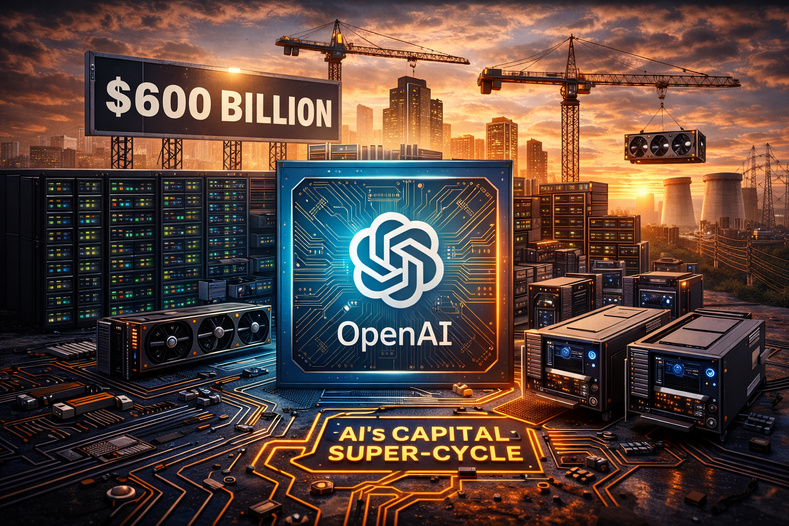
OpenAI’s expectation that it could spend roughly $600 billion on computing infrastructure through 2030 underscores a transformation that extends far beyond a single company’s balance sheet. The projected outlay reflects the escalating cost of training and running advanced artificial intelligence models, the intensifying competition for computing power, and the emergence of AI as a capital-intensive industrial sector comparable to energy or telecommunications.
The scale is unprecedented for a software-focused company. Traditionally, technology firms scaled through code, talent, and distribution. Artificial intelligence, particularly large-scale generative models, has shifted that paradigm. Performance gains are increasingly tied to the availability of high-end processors, expansive data centers, and massive energy consumption. Compute is no longer a supporting function; it is the core production input.
OpenAI’s reported 2025 revenue of $13 billion, exceeding internal projections, and its growing enterprise and consumer footprint illustrate the commercial traction behind these investments. Yet even strong revenue growth has not insulated the company from soaring costs. Spending on computing infrastructure is rising at a pace that requires continuous capital infusion and long-term planning.
The Economics of AI Scale
The economics driving such a projection are rooted in scaling laws. Advanced AI systems improve as they are trained on larger datasets using more powerful hardware. Each new generation of models demands exponentially greater computational resources. Training runs for frontier models require clusters of specialized graphics processing units and custom AI accelerators operating for weeks or months at a time.
Beyond training, inference—the process of running models in real time for users—has emerged as a significant cost center. As consumer adoption of AI assistants and enterprise integration expands, the computational load increases correspondingly. Serving millions of simultaneous users, each generating complex queries, consumes substantial processing capacity.
Reports that inference-related expenses quadrupled in a single year highlight the structural challenge. While gross margins may remain healthy compared to traditional heavy industries, they are narrower than in typical software-as-a-service models. The need to balance innovation with sustainable economics is central to OpenAI’s strategy.
The projected $600 billion figure likely encompasses a combination of capital expenditures, long-term cloud contracts, hardware procurement, and partnerships. It reflects cumulative compute investments rather than a single funding round. In this context, AI development begins to resemble infrastructure deployment rather than conventional software iteration.
Strategic Partnerships and Capital Flows
The anticipated compute spending aligns with a broader wave of investment in AI infrastructure. Nvidia’s reported multi-billion-dollar investment in OpenAI, alongside participation from other institutional backers, signals recognition that AI’s next phase demands unprecedented capital.
Microsoft’s longstanding partnership with OpenAI has already resulted in deep integration of AI capabilities across cloud services and productivity platforms. Cloud providers, semiconductor manufacturers, and hyperscale data center operators stand to benefit from sustained compute demand. The AI ecosystem is evolving into a vertically interconnected network, where hardware, software, and services reinforce one another.
OpenAI’s potential path toward a public offering further contextualizes the projected spending. A valuation approaching the upper tiers of global corporations would hinge on expectations of long-term dominance in foundational AI models. To justify such valuations, sustained investment in compute is not optional—it is foundational.
Altman’s earlier remarks about ambitions to build tens of gigawatts of computing capacity illustrate the magnitude of the vision. The reference to energy consumption equivalent to millions of homes underscores how AI is intersecting with power grids, renewable energy development, and national infrastructure planning.
Energy, Data Centers, and Geopolitical Stakes
Compute at this scale has implications beyond corporate finance. Data centers capable of supporting advanced AI models require vast quantities of electricity, sophisticated cooling systems, and strategic geographic placement. Regions with reliable energy supplies, favorable regulation, and stable connectivity become critical nodes in the AI supply chain.
Governments are increasingly viewing AI infrastructure as a matter of national competitiveness. Semiconductor supply chains, export controls on advanced chips, and incentives for domestic data center construction reflect this reality. The race for compute capacity intersects with geopolitical tensions, particularly as AI systems acquire economic and military relevance.
For OpenAI, ensuring access to sufficient hardware may involve diversification of suppliers and long-term procurement agreements. The concentration of advanced chip manufacturing in specific regions introduces risk. Building resilient infrastructure requires not only capital but also strategic alignment with hardware partners.
Environmental considerations also loom large. High-performance data centers consume significant energy and water resources. Companies investing at this scale must address sustainability, integrating renewable energy and efficiency improvements into expansion plans. The projected spending suggests that AI firms will become major stakeholders in energy markets and climate strategy.
Revenue Ambitions and Competitive Pressure
OpenAI’s expectation of more than $280 billion in cumulative revenue by 2030 reflects confidence in the monetization of AI across consumer and enterprise segments. Consumer subscriptions, enterprise licensing, API usage, and embedded AI services across industries form the revenue base.
Competition is intensifying. Rival technology giants and emerging startups are investing aggressively in proprietary models and infrastructure. Sustained compute investment becomes both a competitive moat and a necessity. Falling behind in model performance can erode market share rapidly in a field where innovation cycles are short.
The balancing act lies in maintaining gross margins while scaling capacity. If inference costs continue to rise faster than pricing power, profitability pressures could mount. Conversely, breakthroughs in hardware efficiency or algorithm optimization could moderate expenditure trajectories.
Investors evaluating long-term AI plays increasingly assess compute access as a leading indicator of strategic strength. The projected $600 billion outlay thus signals not only ambition but also recognition of the cost structure inherent in maintaining leadership at the frontier of AI research.
A New Industrial Model for Software
The magnitude of projected compute spending suggests that AI firms are transitioning into a hybrid model—part software company, part infrastructure operator. Traditional tech firms relied on scalable code and marginal-cost distribution. AI development introduces significant fixed costs tied to physical assets.
This shift may redefine how markets value technology companies. Capital intensity, once associated with manufacturing or utilities, is becoming characteristic of AI leaders. Debt financing, joint ventures, and long-term capital commitments may become more common.
For policymakers and regulators, the concentration of compute resources raises questions about market structure. Access to massive computational power could become a barrier to entry, entrenching leading firms. At the same time, collaborative initiatives and open research may counterbalance consolidation.
OpenAI’s projected $600 billion compute trajectory encapsulates the broader transformation of artificial intelligence from experimental software to foundational infrastructure. The numbers illustrate that AI’s promise is intertwined with physical capacity—chips, energy, data centers—and the financial systems required to sustain them. As the decade progresses, the interplay between capital investment, technological advancement, and competitive positioning will define the contours of this new industrial era.
(Source:www.business-standard.com)
The scale is unprecedented for a software-focused company. Traditionally, technology firms scaled through code, talent, and distribution. Artificial intelligence, particularly large-scale generative models, has shifted that paradigm. Performance gains are increasingly tied to the availability of high-end processors, expansive data centers, and massive energy consumption. Compute is no longer a supporting function; it is the core production input.
OpenAI’s reported 2025 revenue of $13 billion, exceeding internal projections, and its growing enterprise and consumer footprint illustrate the commercial traction behind these investments. Yet even strong revenue growth has not insulated the company from soaring costs. Spending on computing infrastructure is rising at a pace that requires continuous capital infusion and long-term planning.
The Economics of AI Scale
The economics driving such a projection are rooted in scaling laws. Advanced AI systems improve as they are trained on larger datasets using more powerful hardware. Each new generation of models demands exponentially greater computational resources. Training runs for frontier models require clusters of specialized graphics processing units and custom AI accelerators operating for weeks or months at a time.
Beyond training, inference—the process of running models in real time for users—has emerged as a significant cost center. As consumer adoption of AI assistants and enterprise integration expands, the computational load increases correspondingly. Serving millions of simultaneous users, each generating complex queries, consumes substantial processing capacity.
Reports that inference-related expenses quadrupled in a single year highlight the structural challenge. While gross margins may remain healthy compared to traditional heavy industries, they are narrower than in typical software-as-a-service models. The need to balance innovation with sustainable economics is central to OpenAI’s strategy.
The projected $600 billion figure likely encompasses a combination of capital expenditures, long-term cloud contracts, hardware procurement, and partnerships. It reflects cumulative compute investments rather than a single funding round. In this context, AI development begins to resemble infrastructure deployment rather than conventional software iteration.
Strategic Partnerships and Capital Flows
The anticipated compute spending aligns with a broader wave of investment in AI infrastructure. Nvidia’s reported multi-billion-dollar investment in OpenAI, alongside participation from other institutional backers, signals recognition that AI’s next phase demands unprecedented capital.
Microsoft’s longstanding partnership with OpenAI has already resulted in deep integration of AI capabilities across cloud services and productivity platforms. Cloud providers, semiconductor manufacturers, and hyperscale data center operators stand to benefit from sustained compute demand. The AI ecosystem is evolving into a vertically interconnected network, where hardware, software, and services reinforce one another.
OpenAI’s potential path toward a public offering further contextualizes the projected spending. A valuation approaching the upper tiers of global corporations would hinge on expectations of long-term dominance in foundational AI models. To justify such valuations, sustained investment in compute is not optional—it is foundational.
Altman’s earlier remarks about ambitions to build tens of gigawatts of computing capacity illustrate the magnitude of the vision. The reference to energy consumption equivalent to millions of homes underscores how AI is intersecting with power grids, renewable energy development, and national infrastructure planning.
Energy, Data Centers, and Geopolitical Stakes
Compute at this scale has implications beyond corporate finance. Data centers capable of supporting advanced AI models require vast quantities of electricity, sophisticated cooling systems, and strategic geographic placement. Regions with reliable energy supplies, favorable regulation, and stable connectivity become critical nodes in the AI supply chain.
Governments are increasingly viewing AI infrastructure as a matter of national competitiveness. Semiconductor supply chains, export controls on advanced chips, and incentives for domestic data center construction reflect this reality. The race for compute capacity intersects with geopolitical tensions, particularly as AI systems acquire economic and military relevance.
For OpenAI, ensuring access to sufficient hardware may involve diversification of suppliers and long-term procurement agreements. The concentration of advanced chip manufacturing in specific regions introduces risk. Building resilient infrastructure requires not only capital but also strategic alignment with hardware partners.
Environmental considerations also loom large. High-performance data centers consume significant energy and water resources. Companies investing at this scale must address sustainability, integrating renewable energy and efficiency improvements into expansion plans. The projected spending suggests that AI firms will become major stakeholders in energy markets and climate strategy.
Revenue Ambitions and Competitive Pressure
OpenAI’s expectation of more than $280 billion in cumulative revenue by 2030 reflects confidence in the monetization of AI across consumer and enterprise segments. Consumer subscriptions, enterprise licensing, API usage, and embedded AI services across industries form the revenue base.
Competition is intensifying. Rival technology giants and emerging startups are investing aggressively in proprietary models and infrastructure. Sustained compute investment becomes both a competitive moat and a necessity. Falling behind in model performance can erode market share rapidly in a field where innovation cycles are short.
The balancing act lies in maintaining gross margins while scaling capacity. If inference costs continue to rise faster than pricing power, profitability pressures could mount. Conversely, breakthroughs in hardware efficiency or algorithm optimization could moderate expenditure trajectories.
Investors evaluating long-term AI plays increasingly assess compute access as a leading indicator of strategic strength. The projected $600 billion outlay thus signals not only ambition but also recognition of the cost structure inherent in maintaining leadership at the frontier of AI research.
A New Industrial Model for Software
The magnitude of projected compute spending suggests that AI firms are transitioning into a hybrid model—part software company, part infrastructure operator. Traditional tech firms relied on scalable code and marginal-cost distribution. AI development introduces significant fixed costs tied to physical assets.
This shift may redefine how markets value technology companies. Capital intensity, once associated with manufacturing or utilities, is becoming characteristic of AI leaders. Debt financing, joint ventures, and long-term capital commitments may become more common.
For policymakers and regulators, the concentration of compute resources raises questions about market structure. Access to massive computational power could become a barrier to entry, entrenching leading firms. At the same time, collaborative initiatives and open research may counterbalance consolidation.
OpenAI’s projected $600 billion compute trajectory encapsulates the broader transformation of artificial intelligence from experimental software to foundational infrastructure. The numbers illustrate that AI’s promise is intertwined with physical capacity—chips, energy, data centers—and the financial systems required to sustain them. As the decade progresses, the interplay between capital investment, technological advancement, and competitive positioning will define the contours of this new industrial era.
(Source:www.business-standard.com)
 Homepage
 Send to a friend
 Printable version
 Share
Share


