


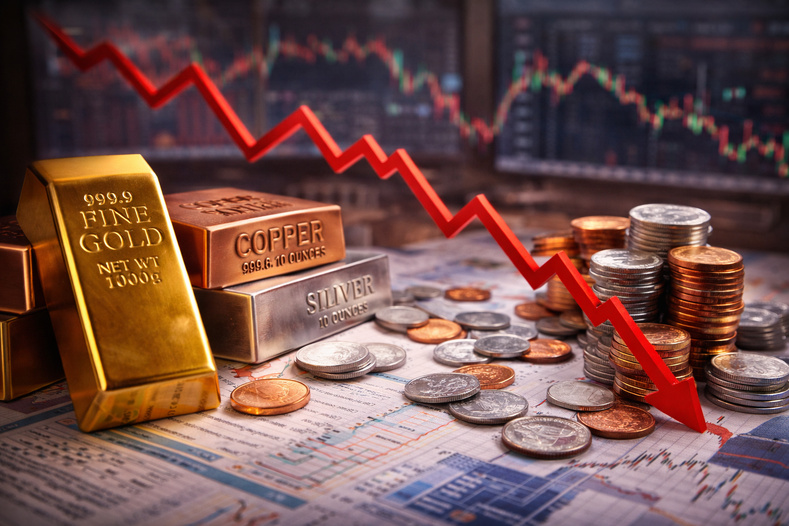
The sharp sell-off in gold, silver, and copper following a period of record-breaking gains has underscored a familiar but often forgotten truth about commodity markets: rallies driven by narrative and momentum can reverse abruptly when macro assumptions shift. What unfolded was not simply profit-taking at elevated levels, but a broader reassessment of risk as investors recalibrated expectations around interest rates, currency stability, and the durability of speculative inflows.
After weeks of near one-way moves higher, precious and industrial metals ran headlong into a change in sentiment. The trigger was not a single data point but the convergence of tightening financial expectations, thinner liquidity, and a renewed focus on fundamentals. Markets that had been pricing an almost frictionless path toward looser monetary policy were forced to confront the possibility that the easing cycle may be slower, more conditional, and less supportive of speculative excess than previously assumed.
How speculative positioning stretched metals beyond fundamentals
The rally across metals in recent months was fueled less by immediate supply disruptions than by financial positioning. Gold and silver benefited from a powerful mix of inflation hedging, geopolitical anxiety, and expectations that U.S. interest rates would fall aggressively. Copper, meanwhile, rode a separate but overlapping wave tied to electrification, energy transition narratives, and optimism about medium-term demand growth.
As prices climbed, momentum-driven strategies amplified the move. Systematic funds, commodity trading advisors, and retail participants piled in as technical levels broke and headlines reinforced bullish conviction. In such environments, price discovery becomes distorted: liquidity thins, volatility compresses on the way up, and incremental buying has an outsized impact.
By the time gold and silver reached successive record highs, positioning had become crowded. The market’s sensitivity to any shift in macro signals was therefore acute. Once the narrative began to wobble, the same forces that had propelled prices higher accelerated the decline.
Interest rate expectations and the end of easy assumptions
At the core of the reversal was a change in how investors assessed the outlook for U.S. monetary policy. Metals, particularly gold and silver, are highly sensitive to real interest rates. Lower rates reduce the opportunity cost of holding non-yielding assets, while expectations of policy easing tend to weaken the dollar, further supporting dollar-denominated commodities.
Those assumptions were challenged when Donald Trump confirmed his intention to appoint Kevin Warsh to lead the Federal Reserve. Markets quickly interpreted the move as reducing the likelihood of rapid, politically driven rate cuts. Warsh’s reputation for balance-sheet discipline and institutional caution introduced doubt into what had become a near-consensus trade.
As expectations shifted, the U.S. dollar steadied and long-term yields edged higher. That combination proved toxic for metals priced for perfection. Even modest changes in rate expectations were enough to prompt large-scale unwinding of leveraged positions.
The dollar’s quiet role in amplifying the downturn
While the dollar did not surge dramatically, its stabilization was enough to alter the arithmetic for global buyers. A firmer dollar raises the effective cost of metals for non-U.S. investors, dampening marginal demand. More importantly, many trading strategies explicitly link commodity exposure to dollar momentum. When the currency stops weakening, automated models flip from buy to sell.
This dynamic is especially pronounced in precious metals, where financial demand often outweighs physical consumption in the short term. As the dollar found its footing, gold and silver lost a key pillar of support, exposing how reliant recent gains had been on currency weakness rather than underlying demand.
Gold and silver’s decline was notable not only for its speed but for its scale. After weeks of relentless advances, the abrupt correction served as a reminder that these markets are not linear hedges but volatile assets subject to speculative cycles.
The pullback reflected a classic late-stage rally pattern. Thin liquidity, fear of missing out, and extrapolation of macro trends had pushed prices well ahead of incremental changes in fundamentals. Once early sellers emerged, stop-losses were triggered and margin calls followed, reinforcing downward momentum.
For long-term investors, the correction did not invalidate the strategic case for holding precious metals. However, it did expose the vulnerability of short-term positioning built on the assumption that central banks would always err on the side of stimulus.
Copper and the limits of the growth narrative
Copper’s retreat followed a slightly different logic. Unlike gold and silver, copper is deeply tied to industrial activity and global growth expectations. Its rally had been supported by optimism around infrastructure spending, electrification, and constrained mine supply. Yet even here, financial flows played an outsized role.
As prices reached record territory, questions resurfaced about near-term demand, particularly from China, the world’s largest consumer of industrial metals. Seasonal factors, including reduced trading ahead of major holidays, further reduced liquidity. In such conditions, traders became reluctant to carry large positions through periods of heightened uncertainty.
The result was a pullback that reflected risk management rather than a wholesale reassessment of copper’s long-term outlook. Still, the move highlighted how vulnerable even structurally bullish markets can be when prices run ahead of immediate consumption trends.
Volatility returns as markets relearn discipline
What united the sell-off across metals was not panic but recalibration. Investors were forced to reconcile lofty prices with a macro environment that no longer guaranteed abundant liquidity. The notion that policy easing would automatically cushion every asset class gave way to a more selective view of risk.
This shift matters because it reintroduces volatility as a disciplining force. When markets believe downside is limited, leverage increases and price signals become distorted. Corrections, while painful, restore a measure of balance by flushing out excess and refocusing attention on fundamentals.
For commodities, that process often unfolds quickly. Unlike equities, which can absorb valuation shifts over time, futures markets adjust almost instantly as positions are rolled, reduced, or reversed.
What the correction signals going forward
The tumble in gold, silver, and copper does not mark the end of their broader relevance in portfolios. Instead, it signals a transition from narrative-driven momentum to a more discriminating phase. Investors are likely to demand clearer confirmation on inflation trajectories, policy paths, and real economic demand before re-engaging aggressively.
In that sense, the episode reflects maturity rather than collapse. Markets that rediscover gravity do not necessarily fall apart; they reset. For metals, the reset comes with a reminder that even in an era of uncertainty, price still matters—and so does the path by which it is reached.
(Source:www.investing.com)
After weeks of near one-way moves higher, precious and industrial metals ran headlong into a change in sentiment. The trigger was not a single data point but the convergence of tightening financial expectations, thinner liquidity, and a renewed focus on fundamentals. Markets that had been pricing an almost frictionless path toward looser monetary policy were forced to confront the possibility that the easing cycle may be slower, more conditional, and less supportive of speculative excess than previously assumed.
How speculative positioning stretched metals beyond fundamentals
The rally across metals in recent months was fueled less by immediate supply disruptions than by financial positioning. Gold and silver benefited from a powerful mix of inflation hedging, geopolitical anxiety, and expectations that U.S. interest rates would fall aggressively. Copper, meanwhile, rode a separate but overlapping wave tied to electrification, energy transition narratives, and optimism about medium-term demand growth.
As prices climbed, momentum-driven strategies amplified the move. Systematic funds, commodity trading advisors, and retail participants piled in as technical levels broke and headlines reinforced bullish conviction. In such environments, price discovery becomes distorted: liquidity thins, volatility compresses on the way up, and incremental buying has an outsized impact.
By the time gold and silver reached successive record highs, positioning had become crowded. The market’s sensitivity to any shift in macro signals was therefore acute. Once the narrative began to wobble, the same forces that had propelled prices higher accelerated the decline.
Interest rate expectations and the end of easy assumptions
At the core of the reversal was a change in how investors assessed the outlook for U.S. monetary policy. Metals, particularly gold and silver, are highly sensitive to real interest rates. Lower rates reduce the opportunity cost of holding non-yielding assets, while expectations of policy easing tend to weaken the dollar, further supporting dollar-denominated commodities.
Those assumptions were challenged when Donald Trump confirmed his intention to appoint Kevin Warsh to lead the Federal Reserve. Markets quickly interpreted the move as reducing the likelihood of rapid, politically driven rate cuts. Warsh’s reputation for balance-sheet discipline and institutional caution introduced doubt into what had become a near-consensus trade.
As expectations shifted, the U.S. dollar steadied and long-term yields edged higher. That combination proved toxic for metals priced for perfection. Even modest changes in rate expectations were enough to prompt large-scale unwinding of leveraged positions.
The dollar’s quiet role in amplifying the downturn
While the dollar did not surge dramatically, its stabilization was enough to alter the arithmetic for global buyers. A firmer dollar raises the effective cost of metals for non-U.S. investors, dampening marginal demand. More importantly, many trading strategies explicitly link commodity exposure to dollar momentum. When the currency stops weakening, automated models flip from buy to sell.
This dynamic is especially pronounced in precious metals, where financial demand often outweighs physical consumption in the short term. As the dollar found its footing, gold and silver lost a key pillar of support, exposing how reliant recent gains had been on currency weakness rather than underlying demand.
Gold and silver’s decline was notable not only for its speed but for its scale. After weeks of relentless advances, the abrupt correction served as a reminder that these markets are not linear hedges but volatile assets subject to speculative cycles.
The pullback reflected a classic late-stage rally pattern. Thin liquidity, fear of missing out, and extrapolation of macro trends had pushed prices well ahead of incremental changes in fundamentals. Once early sellers emerged, stop-losses were triggered and margin calls followed, reinforcing downward momentum.
For long-term investors, the correction did not invalidate the strategic case for holding precious metals. However, it did expose the vulnerability of short-term positioning built on the assumption that central banks would always err on the side of stimulus.
Copper and the limits of the growth narrative
Copper’s retreat followed a slightly different logic. Unlike gold and silver, copper is deeply tied to industrial activity and global growth expectations. Its rally had been supported by optimism around infrastructure spending, electrification, and constrained mine supply. Yet even here, financial flows played an outsized role.
As prices reached record territory, questions resurfaced about near-term demand, particularly from China, the world’s largest consumer of industrial metals. Seasonal factors, including reduced trading ahead of major holidays, further reduced liquidity. In such conditions, traders became reluctant to carry large positions through periods of heightened uncertainty.
The result was a pullback that reflected risk management rather than a wholesale reassessment of copper’s long-term outlook. Still, the move highlighted how vulnerable even structurally bullish markets can be when prices run ahead of immediate consumption trends.
Volatility returns as markets relearn discipline
What united the sell-off across metals was not panic but recalibration. Investors were forced to reconcile lofty prices with a macro environment that no longer guaranteed abundant liquidity. The notion that policy easing would automatically cushion every asset class gave way to a more selective view of risk.
This shift matters because it reintroduces volatility as a disciplining force. When markets believe downside is limited, leverage increases and price signals become distorted. Corrections, while painful, restore a measure of balance by flushing out excess and refocusing attention on fundamentals.
For commodities, that process often unfolds quickly. Unlike equities, which can absorb valuation shifts over time, futures markets adjust almost instantly as positions are rolled, reduced, or reversed.
What the correction signals going forward
The tumble in gold, silver, and copper does not mark the end of their broader relevance in portfolios. Instead, it signals a transition from narrative-driven momentum to a more discriminating phase. Investors are likely to demand clearer confirmation on inflation trajectories, policy paths, and real economic demand before re-engaging aggressively.
In that sense, the episode reflects maturity rather than collapse. Markets that rediscover gravity do not necessarily fall apart; they reset. For metals, the reset comes with a reminder that even in an era of uncertainty, price still matters—and so does the path by which it is reached.
(Source:www.investing.com)
 Homepage
 Send to a friend
 Printable version
 Share
Share


