


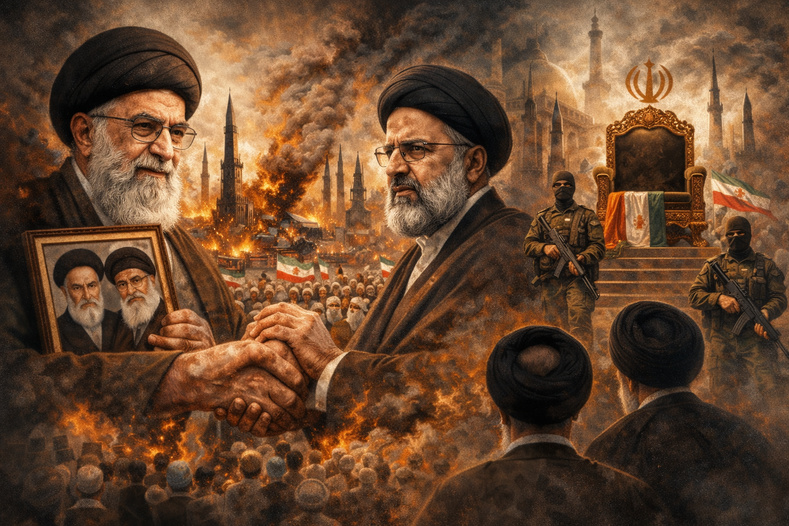
When the first wave of strikes hit Tehran and reports emerged that the Supreme Leader’s residence had been targeted, the shock reverberated far beyond Iran’s borders. Satellite imagery showed damage. Conflicting statements followed—relocation to a secure site, an imminent televised address, then silence. Hours later, confirmation arrived that Ayatollah Ali Khamenei had been killed.
For many observers, the moment appeared sudden and destabilizing. For Iran’s ruling establishment, however, it was the culmination of years of contingency planning. The Islamic Republic had long prepared for precisely such an extraordinary rupture: the loss of its most powerful figure at a time of external assault and internal strain.
The system’s central instinct was not improvisation, but continuity.
Institutionalizing Survival as Doctrine
Since its founding in 1979, the Islamic Republic has been built around a core principle—survival through layered authority. The office of the Supreme Leader stands at the apex, but it is supported by a dense architecture of institutions: the Assembly of Experts, the Guardian Council, the judiciary, the presidency, and, most critically, the Islamic Revolutionary Guard Corps (IRGC).
Over decades, Iran’s leadership internalized a recurring lesson: vulnerability invites intervention. The Iran-Iraq War in the 1980s, covert sabotage campaigns, sanctions regimes, assassinations of nuclear scientists, and cyberattacks all reinforced a belief that leadership decapitation was a plausible objective of adversaries.
As a result, succession planning was never theoretical. Reports had long indicated that Khamenei instructed the Assembly of Experts—an 88-member clerical body tasked with appointing the Supreme Leader—to be prepared for “every eventuality.” The aim was to avoid a power vacuum that could invite internal fragmentation or external exploitation.
In practical terms, this meant identifying clerics acceptable to the religious establishment, aligned with the security apparatus, and capable of projecting continuity. It also meant cultivating second-tier commanders within the IRGC and intelligence services who could assume operational control immediately if senior figures were eliminated.
The extraordinary moment unfolding after the strikes was therefore not merely a crisis; it was a test of a system deliberately engineered for resilience.
Lessons from the Twelve-Day War
The most concentrated rehearsal for this scenario occurred during a brief but intense conflict the previous year. In that confrontation, Israeli operations reportedly killed multiple senior commanders and nuclear scientists within days. The rapid loss of high-ranking personnel exposed the vulnerability of visible leadership structures.
The response was swift. Command chains were adjusted. Decentralized communication networks were reinforced. Senior officials reportedly rotated sleeping locations and relied more heavily on underground facilities. Public visibility was reduced. Strategic authority became more compartmentalized.
Crucially, Khamenei himself was said to have drawn up contingency lists of officials prepared to step into key roles without delay. The objective was psychological as much as operational: to signal that leadership could regenerate faster than adversaries could eliminate it.
This doctrine extended beyond the clerical elite. The IRGC, whose economic and military footprint spans missile forces, naval units, and overseas proxy networks, was positioned as the guarantor of stability. Even if the symbolic head of the state were removed, the coercive core would remain intact.
The recent strikes, devastating as they were, did not catch the system unprepared. They activated mechanisms long rehearsed.
Messaging, Morale and Managed Perception
In the immediate aftermath of confirmation of Khamenei’s death, state media emphasized composure and order. Official statements underscored that constitutional procedures would guide succession. Senior commanders appeared in coordinated broadcasts. The message was unmistakable: authority remained centralized, retaliation was calibrated, and governance structures were functioning.
This was not solely outward-facing propaganda. It was also directed inward—toward bureaucrats, security personnel, and provincial officials whose loyalty depends on confidence in continuity.
At the same time, images circulated of celebrations in parts of Tehran and other cities. For years, segments of the population had expressed frustration over economic hardship, social restrictions, and crackdowns on dissent. The death of a long-serving leader inevitably triggers mixed reactions in societies marked by polarization.
Yet Iran’s leadership anticipated this dynamic. Over time, it had fused political legitimacy less with personal charisma and more with institutional durability. The Supreme Leader embodied the revolution, but the revolution’s machinery extended far beyond any individual.
In this sense, the extraordinary moment was framed domestically not as collapse, but as transition within a fortified system.
The Strategic Rationale Behind Preparedness
Iran’s preparation for leadership decapitation reflects its broader strategic culture. The state has long relied on asymmetric tools—ballistic missiles, drone fleets, maritime harassment capabilities, and a network of allied militias across Lebanon, Iraq, Syria, and Yemen. These assets are structured to operate semi-independently, ensuring that pressure in one theater does not paralyze the entire apparatus.
Similarly, the succession framework aims to prevent a single strike from unraveling governance. The Assembly of Experts can convene rapidly. Interim arrangements can be implemented while deliberations proceed. Clerical legitimacy, though contested in parts of society, remains embedded within the constitutional order.
Even speculation over potential successors—including figures within Khamenei’s close circle or respected senior clerics—had circulated for years. That visibility was not accidental; it familiarized elites with plausible outcomes and reduced the shock factor.
Externally, Iran has often signaled that attempts to destabilize its leadership would not produce capitulation. By preparing for the extraordinary, it sought to deny adversaries the strategic reward of chaos.
Continuity Amid Unfinished Conflict
The removal of a Supreme Leader in the midst of military confrontation might appear to invite disorder. Yet Iran’s planners understood that such a scenario was conceivable precisely because tensions with Israel and the United States had intensified.
From Tehran’s perspective, preparation served both deterrent and defensive functions. If adversaries believed that decapitation would fracture the state, the incentive to pursue it would grow. Demonstrating readiness aimed to blunt that calculation.
The conflict now unfolding remains volatile. Missile exchanges, cyber operations, and proxy actions continue to shape a shifting battlefield. But inside Iran, the overriding objective is clear: prevent external pressure from translating into internal fragmentation.
In the coming period, the selection of a successor will be scrutinized for signs of policy shift or ideological recalibration. Yet regardless of personality, the structural priorities of the Islamic Republic—sovereignty, deterrence, and preservation of clerical authority—are unlikely to change abruptly.
The extraordinary moment that followed the strikes did not emerge from improvisation. It arose within a system that had long anticipated the possibility that its highest office could be targeted. Preparedness was not an afterthought; it was doctrine.
By embedding succession into institutional design and reinforcing security layers across military and political spheres, Iran positioned itself to endure the unthinkable. In that sense, the confirmation of Khamenei’s death was less a rupture than a stress test—one that the Islamic Republic had spent years preparing to confront.
(Source:www.bbc.com)
For many observers, the moment appeared sudden and destabilizing. For Iran’s ruling establishment, however, it was the culmination of years of contingency planning. The Islamic Republic had long prepared for precisely such an extraordinary rupture: the loss of its most powerful figure at a time of external assault and internal strain.
The system’s central instinct was not improvisation, but continuity.
Institutionalizing Survival as Doctrine
Since its founding in 1979, the Islamic Republic has been built around a core principle—survival through layered authority. The office of the Supreme Leader stands at the apex, but it is supported by a dense architecture of institutions: the Assembly of Experts, the Guardian Council, the judiciary, the presidency, and, most critically, the Islamic Revolutionary Guard Corps (IRGC).
Over decades, Iran’s leadership internalized a recurring lesson: vulnerability invites intervention. The Iran-Iraq War in the 1980s, covert sabotage campaigns, sanctions regimes, assassinations of nuclear scientists, and cyberattacks all reinforced a belief that leadership decapitation was a plausible objective of adversaries.
As a result, succession planning was never theoretical. Reports had long indicated that Khamenei instructed the Assembly of Experts—an 88-member clerical body tasked with appointing the Supreme Leader—to be prepared for “every eventuality.” The aim was to avoid a power vacuum that could invite internal fragmentation or external exploitation.
In practical terms, this meant identifying clerics acceptable to the religious establishment, aligned with the security apparatus, and capable of projecting continuity. It also meant cultivating second-tier commanders within the IRGC and intelligence services who could assume operational control immediately if senior figures were eliminated.
The extraordinary moment unfolding after the strikes was therefore not merely a crisis; it was a test of a system deliberately engineered for resilience.
Lessons from the Twelve-Day War
The most concentrated rehearsal for this scenario occurred during a brief but intense conflict the previous year. In that confrontation, Israeli operations reportedly killed multiple senior commanders and nuclear scientists within days. The rapid loss of high-ranking personnel exposed the vulnerability of visible leadership structures.
The response was swift. Command chains were adjusted. Decentralized communication networks were reinforced. Senior officials reportedly rotated sleeping locations and relied more heavily on underground facilities. Public visibility was reduced. Strategic authority became more compartmentalized.
Crucially, Khamenei himself was said to have drawn up contingency lists of officials prepared to step into key roles without delay. The objective was psychological as much as operational: to signal that leadership could regenerate faster than adversaries could eliminate it.
This doctrine extended beyond the clerical elite. The IRGC, whose economic and military footprint spans missile forces, naval units, and overseas proxy networks, was positioned as the guarantor of stability. Even if the symbolic head of the state were removed, the coercive core would remain intact.
The recent strikes, devastating as they were, did not catch the system unprepared. They activated mechanisms long rehearsed.
Messaging, Morale and Managed Perception
In the immediate aftermath of confirmation of Khamenei’s death, state media emphasized composure and order. Official statements underscored that constitutional procedures would guide succession. Senior commanders appeared in coordinated broadcasts. The message was unmistakable: authority remained centralized, retaliation was calibrated, and governance structures were functioning.
This was not solely outward-facing propaganda. It was also directed inward—toward bureaucrats, security personnel, and provincial officials whose loyalty depends on confidence in continuity.
At the same time, images circulated of celebrations in parts of Tehran and other cities. For years, segments of the population had expressed frustration over economic hardship, social restrictions, and crackdowns on dissent. The death of a long-serving leader inevitably triggers mixed reactions in societies marked by polarization.
Yet Iran’s leadership anticipated this dynamic. Over time, it had fused political legitimacy less with personal charisma and more with institutional durability. The Supreme Leader embodied the revolution, but the revolution’s machinery extended far beyond any individual.
In this sense, the extraordinary moment was framed domestically not as collapse, but as transition within a fortified system.
The Strategic Rationale Behind Preparedness
Iran’s preparation for leadership decapitation reflects its broader strategic culture. The state has long relied on asymmetric tools—ballistic missiles, drone fleets, maritime harassment capabilities, and a network of allied militias across Lebanon, Iraq, Syria, and Yemen. These assets are structured to operate semi-independently, ensuring that pressure in one theater does not paralyze the entire apparatus.
Similarly, the succession framework aims to prevent a single strike from unraveling governance. The Assembly of Experts can convene rapidly. Interim arrangements can be implemented while deliberations proceed. Clerical legitimacy, though contested in parts of society, remains embedded within the constitutional order.
Even speculation over potential successors—including figures within Khamenei’s close circle or respected senior clerics—had circulated for years. That visibility was not accidental; it familiarized elites with plausible outcomes and reduced the shock factor.
Externally, Iran has often signaled that attempts to destabilize its leadership would not produce capitulation. By preparing for the extraordinary, it sought to deny adversaries the strategic reward of chaos.
Continuity Amid Unfinished Conflict
The removal of a Supreme Leader in the midst of military confrontation might appear to invite disorder. Yet Iran’s planners understood that such a scenario was conceivable precisely because tensions with Israel and the United States had intensified.
From Tehran’s perspective, preparation served both deterrent and defensive functions. If adversaries believed that decapitation would fracture the state, the incentive to pursue it would grow. Demonstrating readiness aimed to blunt that calculation.
The conflict now unfolding remains volatile. Missile exchanges, cyber operations, and proxy actions continue to shape a shifting battlefield. But inside Iran, the overriding objective is clear: prevent external pressure from translating into internal fragmentation.
In the coming period, the selection of a successor will be scrutinized for signs of policy shift or ideological recalibration. Yet regardless of personality, the structural priorities of the Islamic Republic—sovereignty, deterrence, and preservation of clerical authority—are unlikely to change abruptly.
The extraordinary moment that followed the strikes did not emerge from improvisation. It arose within a system that had long anticipated the possibility that its highest office could be targeted. Preparedness was not an afterthought; it was doctrine.
By embedding succession into institutional design and reinforcing security layers across military and political spheres, Iran positioned itself to endure the unthinkable. In that sense, the confirmation of Khamenei’s death was less a rupture than a stress test—one that the Islamic Republic had spent years preparing to confront.
(Source:www.bbc.com)
 Homepage
 Send to a friend
 Printable version
 Share
Share


