


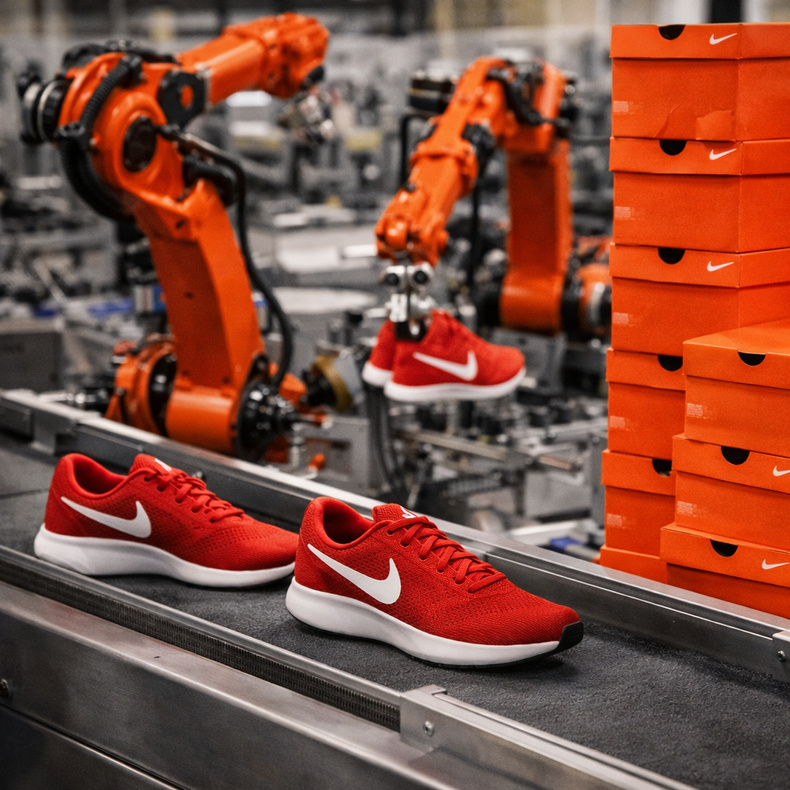
Nike’s decision to eliminate 775 jobs in the United States reflects a deliberate recalibration of how the company intends to operate in a slower, more competitive global sportswear market. Rather than treating the layoffs as a one-off response to weak sales, the move signals a deeper strategic pivot toward automation, cost discipline, and operational speed. At a time when revenue growth has lagged historical norms and margins have come under sustained pressure, Nike is repositioning its distribution backbone to support profitability rather than scale for its own sake.
The concentration of job cuts in U.S. distribution centers underscores where management believes the greatest efficiency gains can be achieved quickly. Warehousing and fulfillment, once built around labor-intensive models designed for peak volumes, are being redesigned around technology that promises flexibility, precision, and lower long-term costs. The layoffs therefore sit at the intersection of financial necessity and technological opportunity, forming a cornerstone of Nike’s broader turnaround effort.
Distribution Automation as the Core Efficiency Lever
Nike’s logistics network expanded aggressively in recent years as the company sought to meet surging demand and shorten delivery times. That expansion left the company with large facilities and sizable workforces calibrated for growth that ultimately failed to materialize. As sales momentum slowed, especially across key international markets, the fixed costs embedded in these operations became increasingly burdensome.
Automation offers a structural solution. Advances in robotics, AI-enabled inventory systems, and automated sorting and picking allow Nike to process orders faster while reducing reliance on manual labor. These systems also improve inventory accuracy and lower error rates, directly supporting Nike’s push toward a more responsive direct-to-consumer model. By automating repetitive and physically intensive tasks, Nike can reconfigure distribution centers to handle fluctuating volumes without carrying excess staffing during downturns.
Targeting distribution roles for layoffs reflects a calculation that automation can deliver measurable savings in the near term. Unlike creative or product-focused functions, warehouse operations lend themselves to standardization and technological substitution. In that sense, the job cuts are less about shrinking the company and more about redesigning its operational engine for a different demand environment.
Margin Pressure and the Economics of Workforce Reduction
The automation push is closely tied to Nike’s struggle to protect profitability. Over the past two years, the company has faced weaker-than-expected sales trends, forcing it to rely more heavily on promotions and inventory resets that have eroded gross margins. At the same time, operating costs, including labor, have remained elevated, squeezing earnings further.
Distribution labor represents a significant and recurring expense, particularly in regions where wage growth and labor shortages have driven up costs. By reducing headcount and increasing automation, Nike lowers its cost base while making expenses more variable and responsive to demand. This shift reduces the risk of margin compression during periods of slower sales and helps stabilize earnings.
The layoffs also reflect a reassessment of capacity. Analysts have noted that Nike likely overbuilt its warehousing footprint during the period of rapid expansion. Automation allows the company to consolidate processes and extract more throughput from existing facilities, reducing the need for both physical space and staffing. In financial terms, this improves asset utilization and supports management’s stated goal of operating with greater discipline.
Leadership Strategy and the Push to Simplify Operations
The restructuring aligns with the agenda set by CEO Elliott Hill, who took charge amid concerns that Nike had become too complex and slow-moving. Hill has emphasized refocusing the brand on core sports categories while streamlining internal processes that hinder execution. Workforce reductions, including earlier cuts to corporate roles, have been framed as necessary steps to restore clarity and speed.
Focusing this round of layoffs on distribution suggests that the turnaround is entering a more operational phase. After addressing organizational layers and portfolio priorities, management is now tackling the infrastructure that underpins Nike’s ability to deliver products efficiently. Automation fits neatly into this vision, offering a way to simplify workflows and reduce dependence on fragmented, labor-heavy systems.
The strategy also reflects a broader belief that competitive advantage increasingly lies in execution rather than sheer scale. Faster fulfillment, better inventory control, and lower costs enable Nike to respond more quickly to trends and consumer preferences, reinforcing the brand’s relevance without requiring aggressive expansion.
Competitive Pressures and the Long-Term Bet on Technology
Nike’s automation-driven layoffs must also be understood in the context of intensifying competition. Rivals have gained market share by operating leaner models, launching products faster, and tailoring offerings more precisely to local markets. In response, Nike is betting that technology-enabled efficiency will help it regain momentum.
Automation reduces exposure to labor volatility and enhances resilience against supply chain disruptions. It also supports data-driven decision-making by integrating real-time information across logistics operations. These capabilities are increasingly critical as the industry shifts toward shorter product cycles and more frequent releases.
The regional impact of the layoffs, particularly in states that host major distribution hubs, highlights the social trade-offs inherent in such transformations. Yet from a corporate perspective, the move represents an investment in long-term sustainability rather than short-term expansion. By cutting jobs now and accelerating automation, Nike is attempting to reshape its cost structure and operational rhythm to match a more uncertain global environment.
The restructuring underscores a central reality facing large consumer brands: profitability and agility now matter as much as growth. Nike’s decision to slash 775 U.S. jobs is therefore less a retreat than a recalibration—one that places automation at the heart of its effort to restore margins, speed, and strategic focus.
(Source:www.tradingview.com)
The concentration of job cuts in U.S. distribution centers underscores where management believes the greatest efficiency gains can be achieved quickly. Warehousing and fulfillment, once built around labor-intensive models designed for peak volumes, are being redesigned around technology that promises flexibility, precision, and lower long-term costs. The layoffs therefore sit at the intersection of financial necessity and technological opportunity, forming a cornerstone of Nike’s broader turnaround effort.
Distribution Automation as the Core Efficiency Lever
Nike’s logistics network expanded aggressively in recent years as the company sought to meet surging demand and shorten delivery times. That expansion left the company with large facilities and sizable workforces calibrated for growth that ultimately failed to materialize. As sales momentum slowed, especially across key international markets, the fixed costs embedded in these operations became increasingly burdensome.
Automation offers a structural solution. Advances in robotics, AI-enabled inventory systems, and automated sorting and picking allow Nike to process orders faster while reducing reliance on manual labor. These systems also improve inventory accuracy and lower error rates, directly supporting Nike’s push toward a more responsive direct-to-consumer model. By automating repetitive and physically intensive tasks, Nike can reconfigure distribution centers to handle fluctuating volumes without carrying excess staffing during downturns.
Targeting distribution roles for layoffs reflects a calculation that automation can deliver measurable savings in the near term. Unlike creative or product-focused functions, warehouse operations lend themselves to standardization and technological substitution. In that sense, the job cuts are less about shrinking the company and more about redesigning its operational engine for a different demand environment.
Margin Pressure and the Economics of Workforce Reduction
The automation push is closely tied to Nike’s struggle to protect profitability. Over the past two years, the company has faced weaker-than-expected sales trends, forcing it to rely more heavily on promotions and inventory resets that have eroded gross margins. At the same time, operating costs, including labor, have remained elevated, squeezing earnings further.
Distribution labor represents a significant and recurring expense, particularly in regions where wage growth and labor shortages have driven up costs. By reducing headcount and increasing automation, Nike lowers its cost base while making expenses more variable and responsive to demand. This shift reduces the risk of margin compression during periods of slower sales and helps stabilize earnings.
The layoffs also reflect a reassessment of capacity. Analysts have noted that Nike likely overbuilt its warehousing footprint during the period of rapid expansion. Automation allows the company to consolidate processes and extract more throughput from existing facilities, reducing the need for both physical space and staffing. In financial terms, this improves asset utilization and supports management’s stated goal of operating with greater discipline.
Leadership Strategy and the Push to Simplify Operations
The restructuring aligns with the agenda set by CEO Elliott Hill, who took charge amid concerns that Nike had become too complex and slow-moving. Hill has emphasized refocusing the brand on core sports categories while streamlining internal processes that hinder execution. Workforce reductions, including earlier cuts to corporate roles, have been framed as necessary steps to restore clarity and speed.
Focusing this round of layoffs on distribution suggests that the turnaround is entering a more operational phase. After addressing organizational layers and portfolio priorities, management is now tackling the infrastructure that underpins Nike’s ability to deliver products efficiently. Automation fits neatly into this vision, offering a way to simplify workflows and reduce dependence on fragmented, labor-heavy systems.
The strategy also reflects a broader belief that competitive advantage increasingly lies in execution rather than sheer scale. Faster fulfillment, better inventory control, and lower costs enable Nike to respond more quickly to trends and consumer preferences, reinforcing the brand’s relevance without requiring aggressive expansion.
Competitive Pressures and the Long-Term Bet on Technology
Nike’s automation-driven layoffs must also be understood in the context of intensifying competition. Rivals have gained market share by operating leaner models, launching products faster, and tailoring offerings more precisely to local markets. In response, Nike is betting that technology-enabled efficiency will help it regain momentum.
Automation reduces exposure to labor volatility and enhances resilience against supply chain disruptions. It also supports data-driven decision-making by integrating real-time information across logistics operations. These capabilities are increasingly critical as the industry shifts toward shorter product cycles and more frequent releases.
The regional impact of the layoffs, particularly in states that host major distribution hubs, highlights the social trade-offs inherent in such transformations. Yet from a corporate perspective, the move represents an investment in long-term sustainability rather than short-term expansion. By cutting jobs now and accelerating automation, Nike is attempting to reshape its cost structure and operational rhythm to match a more uncertain global environment.
The restructuring underscores a central reality facing large consumer brands: profitability and agility now matter as much as growth. Nike’s decision to slash 775 U.S. jobs is therefore less a retreat than a recalibration—one that places automation at the heart of its effort to restore margins, speed, and strategic focus.
(Source:www.tradingview.com)
 Homepage
 Send to a friend
 Printable version
 Share
Share


