


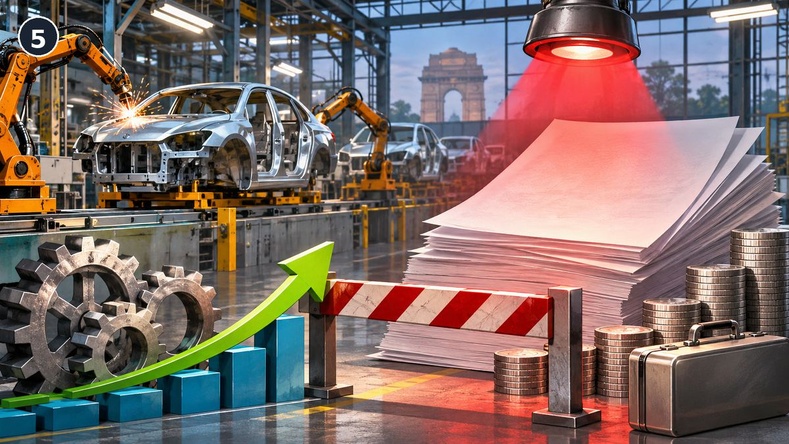
Volkswagen's attempt to challenge a $1.2 billion tax demand in India has developed into a wider dispute over customs classification, the treatment of international automobile manufacturers and the consistency of India's tax enforcement system. By bringing Mercedes-Benz, BMW and other manufacturers into its legal arguments, the German carmaker is seeking to establish that its import practices were not fundamentally different from those followed by competitors. The case could have implications beyond the immediate tax liability, particularly for foreign manufacturers evaluating the financial risks of assembling vehicles in India.
The dispute centres on the classification of imported automobile components and the customs duties applicable to them. Indian authorities allege that Volkswagen imported individual components at a lower tariff rate of around 10% and subsequently assembled them into complete vehicles in India. According to the tax authorities, the company effectively imported nearly complete cars in separate consignments while avoiding the higher duties applicable to completely knocked-down vehicle kits, which can attract rates of around 30%.
Volkswagen disputes the allegations and is seeking to have the tax demand cancelled. In its latest court filing, the company argued that other manufacturers, including Mercedes-Benz, BMW, Kia, Hyundai, Isuzu and JSW MG, also import automobile components under lower tariff classifications. It has cited shipment information involving some competitors to support its argument that tax authorities have singled it out.
The legal question, however, is more complicated than whether other companies import similar components. Volkswagen must establish that the relevant import arrangements and subsequent assembly activities were sufficiently comparable to its own. The existence of similar import practices alone would not establish that the company complied with customs regulations.
The Dispute Concerns More Than the Import Duty
Automobile manufacturers operating in India use different production and import arrangements depending on the scale of their operations, the models they sell and the extent of local manufacturing. Completely knocked-down kits generally involve importing vehicles in disassembled form for assembly within the country. Individual components may be imported separately under different customs classifications, depending on the nature of the goods and the applicable regulations.
The distinction matters because the difference in customs duties can be substantial. Manufacturers that assemble vehicles locally have an incentive to import components under classifications that attract lower tariffs, particularly when they want to manage production costs and compete with companies manufacturing a larger proportion of their vehicles domestically.
India's tariff structure has historically been designed to encourage domestic automobile manufacturing and the development of local supply chains. Higher duties on imported vehicles and certain vehicle kits provide an incentive for manufacturers to establish production facilities and source components locally. However, the classification of imported goods becomes particularly important when companies use complex supply arrangements involving multiple consignments.
The government alleges that Volkswagen deliberately divided imports of components for Audi, Skoda and Volkswagen vehicles to avoid higher customs duties. The company rejects this interpretation and maintains that the authorities have incorrectly treated its imports as complete vehicle kits.
The case therefore raises an important question about how customs regulations should be applied to modern automobile manufacturing. International manufacturers frequently operate through global supply chains, with components sourced from several countries before being assembled at regional production facilities. Customs authorities must distinguish between legitimate component imports and arrangements that effectively amount to importing complete vehicles in disassembled form.
Why Volkswagen Has Brought Competitors Into the Case
Volkswagen's reference to Mercedes-Benz, BMW and other automobile manufacturers is an attempt to challenge the consistency of regulatory enforcement. If comparable companies have been permitted to import components under lower tariff classifications, Volkswagen can argue that it deserves similar treatment.
However, this argument will need to be supported by detailed evidence. Different manufacturers may import components under different commercial arrangements, technical specifications and customs classifications. Even when the products appear similar, their legal treatment may depend on how the imports are structured and what happens after they enter India.
The company has cited shipment data involving BMW and Mercedes-Benz, but establishing that these imports were subsequently used to assemble complete vehicles will be important to its case. Without demonstrating that the circumstances were comparable, references to competitors may not be sufficient to overturn the tax demand.
The case also raises a wider question about the predictability of India's tax administration. International companies need clarity about how customs regulations will be interpreted over the life of a manufacturing investment. If a business follows an established import arrangement for several years and subsequently faces a substantial retrospective tax demand, the financial uncertainty can affect future investment decisions.
This does not mean that the government should avoid investigating suspected violations. Companies operating in India must comply with domestic customs laws, and authorities have a responsibility to protect public revenue. The concern arises when interpretations of regulations remain disputed for extended periods, leaving manufacturers uncertain about their potential liabilities.
India's Manufacturing Ambitions Face a Test
The dispute comes at a time when India is attempting to strengthen its position as an automobile manufacturing centre. The country has attracted investments from international manufacturers and has developed a substantial domestic component industry. Government policies have encouraged local production, technology development and the expansion of manufacturing capacity.
However, attracting investment requires more than offering a large consumer market and incentives for domestic production. Manufacturers also consider taxation, regulatory consistency, access to suppliers, infrastructure and the possibility of prolonged litigation. A dispute involving billions of dollars can therefore attract attention well beyond the company directly involved.
Volkswagen's position in India makes the case particularly important. The group has invested in manufacturing facilities and sells vehicles through its Volkswagen, Skoda and Audi brands. Despite these investments, its combined position in the Indian passenger vehicle market remains relatively small, with the company holding around 2% market share.
A major tax liability could therefore have a disproportionate impact on its Indian operations. The company has argued that the demand threatens its investment and could seriously undermine its business prospects. Its financial challenges in other major markets, including China, add to the importance of managing costs and maintaining a stable operating environment.
For India, the wider concern is whether tax disputes of this scale could discourage manufacturers from expanding local production. International companies may be willing to accept higher tariffs on imported vehicles if they receive predictable rules governing domestic assembly and component imports. Uncertainty over retrospective tax claims, however, makes investment calculations more difficult.
The Court's Decision Could Have Wider Consequences
The immediate legal proceedings are taking place before a court in Mumbai. One important issue concerns whether Indian authorities can examine imports dating back 12 years. The court's consideration of this question could influence the scope of the dispute, even if it does not immediately settle the underlying classification issue.
The case should not be treated as evidence that Volkswagen has been found guilty of customs violations. The company's challenge remains before the court, and the allegations made by tax authorities have not been finally established through a judicial determination.
At the same time, the company cannot establish its case simply by demonstrating that competitors also import components under lower tariff classifications. The relevant evidence will concern the nature of those imports, their subsequent use and whether the applicable customs rules were followed.
The eventual outcome will matter to other manufacturers operating through imported components and domestic assembly arrangements. A decision clarifying how customs authorities should distinguish individual parts from vehicle kits could provide greater certainty across the automobile industry.
India has a legitimate interest in preventing the misuse of lower tariff classifications, particularly when its industrial policy is designed to encourage domestic value addition. Equally, enforcement must be consistent and based on clearly established rules. The Volkswagen case will test whether these objectives can be balanced without creating unnecessary uncertainty for manufacturers that have made substantial long-term investments in the country.
(Source:www.automotiveworld.com)
 Homepage
 Send to a friend
 Printable version
 Share


