


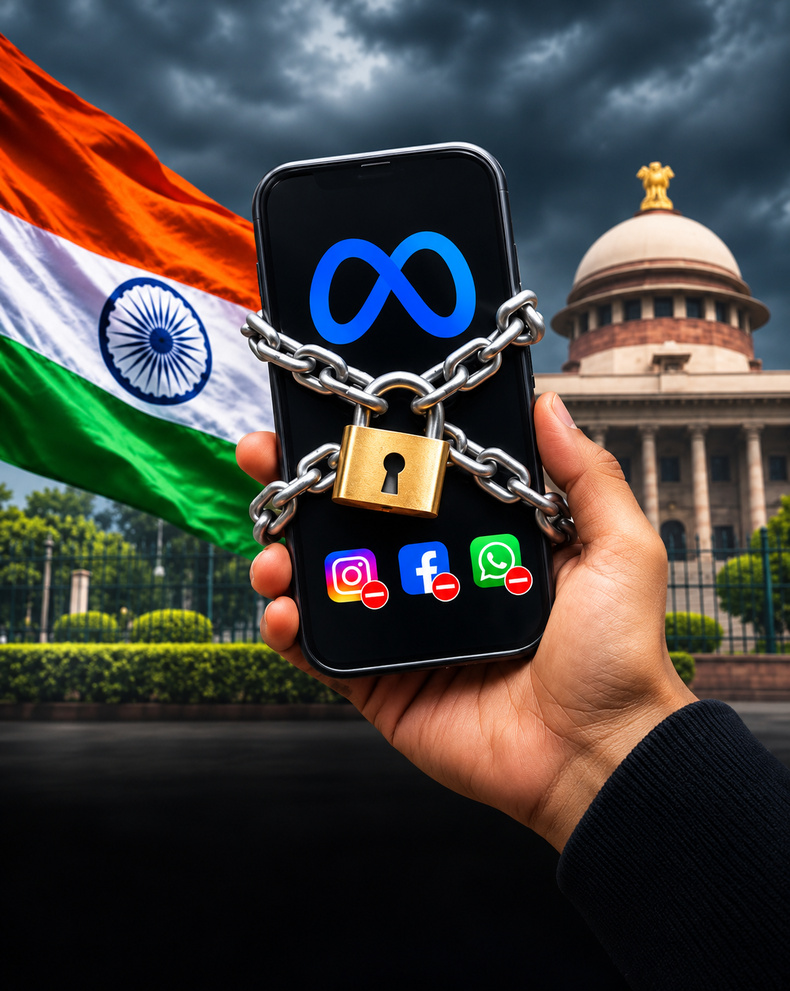
Meta is facing an increasingly difficult political and regulatory battle in India, where the scale of content restrictions on Facebook and Instagram has grown dramatically following changes to the government's information technology rules. The company restricted access to more than 5.44 million items of content in the country during the first half of 2026, compared with approximately 70,000 during the whole of 2025. The extraordinary increase has brought renewed attention to the government's expanding authority over online expression and the willingness of global technology companies to enforce its demands.
The immediate confrontation has been triggered by India's opposition Congress party, which has taken Meta and the Union government to the Delhi High Court. The party alleges that automated systems are blocking political posts, photographs and other material featuring opposition leader Rahul Gandhi, even when the content is not an exact reproduction of anything previously ordered removed. Congress has also organised protests outside Meta offices, accusing the company of restricting opposition voices and failing to operate impartially. But the legal challenge is only one part of a much wider dispute over who exercises control over political communication in India.
The figures reported by Meta are particularly significant because they coincide with a tightening of the regulatory framework. The February 2026 amendments to India's Information Technology Rules require large platforms to remove content identified as unlawful within three hours of receiving an order, compared with the earlier 36-hour deadline. They also require platforms to use automated tools to identify and restrict copies of material previously removed under a court order or written government direction. What was previously an obligation to make efforts to identify such copies has become a formal compliance requirement.
The scale of India's content restrictions
The increase in Meta's reported restrictions cannot be understood simply as a rise in the number of individual government takedown requests. The company says much of the additional volume comes from its obligation to restrict identical copies of content at scale within India. Under the revised rules, a single removal order can therefore have consequences well beyond the original post. Material reproduced across different accounts can be identified and blocked automatically, expanding the reach of an initial restriction.
Meta's transparency disclosures indicate that India accounted for a substantial share of its worldwide restrictions under local laws during the first half of 2026. The company restricted approximately 5.44 million items in India, compared with around 41,400 in the preceding six months. India ranked second globally, behind Indonesia, in the number of items restricted under local legal requirements. The figures demonstrate the scale of the new enforcement system, although they do not establish that every restricted item was political content or individually identified by a government agency.
That distinction matters. Meta's disclosures cover several categories of material, including online gaming, synthetically generated content depicting prominent figures, threats to India's sovereignty and integrity, gender-based harassment and content promoting enmity between groups. The company has also said that it is required to restrict certain material proactively under local law. It is therefore inaccurate to describe all 5.44 million restrictions as anti-government posts removed at the direct instruction of the government.
Nevertheless, the extraordinary expansion of restrictions raises questions about the practical reach of government authority. The amended rules have created a system in which platforms must respond rapidly to legal directions and use technology to extend restrictions to matching content. The central concern is whether these systems can distinguish between genuinely unlawful material and legitimate expression that happens to contain the same image, phrase or visual element. A birthday greeting, political tribute or public statement may have an entirely different purpose from the original content that was ordered removed.
Congress argues that its own experience illustrates this problem. Its petition cites posts featuring Gandhi, including birthday greetings, tributes and a wedding invitation, which it says were restricted despite not being identical copies of previously banned material. The party has asked the court to overturn the automated takedown mandate, restore the affected posts and require Meta to disclose the criteria used to block content. These claims will need to be examined through the legal proceedings, but they raise a wider question about the accuracy and accountability of automated enforcement.
Government orders and the growing power of platforms
The regulatory changes have placed technology companies in an increasingly complicated position. Meta operates one of the largest social media networks in India, making the country commercially important as well as politically sensitive. At the same time, the company faces legal obligations to comply with government directions. Failure to meet the requirements can put the legal protections enjoyed by platforms at risk, including safe-harbour provisions that shield them from liability for much of the content users publish.
This creates an obvious imbalance. Government authorities determine the legal requirements and issue removal directions, while private companies develop and operate the systems that enforce them. Meta may be responsible for implementing the restrictions, but it does not independently determine the legal framework within which it must operate. Its position is that it moderates content in India in accordance with the law and is continuing to test and refine its automated systems.
For the government, the argument is that faster enforcement is necessary to deal with unlawful and harmful online material. India's enormous digital population presents a substantial moderation challenge. Misinformation, manipulated media, online harassment and material capable of inciting violence can spread rapidly, making delayed responses difficult to justify in certain circumstances. The government can reasonably argue that platforms should not be allowed to ignore lawful removal orders simply because enforcement is technically demanding.
The difficulty is that a short compliance deadline can encourage platforms to prioritise legal protection over careful examination. When companies face the possibility of penalties or loss of safe-harbour protection, restricting disputed material may appear less risky than challenging a government direction. Automated systems make compliance easier to administer, but they can also magnify the consequences of an inaccurate or excessively broad order.
The question of transparency becomes equally important. Users may receive a notification stating that content has been restricted because of legal requirements without being told which authority initiated the action or what specific legal direction applies. Meta's transparency disclosures indicate that India is among the markets where it does not identify the government authority seeking certain restrictions, citing legal obligations and regulatory considerations. Without adequate information, users may find it difficult to challenge a restriction or determine whether it was justified.
Political speech caught in a regulatory dispute
The Congress confrontation has brought the political implications of this system into sharper focus. Facebook and Instagram are major channels through which political parties communicate with supporters, distribute campaign material and reach voters. Restrictions on accounts and posts can therefore affect a party's ability to organise and communicate, particularly before elections. Congress argues that the automated system is undermining the level playing field required for fair political competition ahead of state elections expected in early 2027.
The party has also accused Meta of treating political groups unequally, an allegation the company has rejected. In discussions with Congress representatives, Meta maintained that it was politically neutral and bound by Indian law. The ruling Bharatiya Janata Party, meanwhile, has criticised the protests against the company, with its representatives accusing Congress workers of vandalising private property. These competing claims should not be confused with an established finding that Meta has deliberately favoured one political party over another.
Yet the broader concern extends beyond the fortunes of Congress or the political standing of Rahul Gandhi. The same enforcement architecture can affect journalists, independent commentators, civil society organisations and ordinary users. A system designed to identify identical copies of prohibited material can restrict legitimate discussion if it fails to recognise differences in context. A photograph used in a news report, for instance, may be visually identical to one appearing in material previously removed, while serving an entirely different editorial purpose.
The implications become more serious when restrictions operate at scale. A mistaken decision affecting one post can be corrected through an appeal, although even that process may take time. An automated mechanism capable of blocking thousands of copies can spread the same error across numerous accounts before a meaningful review takes place. By the time a restriction is reversed, the political or public debate in which the material was relevant may already have moved on.
India's dispute with Meta is also part of a broader international debate about the responsibilities of global technology companies when national governments demand control over online content. Platforms must comply with local laws, but they also face expectations from users, civil society and investors that they protect freedom of expression and apply moderation policies consistently. The challenge is particularly acute in markets where regulatory powers are extensive and the consequences of refusing government directions can be significant.
The limits of automated accountability
The immediate legal battle may determine whether India's automated takedown requirements are consistent with constitutional protections and whether Meta has applied them correctly. But the larger issue cannot be resolved by focusing exclusively on the removal of Congress posts. It requires scrutiny of the entire process: how government orders are issued, how platforms interpret them, what material their systems identify, and what remedies are available when lawful expression is restricted.
Human oversight is one safeguard, but its value depends on how it operates. A review process that merely confirms an automated decision without examining context will do little to prevent wrongful restrictions. Platforms also need clear procedures through which users can obtain information about the legal basis of a takedown, challenge an incorrect match and secure prompt restoration of material. Equally, government authorities should be expected to provide sufficiently precise directions that do not leave companies to interpret broad restrictions through automated systems.
For Meta, the commercial importance of India makes a prolonged confrontation with the government difficult to contemplate. However, compliance alone does not settle questions about the accuracy of its systems or the consequences of restrictions for public debate. The company will have to explain how it balances its legal obligations with the need to avoid blocking legitimate material, particularly when the enforcement mechanism can operate across millions of posts.
The Congress lawsuit has brought these questions into the courtroom, but the underlying issue is much larger than one political party or one opposition leader. The restriction of more than 5.4 million items in six months illustrates how quickly government regulation and automated enforcement can change the environment in which online speech operates. The eventual test will be whether India can enforce legitimate restrictions on unlawful content without allowing speed, scale and technological convenience to weaken transparency, due process and the right to political expression.
(Source:www.indianexpress.com)
 Homepage
 Send to a friend
 Printable version
 Share


