


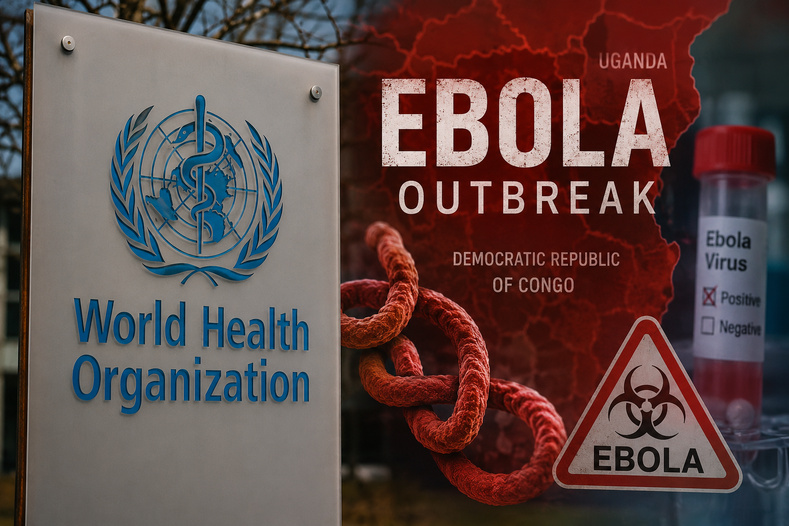
The World Health Organization has declared the latest Ebola outbreak affecting the Democratic Republic of the Congo and Uganda a public health emergency of international concern, signaling growing fears that cross-border transmission and limited medical countermeasures could complicate efforts to contain the virus. The declaration places renewed global attention on one of the world’s deadliest infectious diseases and underscores the continuing vulnerability of parts of Central and East Africa to recurring Ebola outbreaks.
The emergency designation reflects concerns not only about the number of suspected infections and deaths already reported, but also about the outbreak’s geographic spread, the movement of infected individuals across borders, and the absence of approved vaccines or targeted treatments for the specific virus strain involved. Health officials have warned that the outbreak may already be larger than currently confirmed because testing capacity, surveillance limitations, and delayed case detection continue to challenge response efforts in affected areas.
The outbreak is centered primarily in eastern Congo’s Ituri province, a region that has repeatedly faced humanitarian crises involving armed conflict, population displacement, weak healthcare infrastructure, and infectious disease outbreaks. Such conditions complicate disease surveillance and make rapid containment more difficult, particularly when communities face limited access to healthcare facilities and emergency medical resources.
The latest outbreak involves the Bundibugyo strain of Ebola, one of several known variants of the virus. Unlike the more common Ebola-Zaire strain, for which vaccines and treatments have been developed in recent years, the Bundibugyo variant currently lacks approved strain-specific therapeutics or vaccines. That reality has heightened concern among global health officials because existing medical tools may offer more limited protection compared with previous outbreaks dominated by the Zaire strain.
The declaration by the WHO does not mean the outbreak has reached pandemic status. However, it signals that the situation carries serious international public health risks requiring coordinated cross-border response measures, surveillance systems, and emergency preparedness efforts across neighboring countries.
Cross-Border Movement Raises Risk of Wider Regional Spread
One of the primary reasons behind the WHO’s emergency declaration is evidence that the outbreak has already spread beyond localized transmission zones. Health officials reported laboratory-confirmed cases linked to travel between Congo and Uganda, while an infected individual also traveled from eastern Congo to the capital city of Kinshasa, raising concerns about urban transmission risks.
Cross-border mobility remains one of the greatest challenges in controlling Ebola outbreaks in Central Africa. The borders separating Congo, Uganda, Rwanda, South Sudan, and other neighboring countries are often porous, with extensive informal trade routes and frequent movement by workers, traders, refugees, and local communities. In many border regions, populations move daily across national boundaries for economic activity, healthcare access, or family connections.
Such mobility increases the difficulty of tracking contacts and monitoring potential exposure chains. Even when governments implement official screening systems at major border crossings, informal transit routes can bypass monitoring efforts entirely. Public health officials therefore face the challenge of balancing disease control measures with the practical realities of regional mobility and economic dependence on cross-border trade.
The WHO urged neighboring countries to activate emergency response mechanisms, strengthen disease surveillance systems, and expand screening operations at major transportation hubs and internal road networks. Authorities were also advised to improve rapid isolation procedures and intensify contact tracing efforts to prevent further spread.
At the same time, global health agencies warned against imposing blanket border closures or broad travel bans. Previous Ebola outbreaks demonstrated that excessive restrictions can sometimes worsen containment efforts by encouraging unmonitored movement through informal routes. Health experts therefore continue emphasizing targeted surveillance and community engagement rather than broad isolation measures that risk disrupting humanitarian access and regional trade flows.
The emergence of confirmed Ebola cases in Kampala, Uganda’s densely populated capital, further intensified concerns because urban outbreaks are often significantly harder to contain than rural clusters. Cities create more opportunities for rapid person-to-person transmission through crowded transportation systems, hospitals, markets, and residential areas.
The spread of infectious diseases into major urban centers has historically complicated outbreak responses across Africa because healthcare systems can become overwhelmed quickly when transmission accelerates. Rapid detection and isolation therefore remain central priorities for health authorities attempting to limit wider community spread.
Limited Medical Tools Complicate the Response Effort
The Bundibugyo strain involved in the current outbreak presents additional challenges because medical countermeasures developed during earlier Ebola outbreaks were primarily designed for the Zaire strain. Over the past decade, advances in vaccine development and therapeutic treatments significantly improved survival rates during certain Ebola outbreaks, particularly after major epidemics in West Africa and eastern Congo.
However, the effectiveness of those tools against other Ebola variants remains less certain. The lack of approved strain-specific vaccines or treatments for Bundibugyo Ebola has increased pressure on traditional outbreak-control measures such as quarantine protocols, rapid isolation, protective equipment use, and intensive contact tracing.
Ebola remains one of the world’s most feared infectious diseases because of its high fatality rate and severe symptoms. The virus spreads through direct contact with bodily fluids from infected individuals, contaminated surfaces, or deceased patients. Symptoms often include fever, vomiting, severe weakness, diarrhea, and internal or external bleeding in advanced stages.
Containing Ebola outbreaks requires rapid identification of infected individuals and extensive monitoring of people who may have been exposed. Health workers must also use specialized protective equipment while treating patients, particularly in regions where healthcare infrastructure remains limited.
The challenge becomes even greater in conflict-affected areas such as eastern Congo, where insecurity and mistrust toward authorities can undermine response operations. Armed violence, population displacement, and weak public infrastructure have repeatedly complicated humanitarian and medical efforts across parts of the region.
Community trust also plays a critical role in outbreak containment. During previous Ebola epidemics, misinformation, fear, and distrust of health workers occasionally led communities to avoid treatment centers or resist public health interventions. Health agencies increasingly recognize that successful outbreak responses depend not only on medical resources but also on effective local communication and community participation.
International health organizations and humanitarian agencies are therefore expected to intensify coordination efforts involving testing capacity, laboratory support, emergency medical supplies, and regional surveillance systems as the outbreak evolves.
Ebola’s Recurring Threat Reflects Deeper Structural Challenges
The latest outbreak is part of a longer history of recurring Ebola epidemics in Central Africa, particularly in Congo, where the virus was first identified in the 1970s. The country’s dense tropical forests are believed to act as natural reservoirs for Ebola viruses, likely involving transmission cycles linked to wildlife hosts such as fruit bats.
Environmental factors, population movement, deforestation, and human interaction with wildlife continue contributing to periodic outbreaks across the region. Scientists have long warned that emerging infectious diseases may become more frequent as ecological disruption increases contact between humans and virus-carrying animal populations.
At the same time, recurring Ebola outbreaks expose broader structural weaknesses within healthcare systems across several African countries. Limited medical infrastructure, shortages of trained healthcare personnel, underfunded public health systems, and logistical challenges often hinder rapid emergency responses.
International support has improved outbreak-management capacity significantly compared with earlier decades. Surveillance networks, emergency-response protocols, and laboratory testing systems are stronger than during the devastating West African Ebola epidemic of 2014-2016, which killed more than 11,000 people and exposed major weaknesses in global outbreak preparedness.
Nevertheless, the latest emergency declaration demonstrates that Ebola remains a serious recurring global health threat capable of crossing borders rapidly when early containment efforts face delays or operational obstacles.
The outbreak also arrives at a time when global health systems continue dealing with broader concerns surrounding pandemic preparedness, emerging infectious diseases, and the need for stronger international coordination mechanisms. Lessons from recent global health crises have reinforced the importance of rapid response systems capable of identifying and containing outbreaks before they escalate into wider regional or international emergencies.
As health authorities attempt to contain the spread of the Bundibugyo strain across Congo and Uganda, the WHO’s emergency declaration reflects growing concern that delays in surveillance, treatment access, or cross-border coordination could allow the outbreak to expand further across a region already facing substantial humanitarian and healthcare pressures.
(Source:www.who.int)
The emergency designation reflects concerns not only about the number of suspected infections and deaths already reported, but also about the outbreak’s geographic spread, the movement of infected individuals across borders, and the absence of approved vaccines or targeted treatments for the specific virus strain involved. Health officials have warned that the outbreak may already be larger than currently confirmed because testing capacity, surveillance limitations, and delayed case detection continue to challenge response efforts in affected areas.
The outbreak is centered primarily in eastern Congo’s Ituri province, a region that has repeatedly faced humanitarian crises involving armed conflict, population displacement, weak healthcare infrastructure, and infectious disease outbreaks. Such conditions complicate disease surveillance and make rapid containment more difficult, particularly when communities face limited access to healthcare facilities and emergency medical resources.
The latest outbreak involves the Bundibugyo strain of Ebola, one of several known variants of the virus. Unlike the more common Ebola-Zaire strain, for which vaccines and treatments have been developed in recent years, the Bundibugyo variant currently lacks approved strain-specific therapeutics or vaccines. That reality has heightened concern among global health officials because existing medical tools may offer more limited protection compared with previous outbreaks dominated by the Zaire strain.
The declaration by the WHO does not mean the outbreak has reached pandemic status. However, it signals that the situation carries serious international public health risks requiring coordinated cross-border response measures, surveillance systems, and emergency preparedness efforts across neighboring countries.
Cross-Border Movement Raises Risk of Wider Regional Spread
One of the primary reasons behind the WHO’s emergency declaration is evidence that the outbreak has already spread beyond localized transmission zones. Health officials reported laboratory-confirmed cases linked to travel between Congo and Uganda, while an infected individual also traveled from eastern Congo to the capital city of Kinshasa, raising concerns about urban transmission risks.
Cross-border mobility remains one of the greatest challenges in controlling Ebola outbreaks in Central Africa. The borders separating Congo, Uganda, Rwanda, South Sudan, and other neighboring countries are often porous, with extensive informal trade routes and frequent movement by workers, traders, refugees, and local communities. In many border regions, populations move daily across national boundaries for economic activity, healthcare access, or family connections.
Such mobility increases the difficulty of tracking contacts and monitoring potential exposure chains. Even when governments implement official screening systems at major border crossings, informal transit routes can bypass monitoring efforts entirely. Public health officials therefore face the challenge of balancing disease control measures with the practical realities of regional mobility and economic dependence on cross-border trade.
The WHO urged neighboring countries to activate emergency response mechanisms, strengthen disease surveillance systems, and expand screening operations at major transportation hubs and internal road networks. Authorities were also advised to improve rapid isolation procedures and intensify contact tracing efforts to prevent further spread.
At the same time, global health agencies warned against imposing blanket border closures or broad travel bans. Previous Ebola outbreaks demonstrated that excessive restrictions can sometimes worsen containment efforts by encouraging unmonitored movement through informal routes. Health experts therefore continue emphasizing targeted surveillance and community engagement rather than broad isolation measures that risk disrupting humanitarian access and regional trade flows.
The emergence of confirmed Ebola cases in Kampala, Uganda’s densely populated capital, further intensified concerns because urban outbreaks are often significantly harder to contain than rural clusters. Cities create more opportunities for rapid person-to-person transmission through crowded transportation systems, hospitals, markets, and residential areas.
The spread of infectious diseases into major urban centers has historically complicated outbreak responses across Africa because healthcare systems can become overwhelmed quickly when transmission accelerates. Rapid detection and isolation therefore remain central priorities for health authorities attempting to limit wider community spread.
Limited Medical Tools Complicate the Response Effort
The Bundibugyo strain involved in the current outbreak presents additional challenges because medical countermeasures developed during earlier Ebola outbreaks were primarily designed for the Zaire strain. Over the past decade, advances in vaccine development and therapeutic treatments significantly improved survival rates during certain Ebola outbreaks, particularly after major epidemics in West Africa and eastern Congo.
However, the effectiveness of those tools against other Ebola variants remains less certain. The lack of approved strain-specific vaccines or treatments for Bundibugyo Ebola has increased pressure on traditional outbreak-control measures such as quarantine protocols, rapid isolation, protective equipment use, and intensive contact tracing.
Ebola remains one of the world’s most feared infectious diseases because of its high fatality rate and severe symptoms. The virus spreads through direct contact with bodily fluids from infected individuals, contaminated surfaces, or deceased patients. Symptoms often include fever, vomiting, severe weakness, diarrhea, and internal or external bleeding in advanced stages.
Containing Ebola outbreaks requires rapid identification of infected individuals and extensive monitoring of people who may have been exposed. Health workers must also use specialized protective equipment while treating patients, particularly in regions where healthcare infrastructure remains limited.
The challenge becomes even greater in conflict-affected areas such as eastern Congo, where insecurity and mistrust toward authorities can undermine response operations. Armed violence, population displacement, and weak public infrastructure have repeatedly complicated humanitarian and medical efforts across parts of the region.
Community trust also plays a critical role in outbreak containment. During previous Ebola epidemics, misinformation, fear, and distrust of health workers occasionally led communities to avoid treatment centers or resist public health interventions. Health agencies increasingly recognize that successful outbreak responses depend not only on medical resources but also on effective local communication and community participation.
International health organizations and humanitarian agencies are therefore expected to intensify coordination efforts involving testing capacity, laboratory support, emergency medical supplies, and regional surveillance systems as the outbreak evolves.
Ebola’s Recurring Threat Reflects Deeper Structural Challenges
The latest outbreak is part of a longer history of recurring Ebola epidemics in Central Africa, particularly in Congo, where the virus was first identified in the 1970s. The country’s dense tropical forests are believed to act as natural reservoirs for Ebola viruses, likely involving transmission cycles linked to wildlife hosts such as fruit bats.
Environmental factors, population movement, deforestation, and human interaction with wildlife continue contributing to periodic outbreaks across the region. Scientists have long warned that emerging infectious diseases may become more frequent as ecological disruption increases contact between humans and virus-carrying animal populations.
At the same time, recurring Ebola outbreaks expose broader structural weaknesses within healthcare systems across several African countries. Limited medical infrastructure, shortages of trained healthcare personnel, underfunded public health systems, and logistical challenges often hinder rapid emergency responses.
International support has improved outbreak-management capacity significantly compared with earlier decades. Surveillance networks, emergency-response protocols, and laboratory testing systems are stronger than during the devastating West African Ebola epidemic of 2014-2016, which killed more than 11,000 people and exposed major weaknesses in global outbreak preparedness.
Nevertheless, the latest emergency declaration demonstrates that Ebola remains a serious recurring global health threat capable of crossing borders rapidly when early containment efforts face delays or operational obstacles.
The outbreak also arrives at a time when global health systems continue dealing with broader concerns surrounding pandemic preparedness, emerging infectious diseases, and the need for stronger international coordination mechanisms. Lessons from recent global health crises have reinforced the importance of rapid response systems capable of identifying and containing outbreaks before they escalate into wider regional or international emergencies.
As health authorities attempt to contain the spread of the Bundibugyo strain across Congo and Uganda, the WHO’s emergency declaration reflects growing concern that delays in surveillance, treatment access, or cross-border coordination could allow the outbreak to expand further across a region already facing substantial humanitarian and healthcare pressures.
(Source:www.who.int)
 Homepage
 Send to a friend
 Printable version
 Share
Share


