


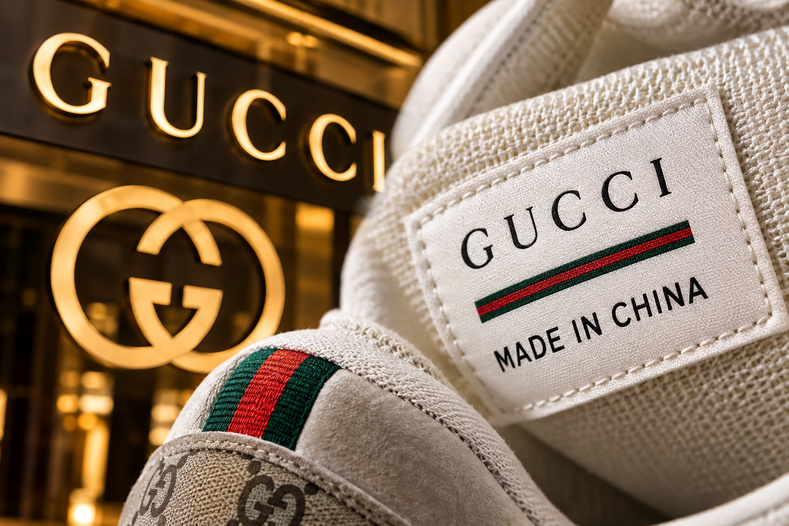
Gucci's decision to sell two new sneaker models labelled "Made in China" marks a significant change in the way one of Italy's most recognizable luxury brands is approaching product development. The move does not represent a broader withdrawal from Italian manufacturing, but it does challenge an assumption that has long been central to Gucci's identity: that luxury products carrying the Gucci name should be closely associated with Italian production.
The decision comes at a particularly important moment for the brand. Gucci has been undergoing a major turnaround under chief executive Luca de Meo and artistic director Demna, after several years of declining sales. Kering reported that Gucci's 2025 revenue fell 22 percent, while the first half of 2026 still recorded a 5 percent comparable decline despite a marked improvement in performance. The group has been emphasizing product renewal, tighter cost management and a more focused approach to the brand's commercial strategy.
Against that background, producing selected sneakers in China can be viewed as part of a broader attempt to balance creative experimentation with commercial discipline. The difficulty is that luxury depends not only on design and materials, but also on the story surrounding how and where a product is made.
China Offers Manufacturing Expertise for New Designs
The immediate explanation for the decision is technical rather than simply financial. Gucci has said that the Chinese manufacturer selected for the new sneakers offered the technological expertise and production capabilities required to meet the performance and quality standards of the designs.
That distinction is important because China has become a major global centre for footwear manufacturing, including technically complex sneakers. The country has extensive experience in synthetic materials, advanced construction techniques and high-volume footwear production. Choosing a Chinese manufacturer for a specific product does not therefore automatically mean that Gucci is seeking to reduce quality or simply cut labour costs.
The Drip sneaker, Demna's first sneaker design for Gucci, illustrates why manufacturing expertise could have influenced the decision. The shoe has a futuristic, sock-like construction and is offered in materials including nylon, canvas and suede. Its design is substantially different from the traditional leather Gucci sneakers that have been closely associated with the brand.
A second slip-on leather sneaker from the same collection is also labelled "Made in China". Gucci has said that its production location was similarly linked to the technical requirements of the design. At the same time, the company has stressed that Italy remains central to its manufacturing model and identity.
The Move Comes During a Costly Gucci Turnaround
The manufacturing decision cannot be separated from Gucci's recent financial difficulties. The brand's revenue declined sharply during 2025, when comparable sales fell 19 percent and wholesale revenue dropped 34 percent. Kering attributed the weakness partly to reduced customer traffic and a broader normalization of luxury demand.
The situation has improved during 2026, but recovery remains incomplete. Gucci's first-half comparable revenue was down 5 percent, although the second quarter showed stronger momentum. Kering has also been reducing its store network and emphasizing cost discipline as part of the group's wider restructuring.
That makes product economics increasingly important. A luxury brand cannot respond to weaker demand simply by producing ever more expensive products. It must decide where high-cost craftsmanship is essential to the customer proposition and where specialized external manufacturing can deliver the required quality more efficiently.
Sneakers are particularly suited to that experiment because they occupy a different position from Gucci's most traditional leather goods. The category is strongly influenced by technology, materials, comfort and construction, as well as fashion.
The challenge is determining whether customers see a sneaker primarily as a technical fashion product or as an extension of Gucci's Italian manufacturing heritage.
The Price Still Demands a Luxury Justification
The Drip is priced at about 800 euros in Europe and 1,000 dollars in the United States. That places it below some Gucci footwear but firmly within the luxury market.
This creates an important distinction between manufacturing cost and perceived value. Consumers do not pay luxury prices simply because production is expensive. They pay for a combination of design, brand reputation, scarcity, craftsmanship, cultural relevance and the expectation that the product offers something distinctive.
For Gucci, the question is therefore not necessarily whether a Chinese factory can make a high-quality sneaker. The more important issue is whether consumers believe that the product deserves a luxury price when its country-of-origin label differs from the manufacturing tradition associated with the brand.
This is especially relevant to aspirational luxury consumers, who account for a substantial part of the market but are more sensitive to price and perceived value than the wealthiest customers. Gucci needs to broaden demand without weakening the exclusivity that makes its products desirable.
The tension becomes sharper when a brand simultaneously experiments with pricing and production. If customers see lower prices and Chinese manufacturing as evidence that Gucci products are becoming less distinctive, the strategy could undermine the very brand equity the turnaround is intended to rebuild.
Italian Production Remains Central but Less Absolute
Gucci has been careful to distinguish the two Chinese-made sneaker models from its broader manufacturing structure. The company has said there are no wider plans to move production outside Italy, while its website continues to identify Italy as the country of origin for its other shoes carrying such labels.
That suggests the company is treating the Chinese-made sneakers as a targeted exception rather than a wholesale change in manufacturing policy.
Yet exceptions can become strategically important in luxury because consumers often interpret individual products as signals about a brand's direction. The decision may therefore matter beyond the relatively small number of sneakers currently made in China.
Gucci is effectively testing whether its brand identity can become more flexible without becoming weaker. If consumers accept the products on the basis of design and quality, the company could gain greater freedom to use specialized manufacturing capabilities around the world. If the origin label becomes a significant source of resistance, Gucci may have to preserve a stronger connection between Italian production and its most visible products.
The choice of manufacturing location also reflects the larger challenge facing Demna. Gucci needs new products capable of creating attention while reconnecting the brand with consumers who have become less willing to spend heavily on luxury fashion.
The appointment of a new artistic director has already been part of Kering's strategy to refresh Gucci's product offering. Kering said Demna's first collection generated renewed interest in the brand, while the company's 2026 results showed sequential improvement.
The Drip therefore has significance beyond its sales numbers. Its unusual design represents an attempt to give Gucci a more contemporary identity, while its manufacturing location introduces another element of experimentation.
The combination reflects the difficult economics of modern luxury. Brands must innovate quickly, control costs and respond to changing consumer behaviour while preserving the intangible qualities that justify premium pricing.
For Gucci, the China-made sneakers are consequently less about abandoning Italian manufacturing than about testing how much flexibility the brand can introduce without weakening its identity. China provides manufacturing capabilities that Gucci says are particularly appropriate for these designs, while Italy remains central to the wider production model.
The commercial question is whether customers will make the same distinction. If they judge the sneakers primarily by design, quality and desirability, the experiment could demonstrate that luxury manufacturing no longer has to be geographically uniform. If country of origin remains an essential part of the value they attach to Gucci, the move could expose a much harder limit to the brand's attempt to combine innovation, affordability and heritage.
(Source:www.euronext.com)
The decision comes at a particularly important moment for the brand. Gucci has been undergoing a major turnaround under chief executive Luca de Meo and artistic director Demna, after several years of declining sales. Kering reported that Gucci's 2025 revenue fell 22 percent, while the first half of 2026 still recorded a 5 percent comparable decline despite a marked improvement in performance. The group has been emphasizing product renewal, tighter cost management and a more focused approach to the brand's commercial strategy.
Against that background, producing selected sneakers in China can be viewed as part of a broader attempt to balance creative experimentation with commercial discipline. The difficulty is that luxury depends not only on design and materials, but also on the story surrounding how and where a product is made.
China Offers Manufacturing Expertise for New Designs
The immediate explanation for the decision is technical rather than simply financial. Gucci has said that the Chinese manufacturer selected for the new sneakers offered the technological expertise and production capabilities required to meet the performance and quality standards of the designs.
That distinction is important because China has become a major global centre for footwear manufacturing, including technically complex sneakers. The country has extensive experience in synthetic materials, advanced construction techniques and high-volume footwear production. Choosing a Chinese manufacturer for a specific product does not therefore automatically mean that Gucci is seeking to reduce quality or simply cut labour costs.
The Drip sneaker, Demna's first sneaker design for Gucci, illustrates why manufacturing expertise could have influenced the decision. The shoe has a futuristic, sock-like construction and is offered in materials including nylon, canvas and suede. Its design is substantially different from the traditional leather Gucci sneakers that have been closely associated with the brand.
A second slip-on leather sneaker from the same collection is also labelled "Made in China". Gucci has said that its production location was similarly linked to the technical requirements of the design. At the same time, the company has stressed that Italy remains central to its manufacturing model and identity.
The Move Comes During a Costly Gucci Turnaround
The manufacturing decision cannot be separated from Gucci's recent financial difficulties. The brand's revenue declined sharply during 2025, when comparable sales fell 19 percent and wholesale revenue dropped 34 percent. Kering attributed the weakness partly to reduced customer traffic and a broader normalization of luxury demand.
The situation has improved during 2026, but recovery remains incomplete. Gucci's first-half comparable revenue was down 5 percent, although the second quarter showed stronger momentum. Kering has also been reducing its store network and emphasizing cost discipline as part of the group's wider restructuring.
That makes product economics increasingly important. A luxury brand cannot respond to weaker demand simply by producing ever more expensive products. It must decide where high-cost craftsmanship is essential to the customer proposition and where specialized external manufacturing can deliver the required quality more efficiently.
Sneakers are particularly suited to that experiment because they occupy a different position from Gucci's most traditional leather goods. The category is strongly influenced by technology, materials, comfort and construction, as well as fashion.
The challenge is determining whether customers see a sneaker primarily as a technical fashion product or as an extension of Gucci's Italian manufacturing heritage.
The Price Still Demands a Luxury Justification
The Drip is priced at about 800 euros in Europe and 1,000 dollars in the United States. That places it below some Gucci footwear but firmly within the luxury market.
This creates an important distinction between manufacturing cost and perceived value. Consumers do not pay luxury prices simply because production is expensive. They pay for a combination of design, brand reputation, scarcity, craftsmanship, cultural relevance and the expectation that the product offers something distinctive.
For Gucci, the question is therefore not necessarily whether a Chinese factory can make a high-quality sneaker. The more important issue is whether consumers believe that the product deserves a luxury price when its country-of-origin label differs from the manufacturing tradition associated with the brand.
This is especially relevant to aspirational luxury consumers, who account for a substantial part of the market but are more sensitive to price and perceived value than the wealthiest customers. Gucci needs to broaden demand without weakening the exclusivity that makes its products desirable.
The tension becomes sharper when a brand simultaneously experiments with pricing and production. If customers see lower prices and Chinese manufacturing as evidence that Gucci products are becoming less distinctive, the strategy could undermine the very brand equity the turnaround is intended to rebuild.
Italian Production Remains Central but Less Absolute
Gucci has been careful to distinguish the two Chinese-made sneaker models from its broader manufacturing structure. The company has said there are no wider plans to move production outside Italy, while its website continues to identify Italy as the country of origin for its other shoes carrying such labels.
That suggests the company is treating the Chinese-made sneakers as a targeted exception rather than a wholesale change in manufacturing policy.
Yet exceptions can become strategically important in luxury because consumers often interpret individual products as signals about a brand's direction. The decision may therefore matter beyond the relatively small number of sneakers currently made in China.
Gucci is effectively testing whether its brand identity can become more flexible without becoming weaker. If consumers accept the products on the basis of design and quality, the company could gain greater freedom to use specialized manufacturing capabilities around the world. If the origin label becomes a significant source of resistance, Gucci may have to preserve a stronger connection between Italian production and its most visible products.
The choice of manufacturing location also reflects the larger challenge facing Demna. Gucci needs new products capable of creating attention while reconnecting the brand with consumers who have become less willing to spend heavily on luxury fashion.
The appointment of a new artistic director has already been part of Kering's strategy to refresh Gucci's product offering. Kering said Demna's first collection generated renewed interest in the brand, while the company's 2026 results showed sequential improvement.
The Drip therefore has significance beyond its sales numbers. Its unusual design represents an attempt to give Gucci a more contemporary identity, while its manufacturing location introduces another element of experimentation.
The combination reflects the difficult economics of modern luxury. Brands must innovate quickly, control costs and respond to changing consumer behaviour while preserving the intangible qualities that justify premium pricing.
For Gucci, the China-made sneakers are consequently less about abandoning Italian manufacturing than about testing how much flexibility the brand can introduce without weakening its identity. China provides manufacturing capabilities that Gucci says are particularly appropriate for these designs, while Italy remains central to the wider production model.
The commercial question is whether customers will make the same distinction. If they judge the sneakers primarily by design, quality and desirability, the experiment could demonstrate that luxury manufacturing no longer has to be geographically uniform. If country of origin remains an essential part of the value they attach to Gucci, the move could expose a much harder limit to the brand's attempt to combine innovation, affordability and heritage.
(Source:www.euronext.com)
 Homepage
 Send to a friend
 Printable version
 Share
Share


