


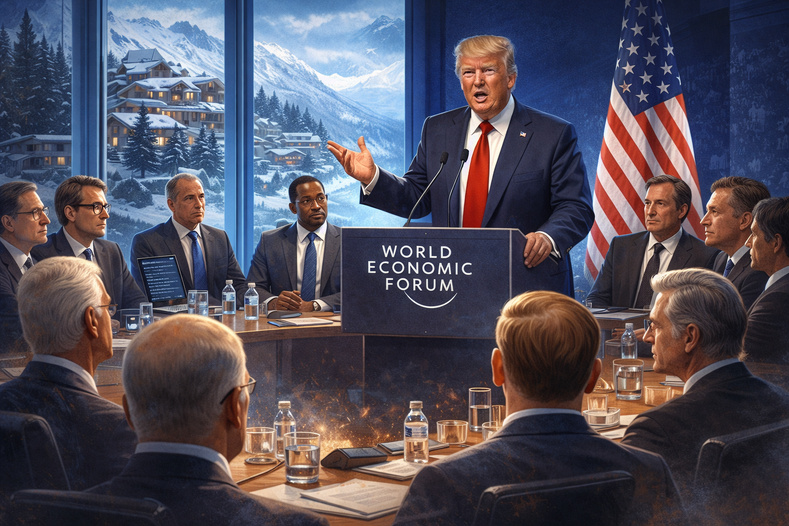
Donald Trump’s decision to engage directly with global chief executives on the sidelines of the World Economic Forum in Davos reflects a deliberate effort to reposition the United States at the centre of global economic decision-making. His presence at the Swiss gathering is not merely ceremonial. It signals an approach in which corporate power, national policy, and geopolitical leverage are increasingly intertwined, with business leaders treated as both stakeholders and conduits for advancing U.S. priorities abroad.
Davos has long functioned as a meeting point where political leaders outline visions and investors gauge the direction of policy. Trump’s appearance, however, reshapes that dynamic. Instead of quietly courting consensus, he arrives with a reputation for disruption and a willingness to place U.S. interests above multilateral sensitivities. The anticipated meetings with chief executives underline how his administration views global corporations not as neutral actors, but as participants in a broader recalibration of trade, investment, and strategic influence.
Why Davos matters to Trump’s economic strategy
For Trump, Davos offers a rare opportunity to address a concentrated audience of decision-makers who control capital flows, supply chains, and technological platforms. Meeting CEOs in this setting allows him to communicate U.S. policy priorities directly, bypassing traditional diplomatic channels and multilateral forums that he has often criticised as slow or ineffective.
The timing is significant. Trump has returned to office with an agenda centred on reshoring industry, reducing trade deficits, and reasserting U.S. leverage in strategic sectors such as energy, finance, and emerging technologies. Speaking to corporate leaders in Davos enables him to frame these policies not as protectionist impulses, but as a rebalancing aimed at long-term stability and competitiveness. For executives navigating fragmented global markets, clarity from Washington carries tangible value, even if the message itself is confrontational.
Davos also provides Trump with a platform to project confidence in U.S. economic resilience. By positioning America as the indispensable market and partner, he reinforces the idea that access to U.S. consumers and capital depends on alignment with his administration’s priorities. The symbolism of a White House–backed reception for CEOs underscores this transactional logic.
The mechanics of CEO engagement
Unlike formal summitry, the planned interactions between Trump and global business leaders appear intentionally flexible. Invitations extended to executives across sectors, from finance and consulting to crypto and asset management, suggest a broad outreach rather than a narrowly focused policy workshop. The lack of a detailed public agenda may itself be strategic, allowing Trump to dominate the conversation and adapt his messaging to the concerns of those in the room.
This style reflects Trump’s broader approach to negotiation. He often opens with maximalist positions, using uncertainty as leverage before narrowing toward specific deals. In Davos, this translates into signalling potential policy shifts—on tariffs, regulation, or taxation—without committing to precise outcomes. For CEOs, the meeting becomes less about immediate agreements and more about reading the administration’s intent.
The presence of senior U.S. officials alongside Trump reinforces the seriousness of the engagement. It suggests that feedback gathered in Davos could feed directly into policy deliberations, blurring the boundary between corporate consultation and statecraft. That dynamic appeals to executives seeking influence, but it also raises questions about whose interests ultimately shape U.S. economic decisions.
U.S. policy as the gravitational pull
Trump’s attendance has already overshadowed much of the World Economic Forum’s planned agenda. Discussions originally centred on climate finance, global growth, and development have been reframed through the lens of shifting U.S. policy. Issues such as tariffs, industrial subsidies, and strategic assets now dominate private conversations, reflecting the extent to which Washington’s direction sets the tone for global markets.
This focus is amplified by Trump’s recent policy signals, including aggressive trade rhetoric and assertive geopolitical demands. For many executives, Davos becomes a venue to assess risk: how exposed their businesses are to U.S. trade actions, and whether supply chains need to be reconfigured in anticipation of policy shocks. Trump’s willingness to use economic tools to pursue non-economic objectives has heightened these concerns.
At the same time, some business leaders view Trump’s approach as pragmatic. By prioritising national advantage and long-term positioning, he appeals to executives who believe the era of frictionless globalisation is over. From this perspective, Davos offers a chance to align corporate strategy with a world defined by blocs, competition, and selective decoupling rather than universal integration.
Europe, geopolitics, and corporate unease
Trump’s Davos engagement unfolds against a backdrop of strained transatlantic relations. European policymakers attending the forum are acutely aware that discussions with CEOs may influence how businesses respond to U.S. pressure. If corporate leaders signal openness to Trump’s demands, European governments risk losing leverage in trade and regulatory disputes.
The inclusion of sensitive geopolitical topics in side meetings, including Arctic security and tariff threats, has added to the sense of unease. For European delegates, Davos is no longer just a forum for dialogue but a stage on which U.S. policy is asserted with immediate market consequences. The reaction of European equities to recent tariff threats underscores how quickly rhetoric can translate into financial volatility.
Corporate leaders are caught between competing imperatives. On one hand, maintaining access to the U.S. market remains critical. On the other, appearing too closely aligned with Washington risks alienating regulators and consumers elsewhere. Trump’s direct engagement forces executives to navigate this tension in real time, often without the buffer of institutional diplomacy.
Markets, messaging, and the Trump effect
Financial markets tend to respond less to speeches than to signals, and Trump’s Davos presence is rich in both. Investors scrutinise not only what he says publicly, but whom he meets and how those interactions are framed. A reception of global CEOs suggests confidence and continuity, even amid policy volatility, offering reassurance to some segments of the market.
Yet the same signals can generate anxiety. Trump’s history of abrupt policy shifts means that optimism can quickly give way to caution. The absence of clear commitments leaves room for speculation, which in turn fuels market swings. Davos, in this context, becomes less a stabilising force and more an amplifier of uncertainty.
For Trump, that uncertainty is not necessarily a drawback. By keeping counterparts guessing, he preserves leverage and attention. In a forum designed for consensus-building, his presence injects a competitive edge, reminding participants that economic power remains unevenly distributed.
A new model of economic diplomacy
Trump’s engagement with CEOs in Davos illustrates a broader transformation in global governance. Economic diplomacy is increasingly conducted not only between states, but through direct interaction with corporate actors who command resources rivaling those of governments. By embracing this model, Trump reinforces his belief that influence flows through deal-making rather than institutional alignment.
This approach carries risks. It can marginalise smaller economies and voices not represented in elite gatherings, and it blurs accountability when policy outcomes reflect private consultations. At the same time, it reflects the realities of a global economy where corporate decisions shape employment, technology, and security as much as formal treaties.
As Trump steps onto the Davos stage, the meeting with global CEOs stands as a microcosm of his governing philosophy. Power is personalised, negotiation is direct, and policy is framed as leverage. For the executives in the room, the encounter is less about protocol and more about positioning themselves in a world where U.S. policy once again asserts itself as the central axis around which global business must turn.
(Source:www.rte.ie)
Davos has long functioned as a meeting point where political leaders outline visions and investors gauge the direction of policy. Trump’s appearance, however, reshapes that dynamic. Instead of quietly courting consensus, he arrives with a reputation for disruption and a willingness to place U.S. interests above multilateral sensitivities. The anticipated meetings with chief executives underline how his administration views global corporations not as neutral actors, but as participants in a broader recalibration of trade, investment, and strategic influence.
Why Davos matters to Trump’s economic strategy
For Trump, Davos offers a rare opportunity to address a concentrated audience of decision-makers who control capital flows, supply chains, and technological platforms. Meeting CEOs in this setting allows him to communicate U.S. policy priorities directly, bypassing traditional diplomatic channels and multilateral forums that he has often criticised as slow or ineffective.
The timing is significant. Trump has returned to office with an agenda centred on reshoring industry, reducing trade deficits, and reasserting U.S. leverage in strategic sectors such as energy, finance, and emerging technologies. Speaking to corporate leaders in Davos enables him to frame these policies not as protectionist impulses, but as a rebalancing aimed at long-term stability and competitiveness. For executives navigating fragmented global markets, clarity from Washington carries tangible value, even if the message itself is confrontational.
Davos also provides Trump with a platform to project confidence in U.S. economic resilience. By positioning America as the indispensable market and partner, he reinforces the idea that access to U.S. consumers and capital depends on alignment with his administration’s priorities. The symbolism of a White House–backed reception for CEOs underscores this transactional logic.
The mechanics of CEO engagement
Unlike formal summitry, the planned interactions between Trump and global business leaders appear intentionally flexible. Invitations extended to executives across sectors, from finance and consulting to crypto and asset management, suggest a broad outreach rather than a narrowly focused policy workshop. The lack of a detailed public agenda may itself be strategic, allowing Trump to dominate the conversation and adapt his messaging to the concerns of those in the room.
This style reflects Trump’s broader approach to negotiation. He often opens with maximalist positions, using uncertainty as leverage before narrowing toward specific deals. In Davos, this translates into signalling potential policy shifts—on tariffs, regulation, or taxation—without committing to precise outcomes. For CEOs, the meeting becomes less about immediate agreements and more about reading the administration’s intent.
The presence of senior U.S. officials alongside Trump reinforces the seriousness of the engagement. It suggests that feedback gathered in Davos could feed directly into policy deliberations, blurring the boundary between corporate consultation and statecraft. That dynamic appeals to executives seeking influence, but it also raises questions about whose interests ultimately shape U.S. economic decisions.
U.S. policy as the gravitational pull
Trump’s attendance has already overshadowed much of the World Economic Forum’s planned agenda. Discussions originally centred on climate finance, global growth, and development have been reframed through the lens of shifting U.S. policy. Issues such as tariffs, industrial subsidies, and strategic assets now dominate private conversations, reflecting the extent to which Washington’s direction sets the tone for global markets.
This focus is amplified by Trump’s recent policy signals, including aggressive trade rhetoric and assertive geopolitical demands. For many executives, Davos becomes a venue to assess risk: how exposed their businesses are to U.S. trade actions, and whether supply chains need to be reconfigured in anticipation of policy shocks. Trump’s willingness to use economic tools to pursue non-economic objectives has heightened these concerns.
At the same time, some business leaders view Trump’s approach as pragmatic. By prioritising national advantage and long-term positioning, he appeals to executives who believe the era of frictionless globalisation is over. From this perspective, Davos offers a chance to align corporate strategy with a world defined by blocs, competition, and selective decoupling rather than universal integration.
Europe, geopolitics, and corporate unease
Trump’s Davos engagement unfolds against a backdrop of strained transatlantic relations. European policymakers attending the forum are acutely aware that discussions with CEOs may influence how businesses respond to U.S. pressure. If corporate leaders signal openness to Trump’s demands, European governments risk losing leverage in trade and regulatory disputes.
The inclusion of sensitive geopolitical topics in side meetings, including Arctic security and tariff threats, has added to the sense of unease. For European delegates, Davos is no longer just a forum for dialogue but a stage on which U.S. policy is asserted with immediate market consequences. The reaction of European equities to recent tariff threats underscores how quickly rhetoric can translate into financial volatility.
Corporate leaders are caught between competing imperatives. On one hand, maintaining access to the U.S. market remains critical. On the other, appearing too closely aligned with Washington risks alienating regulators and consumers elsewhere. Trump’s direct engagement forces executives to navigate this tension in real time, often without the buffer of institutional diplomacy.
Markets, messaging, and the Trump effect
Financial markets tend to respond less to speeches than to signals, and Trump’s Davos presence is rich in both. Investors scrutinise not only what he says publicly, but whom he meets and how those interactions are framed. A reception of global CEOs suggests confidence and continuity, even amid policy volatility, offering reassurance to some segments of the market.
Yet the same signals can generate anxiety. Trump’s history of abrupt policy shifts means that optimism can quickly give way to caution. The absence of clear commitments leaves room for speculation, which in turn fuels market swings. Davos, in this context, becomes less a stabilising force and more an amplifier of uncertainty.
For Trump, that uncertainty is not necessarily a drawback. By keeping counterparts guessing, he preserves leverage and attention. In a forum designed for consensus-building, his presence injects a competitive edge, reminding participants that economic power remains unevenly distributed.
A new model of economic diplomacy
Trump’s engagement with CEOs in Davos illustrates a broader transformation in global governance. Economic diplomacy is increasingly conducted not only between states, but through direct interaction with corporate actors who command resources rivaling those of governments. By embracing this model, Trump reinforces his belief that influence flows through deal-making rather than institutional alignment.
This approach carries risks. It can marginalise smaller economies and voices not represented in elite gatherings, and it blurs accountability when policy outcomes reflect private consultations. At the same time, it reflects the realities of a global economy where corporate decisions shape employment, technology, and security as much as formal treaties.
As Trump steps onto the Davos stage, the meeting with global CEOs stands as a microcosm of his governing philosophy. Power is personalised, negotiation is direct, and policy is framed as leverage. For the executives in the room, the encounter is less about protocol and more about positioning themselves in a world where U.S. policy once again asserts itself as the central axis around which global business must turn.
(Source:www.rte.ie)
 Homepage
 Send to a friend
 Printable version
 Share
Share


