


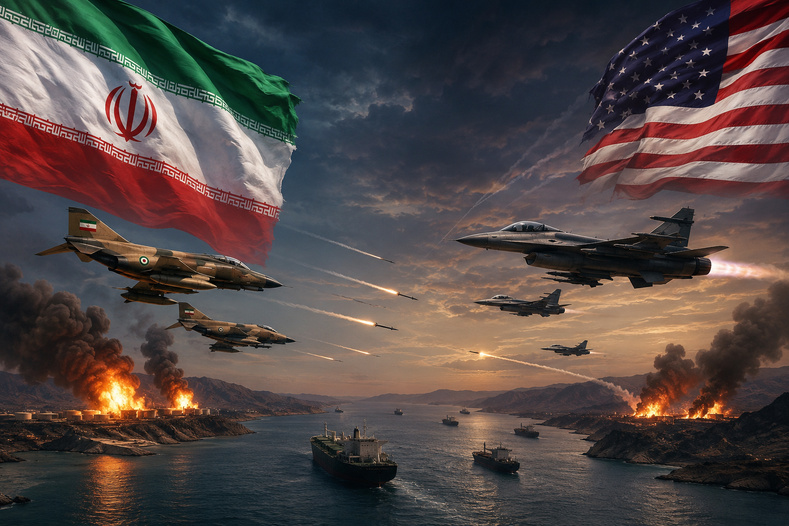
Fresh military exchanges between Iran and the United States have intensified concerns that efforts to stabilize the Gulf region remain vulnerable to collapse, particularly as disagreements over sanctions, shipping control, and nuclear negotiations continue to block a broader diplomatic breakthrough.
The latest confrontation unfolded after U.S. military operations targeted what American officials described as an Iranian drone activity near the Strait of Hormuz, one of the world’s most strategically important energy corridors. Iranian forces responded hours later with strikes aimed at a U.S. airbase in the region, signaling how rapidly tensions can reignite even during periods described publicly as ceasefire conditions.
The renewed hostilities came shortly after President Donald Trump dismissed reports suggesting Washington was close to supporting a compromise arrangement involving commercial shipping routes through the Strait of Hormuz. His rejection of those reports not only weakened speculation about an imminent diplomatic opening but also reinforced uncertainty surrounding the future of negotiations between Tehran and Washington.
The developments underscored how the conflict has evolved beyond direct military confrontation into a wider struggle involving global energy security, maritime control, sanctions policy, and competing visions of regional influence.
The immediate military escalation began when U.S. forces reportedly intercepted multiple Iranian drones and struck a ground control station near Bandar Abbas, a strategically vital Iranian port city overlooking the Strait of Hormuz. American officials characterized the operation as defensive and aimed at preventing further attacks, arguing that the action was necessary to preserve stability in the area.
Iran’s Revolutionary Guard, however, portrayed the strike differently, describing it as an attack on Iranian territory that demanded retaliation. Iranian state-linked media reported that the Guard subsequently targeted a U.S. military installation connected to the earlier operation, although Iranian authorities did not publicly identify the base.
The exchange reflected the increasingly narrow margin separating deterrence from escalation in the Gulf. Both countries attempted to frame their actions as defensive responses, yet each new military operation appeared to trigger another cycle of retaliation.
That pattern has become central to the broader conflict since fighting intensified earlier in the year following coordinated U.S. and Israeli strikes connected to concerns over Iran’s military and nuclear capabilities. Since then, the region has experienced repeated drone interceptions, missile alerts, disruptions to shipping activity, and growing instability around strategic waterways.
Strait of Hormuz Remains the Core Strategic Pressure Point
At the center of the confrontation lies the Strait of Hormuz, the narrow maritime passage connecting the Persian Gulf to global shipping lanes. Before the conflict intensified, the strait handled a substantial share of the world’s oil and liquefied natural gas exports, making it one of the most economically sensitive waterways on the planet.
Any instability there immediately affects global energy markets.
Oil prices reacted sharply once reports of the latest exchanges emerged, reversing earlier declines as traders reassessed the possibility of further disruptions to shipping traffic. Financial markets have repeatedly shown that even limited military incidents around Hormuz can trigger broader economic concerns because of the region’s importance to global supply chains.
The sharp reduction in commercial crossings since the conflict began has already demonstrated the economic consequences of prolonged instability. Shipping companies, insurers, and energy traders have grown increasingly cautious, particularly as drone activity and military patrols continue around the corridor.
Control of maritime traffic through Hormuz has therefore become one of the most contentious issues in negotiations between Iran and the United States.
Iranian media recently reported that discussions had taken place regarding a possible arrangement to restore commercial shipping activity through the strait. According to those reports, Iran and Oman would jointly oversee traffic management while international shipping operations gradually returned to prewar levels.
The proposal immediately drew global attention because it suggested the possibility of partial de-escalation.
Trump, however, publicly rejected the idea that any single country would gain effective authority over the strategic passage. His remarks reinforced Washington’s longstanding position that the waterway must remain open under international maritime principles rather than under the influence of regional powers.
The rejection also reflected broader American concerns that Iran could use control over maritime routes as political leverage in future disputes.
Sanctions and Nuclear Demands Continue to Block Diplomatic Progress
While military clashes dominate headlines, the underlying dispute remains rooted in unresolved disagreements over sanctions, nuclear restrictions, and regional security arrangements.
Iran has continued demanding the release of financial assets frozen under U.S. sanctions, framing the issue as both an economic necessity and a matter of national sovereignty. Iranian officials have argued that any meaningful diplomatic settlement must include unrestricted access to those funds and broader relief from economic penalties imposed over recent years.
For Tehran, sanctions relief remains inseparable from any wider agreement.
Washington, meanwhile, has maintained that Iran’s nuclear program remains a central concern that cannot be separated from regional security negotiations. U.S. officials continue insisting that Iran must not develop nuclear weapons capability, while Iranian authorities maintain that their nuclear activities are intended solely for peaceful purposes.
That disagreement has complicated attempts to build a broader framework for de-escalation.
Iranian officials have reportedly favored separating shipping negotiations from nuclear discussions, potentially delaying more difficult talks about uranium enrichment, inspections, and long-term monitoring mechanisms. Such an approach may appeal to factions inside Tehran seeking immediate economic relief without committing to sweeping concessions on nuclear policy.
For the United States, however, delaying the nuclear issue risks creating a fragmented agreement that fails to address Washington’s core strategic concerns.
The Trump administration’s response suggests American officials remain wary of any arrangement perceived as allowing Iran to secure sanctions relief or expanded regional influence without significant concessions.
That tension helps explain why even reports of preliminary understandings quickly became politically sensitive.
Regional Security Fears Continue to Spread Beyond Iran and the United States
The latest confrontation has also highlighted how quickly instability involving Iran and the United States can spill across the wider Middle East.
Kuwait reported responding to missile and drone threats during the escalation, underscoring the vulnerability of Gulf states hosting American military facilities. Israel also reported hostile aircraft alerts in northern areas, reflecting fears that regional armed groups aligned with Iran could become more deeply involved if tensions worsen further.
The broader conflict already involves multiple interconnected fronts stretching across the region. Iran-backed groups, maritime security forces, Gulf monarchies, Israel, and U.S. military assets remain closely tied to developments around the Strait of Hormuz and surrounding areas.
That interconnected security environment makes diplomacy increasingly difficult because military incidents in one location can rapidly affect negotiations elsewhere.
At the same time, both Tehran and Washington appear aware that a wider regional war would carry enormous economic and political costs. The repeated references to defensive operations and ceasefire preservation suggest that neither side currently seeks uncontrolled escalation, even as military exchanges continue.
The challenge is that limited retaliation strategies can become unstable over time.
Every interception, drone strike, or missile response creates pressure for another countermeasure, particularly when governments attempt to demonstrate strength domestically while also signaling deterrence internationally. That cycle has repeatedly undermined diplomatic efforts across the region over the past two decades.
The latest exchanges therefore reveal a deeper reality behind the public negotiations: despite ongoing diplomatic contacts and periodic ceasefire language, the core disputes between Iran and the United States remain unresolved.
As long as disagreements over sanctions, maritime control, military presence, and nuclear restrictions continue without a comprehensive settlement, the Gulf region is likely to remain exposed to recurring periods of confrontation capable of shaking global energy markets and destabilizing wider regional security calculations.
(Source:www.theguardian.com)
The latest confrontation unfolded after U.S. military operations targeted what American officials described as an Iranian drone activity near the Strait of Hormuz, one of the world’s most strategically important energy corridors. Iranian forces responded hours later with strikes aimed at a U.S. airbase in the region, signaling how rapidly tensions can reignite even during periods described publicly as ceasefire conditions.
The renewed hostilities came shortly after President Donald Trump dismissed reports suggesting Washington was close to supporting a compromise arrangement involving commercial shipping routes through the Strait of Hormuz. His rejection of those reports not only weakened speculation about an imminent diplomatic opening but also reinforced uncertainty surrounding the future of negotiations between Tehran and Washington.
The developments underscored how the conflict has evolved beyond direct military confrontation into a wider struggle involving global energy security, maritime control, sanctions policy, and competing visions of regional influence.
The immediate military escalation began when U.S. forces reportedly intercepted multiple Iranian drones and struck a ground control station near Bandar Abbas, a strategically vital Iranian port city overlooking the Strait of Hormuz. American officials characterized the operation as defensive and aimed at preventing further attacks, arguing that the action was necessary to preserve stability in the area.
Iran’s Revolutionary Guard, however, portrayed the strike differently, describing it as an attack on Iranian territory that demanded retaliation. Iranian state-linked media reported that the Guard subsequently targeted a U.S. military installation connected to the earlier operation, although Iranian authorities did not publicly identify the base.
The exchange reflected the increasingly narrow margin separating deterrence from escalation in the Gulf. Both countries attempted to frame their actions as defensive responses, yet each new military operation appeared to trigger another cycle of retaliation.
That pattern has become central to the broader conflict since fighting intensified earlier in the year following coordinated U.S. and Israeli strikes connected to concerns over Iran’s military and nuclear capabilities. Since then, the region has experienced repeated drone interceptions, missile alerts, disruptions to shipping activity, and growing instability around strategic waterways.
Strait of Hormuz Remains the Core Strategic Pressure Point
At the center of the confrontation lies the Strait of Hormuz, the narrow maritime passage connecting the Persian Gulf to global shipping lanes. Before the conflict intensified, the strait handled a substantial share of the world’s oil and liquefied natural gas exports, making it one of the most economically sensitive waterways on the planet.
Any instability there immediately affects global energy markets.
Oil prices reacted sharply once reports of the latest exchanges emerged, reversing earlier declines as traders reassessed the possibility of further disruptions to shipping traffic. Financial markets have repeatedly shown that even limited military incidents around Hormuz can trigger broader economic concerns because of the region’s importance to global supply chains.
The sharp reduction in commercial crossings since the conflict began has already demonstrated the economic consequences of prolonged instability. Shipping companies, insurers, and energy traders have grown increasingly cautious, particularly as drone activity and military patrols continue around the corridor.
Control of maritime traffic through Hormuz has therefore become one of the most contentious issues in negotiations between Iran and the United States.
Iranian media recently reported that discussions had taken place regarding a possible arrangement to restore commercial shipping activity through the strait. According to those reports, Iran and Oman would jointly oversee traffic management while international shipping operations gradually returned to prewar levels.
The proposal immediately drew global attention because it suggested the possibility of partial de-escalation.
Trump, however, publicly rejected the idea that any single country would gain effective authority over the strategic passage. His remarks reinforced Washington’s longstanding position that the waterway must remain open under international maritime principles rather than under the influence of regional powers.
The rejection also reflected broader American concerns that Iran could use control over maritime routes as political leverage in future disputes.
Sanctions and Nuclear Demands Continue to Block Diplomatic Progress
While military clashes dominate headlines, the underlying dispute remains rooted in unresolved disagreements over sanctions, nuclear restrictions, and regional security arrangements.
Iran has continued demanding the release of financial assets frozen under U.S. sanctions, framing the issue as both an economic necessity and a matter of national sovereignty. Iranian officials have argued that any meaningful diplomatic settlement must include unrestricted access to those funds and broader relief from economic penalties imposed over recent years.
For Tehran, sanctions relief remains inseparable from any wider agreement.
Washington, meanwhile, has maintained that Iran’s nuclear program remains a central concern that cannot be separated from regional security negotiations. U.S. officials continue insisting that Iran must not develop nuclear weapons capability, while Iranian authorities maintain that their nuclear activities are intended solely for peaceful purposes.
That disagreement has complicated attempts to build a broader framework for de-escalation.
Iranian officials have reportedly favored separating shipping negotiations from nuclear discussions, potentially delaying more difficult talks about uranium enrichment, inspections, and long-term monitoring mechanisms. Such an approach may appeal to factions inside Tehran seeking immediate economic relief without committing to sweeping concessions on nuclear policy.
For the United States, however, delaying the nuclear issue risks creating a fragmented agreement that fails to address Washington’s core strategic concerns.
The Trump administration’s response suggests American officials remain wary of any arrangement perceived as allowing Iran to secure sanctions relief or expanded regional influence without significant concessions.
That tension helps explain why even reports of preliminary understandings quickly became politically sensitive.
Regional Security Fears Continue to Spread Beyond Iran and the United States
The latest confrontation has also highlighted how quickly instability involving Iran and the United States can spill across the wider Middle East.
Kuwait reported responding to missile and drone threats during the escalation, underscoring the vulnerability of Gulf states hosting American military facilities. Israel also reported hostile aircraft alerts in northern areas, reflecting fears that regional armed groups aligned with Iran could become more deeply involved if tensions worsen further.
The broader conflict already involves multiple interconnected fronts stretching across the region. Iran-backed groups, maritime security forces, Gulf monarchies, Israel, and U.S. military assets remain closely tied to developments around the Strait of Hormuz and surrounding areas.
That interconnected security environment makes diplomacy increasingly difficult because military incidents in one location can rapidly affect negotiations elsewhere.
At the same time, both Tehran and Washington appear aware that a wider regional war would carry enormous economic and political costs. The repeated references to defensive operations and ceasefire preservation suggest that neither side currently seeks uncontrolled escalation, even as military exchanges continue.
The challenge is that limited retaliation strategies can become unstable over time.
Every interception, drone strike, or missile response creates pressure for another countermeasure, particularly when governments attempt to demonstrate strength domestically while also signaling deterrence internationally. That cycle has repeatedly undermined diplomatic efforts across the region over the past two decades.
The latest exchanges therefore reveal a deeper reality behind the public negotiations: despite ongoing diplomatic contacts and periodic ceasefire language, the core disputes between Iran and the United States remain unresolved.
As long as disagreements over sanctions, maritime control, military presence, and nuclear restrictions continue without a comprehensive settlement, the Gulf region is likely to remain exposed to recurring periods of confrontation capable of shaking global energy markets and destabilizing wider regional security calculations.
(Source:www.theguardian.com)
 Homepage
 Send to a friend
 Printable version
 Share
Share


